
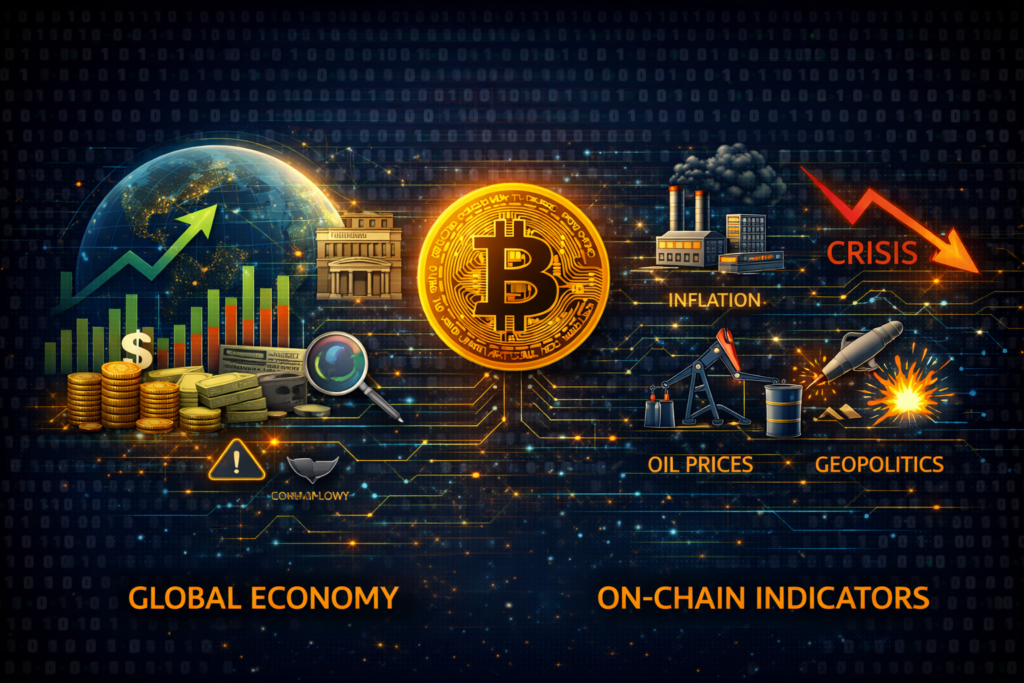
Bitcoin does not exist in isolation. While it was originally designed as a decentralized alternative to traditional financial systems, its price and adoption are increasingly influenced by the same global economic forces that affect stocks, bonds, currencies, and commodities. Over the past few years, major economic events—from inflation spikes and interest rate changes to geopolitical conflicts and financial crises—have played a growing role in shaping Bitcoin’s market behavior.
As Bitcoin matures and becomes more integrated into the global financial system, understanding how macroeconomic developments impact its price and perception is essential for investors and observers alike. Bitcoin is no longer driven solely by crypto-specific narratives; it now responds to broader economic signals in ways that reflect its evolving role as a global asset.
This article explores how key global economic events are influencing Bitcoin and what these dynamics may mean for its future.
Bitcoin’s Changing Relationship with the Global Economy
In its early years, Bitcoin’s price movements were largely disconnected from traditional markets. It was driven primarily by technological milestones, adoption among early users, and speculative interest. Today, that relationship has changed.
Bitcoin is increasingly viewed alongside other risk assets, reacting to economic data releases, central bank decisions, and shifts in global liquidity. This does not mean Bitcoin has lost its unique characteristics, but rather that it now operates within a broader financial context.
As institutional participation grows, Bitcoin’s sensitivity to macroeconomic events has become more pronounced.
Inflation and the Bitcoin Narrative
Inflation has been one of the most significant global economic issues in recent years. Rising consumer prices have affected economies worldwide, reducing purchasing power and prompting central banks to respond aggressively.
Bitcoin is often described as a hedge against inflation due to its limited supply. When inflation concerns rise, interest in Bitcoin often increases, as some investors view it as an alternative store of value outside traditional fiat systems.
However, Bitcoin’s response to inflation has not always been straightforward. While inflation narratives can support demand, actual price performance depends on how markets interpret central bank actions and overall risk sentiment. Inflation alone does not drive Bitcoin’s price, but it remains a key part of the broader discussion.
Central Bank Policies and Interest Rates
Few economic forces influence Bitcoin as directly as central bank policy.
When interest rates are low, liquidity tends to flow into riskier assets, including cryptocurrencies. In such environments, Bitcoin often benefits from increased investor appetite for growth and alternative investments.
Conversely, when central banks raise interest rates to combat inflation, borrowing becomes more expensive and liquidity tightens. Investors may shift toward safer, yield-generating assets, reducing demand for Bitcoin in the short term.
Bitcoin’s recent price movements have closely tracked expectations around interest rate hikes and cuts, highlighting its growing connection to global monetary policy.
Global Liquidity and Market Sentiment
Bitcoin thrives in environments with ample liquidity. When global financial conditions are loose, capital flows more freely into speculative and emerging asset classes.
Economic tightening, on the other hand, often leads to reduced risk-taking. During periods of declining liquidity, Bitcoin can experience sharp corrections as investors reduce exposure to volatile assets.
Global liquidity cycles, shaped by central banks and economic growth, have become one of the most important macro factors influencing Bitcoin’s price.
Geopolitical Tensions and Economic Uncertainty
Geopolitical events such as wars, trade disputes, and sanctions have a complex impact on Bitcoin.
In some cases, geopolitical instability increases interest in Bitcoin as a decentralized and borderless asset. Bitcoin’s ability to operate independently of national financial systems has made it appealing in regions facing currency controls or political uncertainty.
At the same time, heightened global risk can lead to broad market sell-offs, including in cryptocurrencies. Bitcoin’s response often depends on whether it is viewed more as a safe alternative or as a speculative asset during a particular crisis.
This dual perception continues to shape how Bitcoin reacts to global events.
Currency Devaluation and Capital Controls
In countries experiencing currency devaluation or strict capital controls, Bitcoin adoption has often accelerated. When access to stable financial systems is limited, Bitcoin can provide an alternative means of preserving value or transferring funds.
These localized economic events may not always move global Bitcoin prices dramatically, but they contribute to long-term adoption and reinforce Bitcoin’s role as a global financial tool.
Such use cases highlight how economic instability can drive organic Bitcoin demand beyond speculation.
Financial Crises and Systemic Risk
Periods of financial stress, such as banking crises or debt concerns, tend to renew interest in alternative financial systems.
Bitcoin was created in response to the global financial crisis of 2008, and systemic risk remains a powerful narrative within the crypto community. When confidence in traditional institutions weakens, Bitcoin often re-enters the spotlight as an alternative.
However, during acute crises, Bitcoin can also experience volatility as investors seek immediate liquidity. Its behavior reflects both its ideological roots and its current position within global markets.
Stock Markets and Bitcoin Correlation
In recent years, Bitcoin has shown increasing correlation with equity markets, particularly technology stocks. This relationship has strengthened during periods of macro-driven market movements.
When stock markets rally on positive economic data or policy signals, Bitcoin often follows. Conversely, equity market sell-offs driven by economic fears can weigh on Bitcoin prices.
This correlation suggests that Bitcoin is increasingly treated as part of the broader risk asset universe, at least in the short term.
Institutional Investors and Macroeconomic Sensitivity
Institutional participation has played a key role in connecting Bitcoin to global economic events.
Institutions tend to allocate capital based on macroeconomic outlooks, interest rate expectations, and risk models. As they enter and exit Bitcoin positions, their behavior links Bitcoin more closely to traditional financial cycles.
This does not eliminate Bitcoin’s unique value proposition, but it does make its price more responsive to global economic trends.
Regulation as an Economic and Political Factor
Regulatory developments are often influenced by broader economic and political considerations. Governments facing financial instability or capital outflows may tighten controls on cryptocurrencies, while others may seek to regulate and integrate them.
Regulatory clarity can boost confidence and attract institutional capital, while restrictive measures can create uncertainty and volatility.
As global economic pressures evolve, regulation remains a key variable shaping Bitcoin’s adoption and price dynamics.
Long-Term Adoption Versus Short-Term Volatility
While global economic events can drive short-term price fluctuations, they do not fully define Bitcoin’s long-term trajectory.
Technological development, network security, and adoption continue to progress regardless of temporary economic conditions. Long-term holders often focus less on daily price movements and more on Bitcoin’s underlying principles.
This tension between short-term macro-driven volatility and long-term adoption is a defining feature of Bitcoin markets today.
What Global Economic Events Mean for Bitcoin Investors
For investors, understanding Bitcoin’s relationship with global economics is increasingly important.
Rather than viewing Bitcoin in isolation, investors must consider:
- Monetary policy trends
- Inflation and growth expectations
- Global risk sentiment
- Geopolitical developments
Context helps separate temporary market reactions from long-term trends.
Looking Ahead: Bitcoin in a Connected World
As Bitcoin continues to integrate into global finance, its sensitivity to economic events is likely to increase rather than decrease. This integration brings both challenges and opportunities.
Bitcoin may not behave exactly like traditional assets, but it is no longer immune to global forces. Its future will be shaped by how it balances decentralization with increasing institutional and economic relevance.
Understanding this balance is key to interpreting Bitcoin’s price movements in the years ahead.
Final Thoughts
Global economic events are playing an increasingly important role in shaping Bitcoin’s market behavior. Inflation, interest rates, geopolitical tensions, and financial stability all influence how investors perceive and value Bitcoin.
While Bitcoin retains its unique characteristics as a decentralized and scarce asset, it now operates within a highly interconnected global financial system. This reality makes Bitcoin more complex—but also more relevant—than ever before.
Rather than weakening Bitcoin’s identity, its interaction with global economic forces reflects its evolution from a niche experiment to a global financial asset. For those watching the market, understanding these macroeconomic influences is essential to making sense of Bitcoin’s price movements and long-term potential.
Nice article!