
Bitcoin was once treated as an outsider.
Traditional finance had its own institutions, rules and familiar reference points: central banks, stock exchanges, government bonds, corporate earnings and national currencies. Bitcoin appeared to belong to a different universe—one shaped by cryptography, decentralization and a deep skepticism toward financial intermediaries.
That separation has gradually disappeared.
Bitcoin has not replaced the traditional financial system, but it has become increasingly connected to it. Its price reacts to changes in liquidity, interest-rate expectations and investor sentiment. Its accessibility has expanded through regulated investment products. Its volatility attracts traders, challenges long-term investors and forces policymakers to reconsider how digital assets should fit within existing rules.
Exploring Bitcoin today is therefore about much more than analyzing a cryptocurrency. It offers a window into how financial markets are changing—and how investors respond when technology, scarcity, speculation and trust collide.
From a Monetary Experiment to a Global Asset
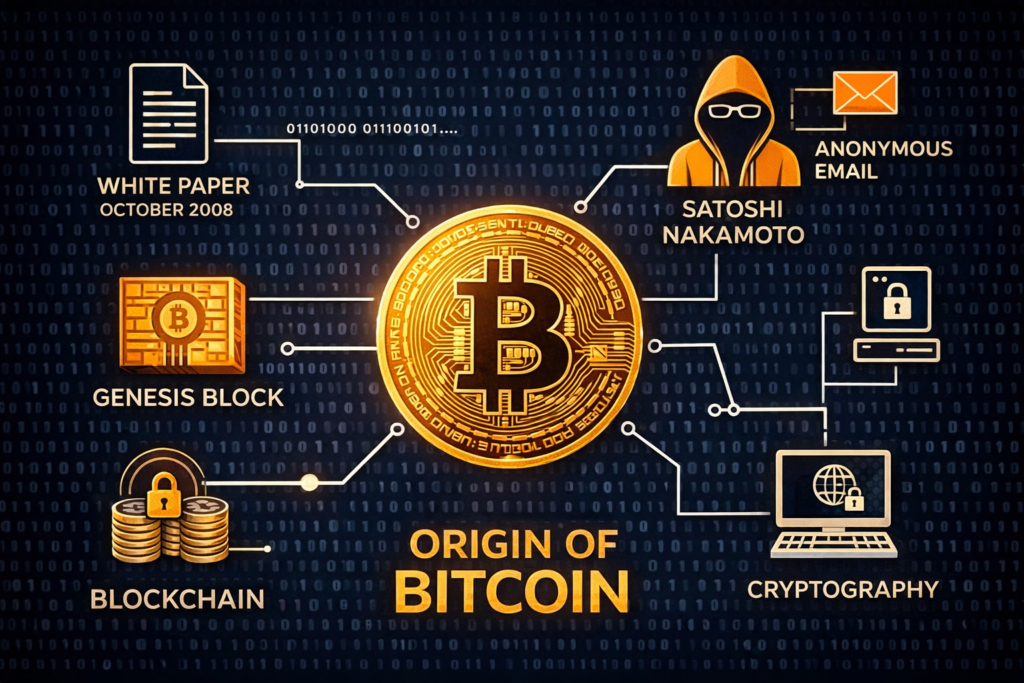
Bitcoin emerged in the aftermath of the global financial crisis as a peer-to-peer electronic cash system designed to function without a traditional financial intermediary. Instead of relying on a bank to verify transactions, the network uses a shared public ledger known as the blockchain.
Its supply structure is equally distinctive. Bitcoin has a maximum limit of 21 million coins, and the creation of new coins slows over time through a scheduled process known as the halving. Approximately every four years, the reward received by miners for adding new blocks to the blockchain is reduced by half.
This does not automatically make Bitcoin valuable. Scarcity matters only when demand exists. However, it gives Bitcoin an unusual characteristic: its issuance cannot be expanded in response to political pressure, economic crises or the decisions of a central authority.
That feature has helped turn Bitcoin into something more complex than its original description suggests. It can be transferred digitally, but it is not widely used to price everyday goods. It is scarce like a commodity, but it has no physical form. It is traded like a financial asset, but it does not produce earnings, dividends, interest payments or rental income.
Bitcoin does not fit neatly into a traditional category. That ambiguity is not a weakness in the discussion—it is the reason the discussion matters.
Bitcoin as a Mirror of Market Sentiment
Bitcoin is frequently described as “digital gold.” The comparison is appealing because both assets have limited supply and can attract investors searching for alternatives to government-issued currencies.
Yet the comparison is incomplete.
Gold has a long history as a store of value and often plays a defensive role in portfolios. Bitcoin has a much shorter track record and can experience dramatic price swings. During periods of financial stress, it may fall alongside technology shares and other risk-sensitive assets rather than behave like a safe haven.
A more useful way to view Bitcoin is as a mirror of market sentiment.
When investors are confident, liquidity is abundant and expectations for future growth are optimistic, they may become more willing to purchase volatile assets. When uncertainty rises or access to capital becomes more expensive, risk appetite can contract quickly.
Bitcoin often intensifies these emotional shifts. It is not merely a thermometer measuring the temperature of financial markets. At times, it behaves more like a lightning rod, concentrating the optimism and anxiety already present in the system.
Why Interest Rates Matter to a Decentralized Asset
Bitcoin operates independently from central banks, but its market value does not exist independently from monetary policy.
Interest rates influence how investors evaluate risk. When safer assets such as government bonds offer relatively attractive returns, highly volatile investments face greater competition for capital. When borrowing costs fall and liquidity becomes more abundant, investors may become more willing to search for higher returns elsewhere.
This does not mean that Bitcoin moves mechanically whenever a central bank changes interest rates. Markets anticipate decisions, interpret economic data and react to expectations long before an official announcement is made.
The relationship is more subtle: monetary policy helps shape the environment in which investors decide how much risk they are prepared to accept.
Inflation adds another layer to the debate. Supporters of Bitcoin often emphasize its fixed maximum supply and argue that it may offer protection against the long-term erosion of purchasing power. Critics respond that an asset with severe short-term volatility cannot function as a reliable hedge in every economic scenario.
Both positions contain part of the truth. Bitcoin’s scarcity is structurally important, but scarcity alone does not guarantee price stability.
Wall Street Did Not Replace Bitcoin—It Built a Bridge to It
One of the most significant changes in Bitcoin’s history has been the development of regulated investment products that offer exposure to its price.
The approval of spot Bitcoin exchange-traded products in the United States made it easier for investors to gain exposure through conventional brokerage accounts. Instead of directly managing a wallet and private keys, investors could access Bitcoin through a familiar financial wrapper.
This development created an important paradox.
Bitcoin remains decentralized at the network level. No single bank, government or company controls its underlying ledger. However, many investors now interact with Bitcoin through centralized channels: asset managers, brokers, custodians and regulated exchanges.
The technology has not become less decentralized, but the investment experience has become more conventional.
This bridge between two financial worlds matters because accessibility can influence market structure. As Bitcoin becomes easier to buy through familiar products, it enters more portfolio discussions, attracts a wider variety of participants and becomes increasingly connected to broader market cycles.
Diversification Without Illusions
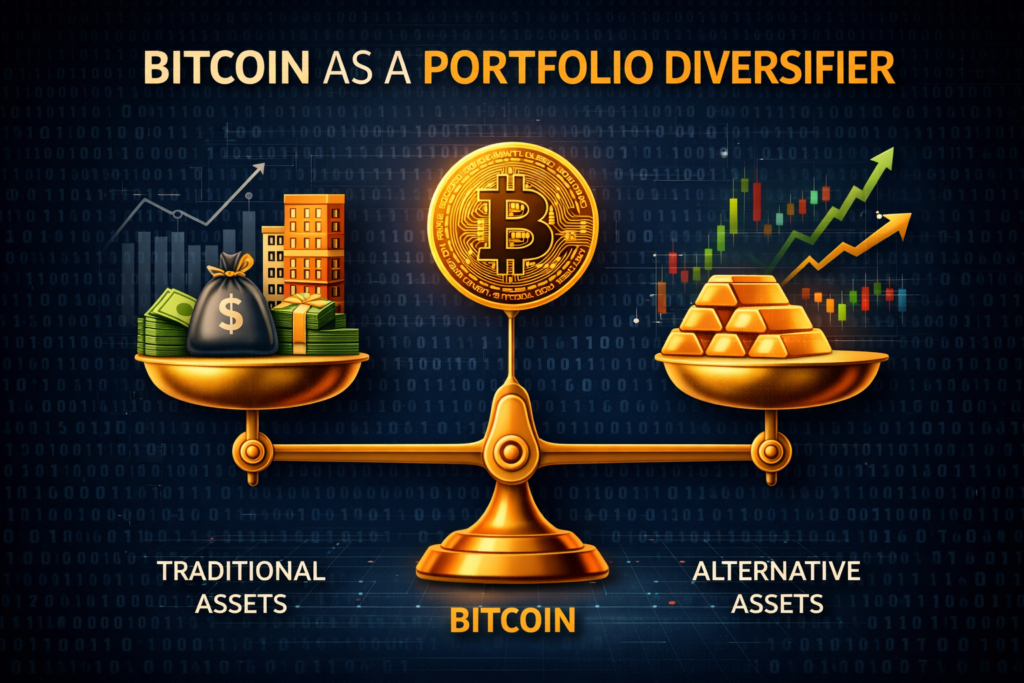
Bitcoin is often promoted as a portfolio diversifier, but this idea requires nuance.
Diversification works when assets do not respond in exactly the same way to the same events. Bitcoin can sometimes behave differently from stocks, bonds or commodities because its value is driven by a distinctive mixture of adoption, scarcity, regulation and investor sentiment.
However, correlations are not fixed laws of nature. They change over time.
During periods of extreme market stress, investors may sell several types of assets simultaneously in search of liquidity. An investment that behaved independently during calm conditions may suddenly move in the same direction as other risk assets during a sell-off.
Bitcoin may still have a place in a diversified portfolio, but it should not be treated as a magical solution. The relevant questions are practical: How much exposure is appropriate? What level of loss could an investor tolerate? Is the position based on a long-term thesis or a short-term emotional reaction?
A portfolio is not improved simply by adding more assets. It is improved by understanding how those assets behave under different conditions.
A Market That Never Sleeps
Traditional stock exchanges open and close according to fixed schedules. Bitcoin trades around the clock.
Its market does not pause for weekends, holidays or the end of the business day. This creates a financial environment that is unusually sensitive to global news, rapid changes in sentiment and sudden shifts in liquidity.
The constant availability of trading can be useful, but it also introduces risks. Investors may feel pressure to react to every price movement. Social media can amplify excitement and panic. Leverage can turn modest market fluctuations into forced liquidations.
In this environment, attention becomes a scarce resource.
The greatest challenge is not always identifying the next market trend. It is learning when not to act. Investors who confuse activity with strategy may find themselves responding to noise rather than information.
Bitcoin Is Only One Part of a Larger Transformation
Bitcoin is the most recognizable digital asset, but it is not the entire story.
Stablecoins, tokenized assets and blockchain-based financial services are expanding the debate beyond speculative trading. Stablecoins aim to maintain a relatively stable value, usually by linking their price to a traditional currency such as the US dollar. They can facilitate transfers between conventional finance and digital-asset markets.
Tokenization goes further. It involves representing financial or real-world assets digitally on a blockchain or similar infrastructure. In theory, this could support faster settlement, improved transparency and new forms of market access.
These innovations also create new risks. A digital financial system still needs reliable governance, resilient infrastructure and clear legal rules. Faster transactions do not eliminate liquidity problems. Technological efficiency does not automatically guarantee consumer protection. A stablecoin is only as credible as the quality, transparency and accessibility of the assets supporting it.
The future of finance is unlikely to be a simple contest between banks and blockchains. A more realistic outcome is a hybrid system in which traditional institutions adopt parts of the technology while regulators attempt to control its most serious vulnerabilities.
Regulation Will Shape the Next Phase
Bitcoin was designed to operate without a central authority, but the businesses and financial products surrounding it cannot operate outside the law.
Regulators face a difficult balancing act. Excessively restrictive rules may discourage useful innovation or push activity toward less transparent markets. Weak oversight may expose investors to fraud, poor custody practices and unstable intermediaries.
The most important question is not whether regulation will arrive. It is whether different countries can create rules that are clear, consistent and enforceable.
This challenge is international by nature. Bitcoin trades globally, while regulation is still largely designed and applied at the national level. That mismatch creates uncertainty, but it also explains why digital assets remain one of the most important policy debates in modern finance.
Conclusion
Bitcoin is no longer a niche experiment, but it should not be mistaken for a guaranteed path to wealth.
Its strengths are meaningful: a predictable supply structure, a decentralized network, global accessibility and a growing connection to mainstream investment markets. It has also encouraged a wider conversation about how money, ownership and financial infrastructure may evolve in a digital economy.
Its limitations are equally important. Bitcoin remains highly volatile, its valuation depends heavily on market confidence and its behavior can resemble that of a risk asset during periods of financial stress. It is not a stable replacement for national currencies, nor is it immune to the forces affecting traditional markets.
The most objective conclusion lies between blind enthusiasm and automatic rejection.
Bitcoin deserves serious attention because it has become part of the global financial landscape. Investors should study it with curiosity, but approach it with discipline. The real lesson is not that Bitcoin will replace the existing financial system. It is that the boundaries of that system are becoming harder to define.
Bitcoin may not provide a final answer to the future of money, but it has already changed the questions that investors, institutions and governments are asking.