
Real estate is often described as a reliable hedge against inflation.
The reasoning appears straightforward.
When the price of materials, labor and land increases, building new homes becomes more expensive. Existing properties become harder to replace. Rents may rise as landlords face higher operating costs. Over time, property values may increase alongside the broader cost of living.
There is truth in this argument.
But it is incomplete.
Inflation does not affect real estate through one single channel. It creates several forces that can move in opposite directions.
Higher construction costs may support the value of existing buildings. Higher rents may improve income for some landlords. Yet inflation can also push central banks to keep interest rates elevated, making mortgages more expensive and reducing the amount buyers can afford to pay.
A property can rise in price while becoming less affordable.
It can increase in nominal value while losing purchasing power in real terms.
Understanding this tension is essential for homeowners, investors and policymakers navigating a global housing market shaped by inflation, borrowing costs and persistent supply shortages.
Nominal Prices and Real Values Are Not the Same Thing
One of the most important distinctions in real estate is also one of the easiest to overlook.
A nominal property price is the number shown in the sale contract.
A real property value adjusts that price for inflation.
Imagine that a home rises in price by 4% during a year in which consumer prices increase by 5%.
The owner sees a higher number on paper.
But the property has lost value in real purchasing-power terms.
This distinction matters because inflation can make markets appear stronger than they really are.
A city may report rising home prices even as households become less capable of buying. Investors may celebrate rental growth without noticing that maintenance, insurance and financing costs are rising at the same time.
The correct question is not simply:
Are property prices increasing?
It is:
Are property values increasing faster than the costs surrounding them?
Inflation Raises the Cost of Replacing a Building
One of the clearest ways inflation affects real estate is through construction.
A building requires land, labor, materials, energy, financing and regulatory approval. When those inputs become more expensive, new development becomes harder to complete profitably.
Steel, concrete, timber, insulation, machinery and transportation all carry costs. Construction companies also need skilled workers, whose wages may rise when labor becomes scarce.
These pressures create a replacement-cost effect.
If building a new apartment block becomes substantially more expensive, existing properties may become more valuable because they cannot be reproduced easily at the previous cost.
But this mechanism has an important limit.
Higher construction costs do not guarantee that buyers can afford higher prices.
A developer may need to charge more to justify a project. If household incomes do not rise sufficiently, demand may fail to support that price.
The result can be fewer new homes rather than more expensive new homes.
This is one reason inflation can worsen housing shortages.
It raises the cost of adding supply precisely when many markets need more of it.
Interest Rates Are Inflation’s Counterforce
Inflation supports property values through replacement costs.
Interest rates can push in the opposite direction.
When inflation remains elevated, central banks may raise interest rates or keep them higher for longer. Mortgage costs increase. Developers face more expensive financing. Investors demand higher returns before committing capital.
For households, the effect is immediate.
A buyer does not purchase a home based only on its advertised price.
They purchase a monthly payment.
When mortgage rates rise, the same monthly budget supports a smaller loan. A household that could once afford a particular property may no longer qualify for the financing required to purchase it.
This reduces effective demand.
The buyer may still want the home.
The bank account says no.
Higher rates also affect investors.
A property generating rent becomes less attractive if safer financial assets offer more competitive yields. A landlord using variable-rate debt may see cash flow deteriorate as financing costs rise. A developer may postpone a project because the expected return no longer justifies the risk.
Inflation can increase the cost of the building.
Interest rates can reduce what anybody is willing or able to pay for it.
Property values emerge from the struggle between those two forces.
Housing Affordability Can Deteriorate Even When Prices Stabilize
A cooling housing market does not automatically become an affordable housing market.
This is a common misunderstanding.
Prices may stop rising or decline modestly while monthly mortgage payments remain difficult to manage because borrowing costs are still high.
At the same time, tenants who hoped to become homeowners may remain in the rental market for longer. This creates additional demand for rental properties and places further pressure on rents.
The effect can become circular.
Higher mortgage rates reduce access to ownership.
More households continue renting.
Rental demand increases.
Higher rents make saving for a deposit more difficult.
The path toward ownership becomes even narrower.
This is why inflation and interest rates affect more than property prices.
They affect tenure decisions: whether households rent, buy, delay moving or remain in homes that no longer match their needs.
A housing market can become less dynamic even when demand remains strong.
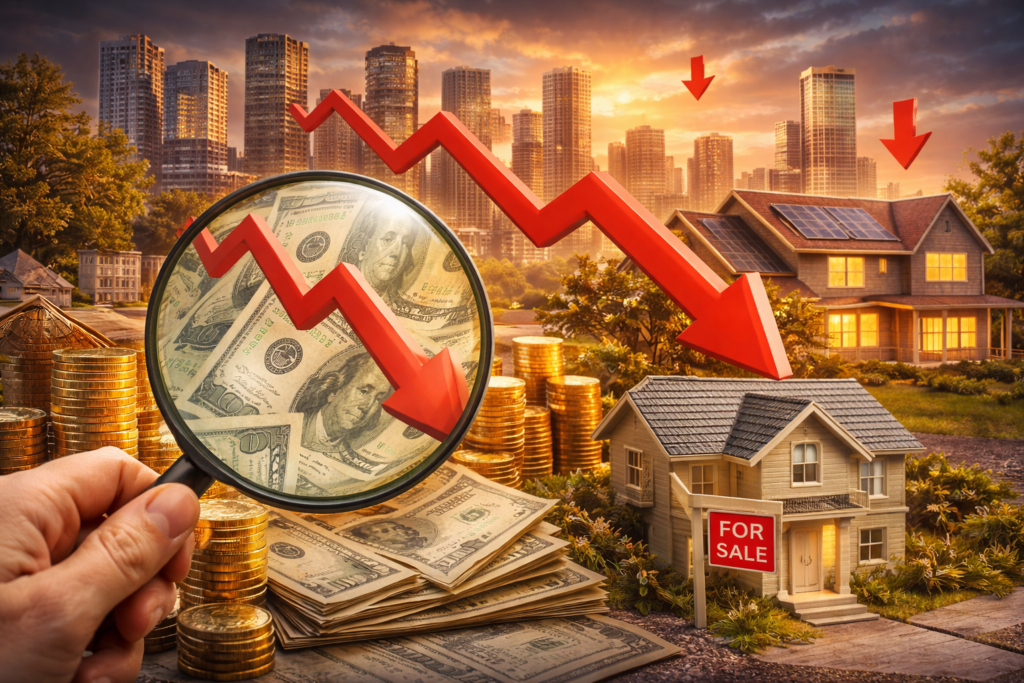
Real Estate Can Hedge Inflation—Under the Right Conditions
Real estate can provide some protection against inflation.
But not every property does so equally well.
The strongest candidates usually share several characteristics:
They are located in areas with durable demand.
They generate reliable rental income.
Their operating costs remain manageable.
Their debt structure is sustainable.
Their supply is difficult to expand quickly.
Their tenants can absorb reasonable rent increases without leaving.
A landlord with long-term fixed-rate debt may benefit when inflation reduces the real value of future loan payments while rents gradually rise.
But an investor using expensive variable-rate financing faces a different reality.
A building purchased at an optimistic valuation may struggle if refinancing becomes more expensive. A landlord may be unable to pass all cost increases to tenants. Rent regulation may limit adjustments. Vacancy may rise if households cannot afford the new price.
Real estate is not one universal inflation hedge.
It is a collection of local assets with different income streams, costs and vulnerabilities.
Rental Income Matters More Than Ever
In an environment of inflation and uncertain valuations, investors often become more interested in cash flow.
A property’s resale price matters.
But the income generated while holding it matters too.
Rents can increase over time, particularly in locations where demand remains strong and housing supply is constrained. This may help protect income from inflation.
However, rising rent does not translate automatically into rising profit.
Landlords also face higher costs.
Maintenance becomes more expensive. Insurance premiums may rise. Property taxes can increase. Utilities and building-management expenses may absorb a larger share of income.
The relevant measure is not gross rent.
It is net operating income.
A property with rapidly rising rents can still become less profitable if expenses rise faster.
This distinction is particularly important when evaluating older buildings that may require significant maintenance or energy-efficiency upgrades.
The rent tells only part of the story.
The building tells the rest.
Commercial Real Estate Requires a Sector-by-Sector View
Inflation does not affect every commercial property in the same way.
Treating offices, shops, warehouses and data centers as one category creates a misleading picture.
Offices
Office markets face a combination of higher financing costs and structural changes in demand.
Hybrid work has reduced the amount of space required by some companies. Older or poorly located buildings may struggle to attract tenants even when the wider economy remains relatively resilient.
Inflation can raise renovation and operating costs while higher interest rates reduce valuations.
A central office building with modern amenities and strong transport connections may remain attractive.
A weaker building may face an expensive problem with no easy solution.
Retail
Retail properties also depend heavily on location and tenant quality.
Inflation can reduce household purchasing power, placing pressure on discretionary spending. Higher costs can weaken retailers with narrow profit margins.
Prime locations may remain valuable.
Secondary assets can become more vulnerable.
Logistics and Industrial Property
Warehouses and logistics facilities often benefit from long-term demand linked to e-commerce, supply-chain resilience and distribution networks.
Some leases include inflation-linked adjustments, which can support rental income.
But even these assets are not immune to financing costs or excessive valuations.
Data Centers and Specialized Assets
Data centers and other specialized properties benefit from growing demand for digital infrastructure.
Yet their economics are complex.
They require substantial electricity, reliable grid connections, cooling systems and capital expenditure. Their value depends not only on property fundamentals, but also on energy availability and technological demand.
The real-estate market is becoming more specialized.
Broad labels matter less.
Operational detail matters more.
Regional Differences Change the Outcome
Inflation is global.
Real estate remains local.
The same inflationary shock can create very different outcomes across countries and cities.
North America
In markets with long-term fixed-rate mortgages, many existing homeowners are partially protected from higher borrowing costs because their monthly payments remain unchanged.
This creates a lock-in effect.
Homeowners hesitate to sell because purchasing another property would require a more expensive mortgage. Fewer homes reach the market. Supply remains constrained.
Prices may therefore remain resilient even when transaction volumes fall.
Europe
European housing markets differ substantially across countries.
Some households use fixed-rate loans. Others face variable rates or shorter fixation periods, meaning higher interest costs reach borrowers more quickly.
Energy costs, housing shortages and local regulation also influence the result.
A single European narrative is not enough.
Asia-Pacific
The region contains very different markets.
Some benefit from strong population growth and urbanization. Others face demographic decline, high household debt or property-sector vulnerabilities.
Government policy can play an especially important role through lending rules, construction incentives and housing programs.
Emerging Economies
In emerging markets, inflation may interact with currency depreciation.
Property prices can rise sharply in local currency terms while delivering weaker returns after adjusting for inflation or converting into a more stable currency.
Real estate may still serve as a store of value for local households.
But investors need to distinguish between nominal appreciation and genuine wealth creation.
A rapidly rising price can still conceal economic weakness.
Fixed-Rate Debt Can Become an Asset
Debt is usually discussed as a risk.
In an inflationary environment, its structure becomes especially important.
An investor with long-term fixed-rate financing knows the nominal cost of the loan in advance. If rents and incomes rise over time, the debt burden may become easier to manage in real terms.
An investor using floating-rate debt has less certainty.
Interest costs can rise quickly. Refinancing may become difficult. A property that appeared profitable under low-rate conditions may no longer generate sufficient cash flow.
This creates an important lesson:
The success of a real-estate investment depends not only on the property.
It also depends on how the property was financed.
Two investors can own similar buildings and experience very different outcomes because their debt structures differ.
In real estate, the mortgage is part of the asset.
Inflation Can Hide Weak Returns
Property owners often focus on appreciation.
A home purchased for 300,000 dollars and later valued at 360,000 dollars appears to have generated a strong return.
But the calculation is incomplete.
How much did inflation rise during that period?
How much was spent on interest, maintenance, insurance and taxes?
How much income did the property generate?
How liquid is the market if the owner needs to sell?
What transaction costs will apply?
Nominal appreciation is emotionally satisfying.
Real returns are financially meaningful.
This does not make real estate unattractive.
It makes careful analysis necessary.
A home can still provide stability, utility and long-term value.
An investment property can still generate attractive income.
But the numbers need to reflect the real world.
Climate Risk Is Becoming Part of Property Value
Inflation is not the only cost affecting real estate.
Climate-related risks increasingly influence insurance, maintenance and long-term valuations.
Flooding, extreme heat, storms, wildfires and water stress can raise the cost of owning certain properties. Insurance may become more expensive or harder to obtain. Energy-efficiency standards may require renovations.
These risks do not affect every location equally.
A building can look affordable because the market has not yet priced the future cost of keeping it resilient.
Investors and homeowners should ask:
How exposed is the location?
Can the building remain comfortable during extreme weather?
What upgrades may be necessary?
Is insurance realistically available?
A property is a long-lived asset.
Its value depends partly on its ability to survive the future.
What Buyers Should Consider
For a household purchasing a home, the most important question is not whether inflation will push prices higher next year.
It is whether the property remains affordable under realistic conditions.
A buyer should examine:
The monthly mortgage payment.
The possibility of higher refinancing costs.
Maintenance and insurance expenses.
Energy efficiency.
Transport costs.
The stability of household income.
The expected length of ownership.
The availability of essential services.
A home is not merely an investment.
It is also a place to live.
The right decision should remain manageable even when the economy becomes less cooperative.
What Investors Should Consider
For investors, inflation makes disciplined underwriting more important.
A sensible review should include:
Net rental income rather than gross rent.
The debt structure and refinancing schedule.
The tenant profile.
The condition and energy efficiency of the building.
Local housing supply.
Population and employment trends.
Regulation.
Insurance costs.
Climate exposure.
The exit strategy.
Investors should avoid assuming that inflation will solve a weak investment thesis.
Higher prices cannot rescue every property.
A good asset purchased with excessive leverage can still fail.
A mediocre asset does not become attractive merely because replacement costs are rising.
Conclusion
Inflation is reshaping property values worldwide, but its influence is neither simple nor uniform.
It can support nominal prices by increasing construction costs, limiting new supply and pushing rents higher.
It can also reduce real values by eroding purchasing power, increasing mortgage costs and weakening demand.
The most objective conclusion is that real estate can provide some protection against inflation, but only under the right conditions.
Location matters.
Rental income matters.
Debt structure matters.
Operating costs matter.
Supply constraints matter.
Climate resilience increasingly matters.
The strongest properties are not merely those whose prices rise.
They are those capable of remaining useful, affordable and financially sustainable when inflation changes the rules of the market.
Real estate may be a tangible asset.
Its value still depends on invisible forces.
Great article! It clearly explains how inflation is influencing property values around the world, making a complex topic easy to understand and very relevant to today’s market.