
The future of finance is not being shaped by a single technology.
It is emerging at the intersection of three very different forces: Bitcoin, traditional financial markets and artificial intelligence.
Bitcoin introduced a decentralized network with a transparent ledger and a predictable supply. Finance brings capital, regulation and the infrastructure needed to transform ideas into investable products. Artificial intelligence adds a new layer of analytical power, allowing institutions and investors to process information at a speed and scale that would have been unimaginable only a generation ago.
These three forces do not always fit together comfortably.
Bitcoin was designed to reduce dependence on trusted intermediaries. Traditional finance is built around intermediaries. Artificial intelligence can make markets more efficient, but it can also make financial decisions harder to understand.
The result is not a simple technological revolution. It is a negotiation between competing ideas about trust, transparency and control.
Understanding that negotiation is essential for anyone trying to make sense of the next phase of digital finance.
Three Systems, Three Different Forms of Trust
Bitcoin, finance and artificial intelligence operate according to different principles.
Bitcoin relies on rules embedded in software. Its blockchain records confirmed transactions on a shared public ledger, while its issuance follows a predetermined schedule. No central bank, government or private company can independently decide to create additional bitcoins.
Traditional finance relies more heavily on institutions. Banks safeguard deposits, exchanges organize trading, regulators establish rules and central banks influence monetary conditions. Trust is placed in organizations, legal frameworks and the expectation that intermediaries will perform their responsibilities correctly.
Artificial intelligence introduces a third model. It relies on data, algorithms and statistical probability. An AI system may identify patterns, detect anomalies or evaluate thousands of variables at once. However, its conclusions are not always easy to explain.
This creates a defining tension for modern markets.
Bitcoin is transparent but difficult to value. Finance is familiar but heavily intermediated. Artificial intelligence is powerful but potentially opaque.
The future will depend on how these systems complement one another—and where their weaknesses collide.
Bitcoin’s Journey Into Mainstream Finance
Bitcoin began as a peer-to-peer electronic cash system intended to allow online payments without passing through a financial institution.
Its role has evolved considerably.
Although Bitcoin can still be transferred directly between users, many investors now treat it as a scarce digital asset rather than an everyday currency. Its maximum supply is limited to 21 million coins, and the pace of new issuance decreases through the halving process, which reduces the mining reward approximately every four years.
Scarcity alone does not guarantee value. Demand remains essential. Yet Bitcoin’s predictable supply gives it a characteristic that is unusual in modern finance: its issuance cannot be altered in response to an election, a recession or a change in monetary policy.
As interest grew, the financial system developed new ways to provide access. Exchanges, custody services and regulated investment products gradually created bridges between Bitcoin and conventional markets.
This process reached an important milestone when spot Bitcoin exchange-traded products were approved in the United States. Investors could obtain exposure through familiar brokerage accounts without directly managing private keys or cryptocurrency wallets.
The paradox is striking.
Bitcoin remains decentralized at the network level, but many investors access it through centralized institutions.
Rather than replacing traditional finance, Bitcoin has encouraged traditional finance to adapt.
A Public Ledger Does Not Explain Itself
Bitcoin offers something unusual: a large amount of publicly accessible data.
Every confirmed transaction is recorded on the blockchain. Analysts can study transfers, transaction volumes, wallet activity and changes in the amount of Bitcoin held by different types of addresses.
This makes Bitcoin a particularly attractive environment for data analysis.
In traditional finance, investors often work with incomplete information. Corporate reports are published periodically. Market positions may remain private. The intentions of large participants are rarely visible in real time.
Bitcoin’s blockchain provides a different kind of visibility.
However, visibility should not be confused with understanding.
A transfer of Bitcoin to an exchange might suggest that an investor is preparing to sell. It might also reflect a custody change, an internal transaction or another operational reason. A large wallet may belong to an individual investor, a company, an exchange or a service holding assets on behalf of thousands of clients.
The ledger reveals movement. It does not automatically reveal motivation.
This is precisely where artificial intelligence becomes useful—but also where caution is necessary.
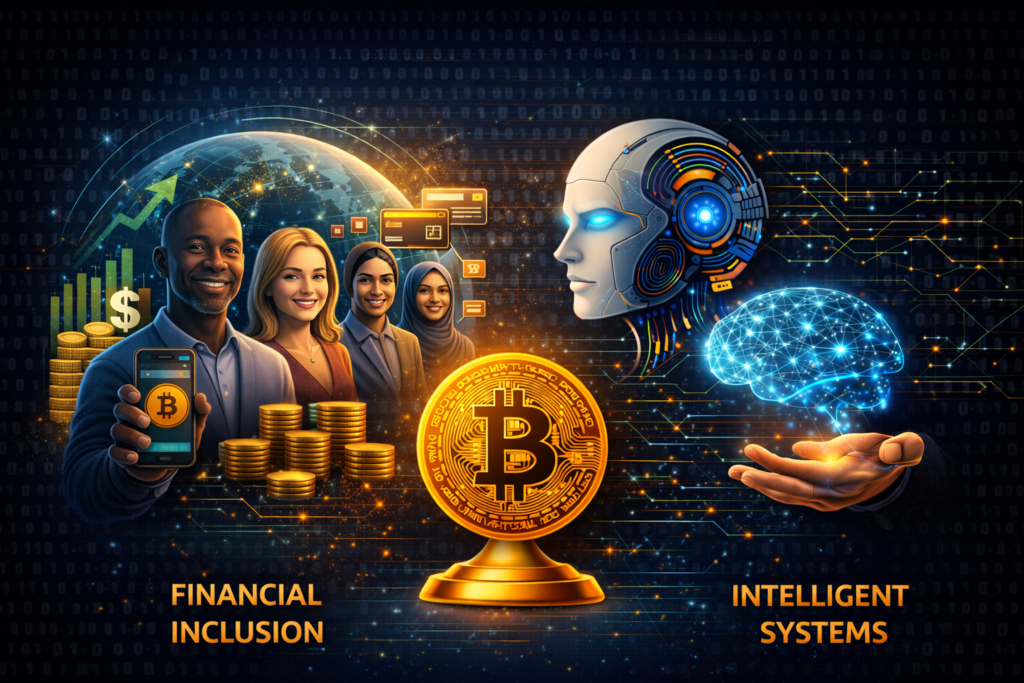
AI as an Interpreter of Financial Complexity
Artificial intelligence can analyze information at a scale far beyond the capacity of any individual investor.
An AI-powered system can evaluate blockchain activity, market prices, macroeconomic indicators, news coverage and changes in sentiment simultaneously. It can identify correlations, detect unusual behavior and compare current conditions with previous market cycles.
This capability creates valuable opportunities.
AI can help institutions monitor risk more efficiently. It can support fraud detection, improve compliance processes and identify market anomalies. It can also assist portfolio managers in testing scenarios and evaluating how different assets might respond to changing economic conditions.
For Bitcoin markets, which operate continuously across borders, this analytical speed is especially relevant. There is no closing bell. Information can influence prices at any time of day.
Yet AI should not be confused with foresight.
A model may recognize patterns without understanding their broader context. It may produce an elegant interpretation of incomplete data. It may perform well under familiar conditions and fail when the market enters a new environment.
AI does not remove uncertainty. It reorganizes it.
When Transparency Meets the Black Box
The meeting point between Bitcoin and artificial intelligence creates an unusual contradiction.
Bitcoin’s blockchain is open. Its rules can be inspected. Its transactions can be verified.
AI models, by contrast, may function as black boxes. Their conclusions can be difficult to trace, especially when they depend on enormous datasets and complex interactions between variables.
This matters because financial decisions require accountability.
An investor should not accept a recommendation merely because it was generated by an advanced system. A financial institution cannot assume that an algorithm is reliable simply because it has processed more information than a human analyst.
The essential questions remain surprisingly simple:
What data is the model using?
How current is that information?
What assumptions shape the result?
What could cause the model to fail?
Who is responsible when it makes a mistake?
The smartest application of AI is not to replace human judgment. It is to expose weaknesses in human judgment while remaining subject to scrutiny itself.
Efficiency Can Amplify Instability
Artificial intelligence can make markets faster and more efficient. But speed is not always beneficial.
If many institutions rely on similar models, datasets or technology providers, they may interpret a shock in similar ways. Their systems could reduce exposure at the same time, intensify selling pressure or withdraw liquidity precisely when markets need it most.
This risk is particularly relevant in Bitcoin markets because trading never stops and sentiment can shift rapidly.
The same tools that improve execution under normal conditions may amplify volatility during periods of stress.
This is a broader lesson for digital finance: a market can become technologically sophisticated without becoming emotionally stable.
Algorithms are designed by humans, trained on human behavior and deployed in markets shaped by human incentives. Automation does not eliminate herd behavior. In certain circumstances, it can accelerate it.
The New Infrastructure of Risk
The convergence of Bitcoin, finance and AI introduces opportunities, but it also creates a more complex map of risks.
There is market risk. Bitcoin remains volatile and can respond sharply to changes in liquidity, regulation and investor sentiment.
There is custody risk. Investors must understand where their assets are held and what protections exist if an intermediary fails.
There is cybersecurity risk. Digital assets and AI systems both create attractive targets for fraud, manipulation and technical attacks.
There is model risk. An algorithm may rely on poor-quality data, misunderstand an unusual event or generate false confidence through an apparently precise recommendation.
There is concentration risk. A large number of financial firms may depend on the same cloud infrastructure, external models or data providers.
And there is behavioral risk. Investors may assume that advanced technology protects them from bad decisions, when it may simply allow them to make those decisions more quickly.
The most dangerous misconception is that innovation eliminates old risks. More often, it reshapes them.
Beyond Trading: A More Intelligent Financial System
The most important impact of this convergence may not come from short-term trading.
AI can help financial institutions detect fraud, assess risk and improve operational efficiency. Blockchain-based systems may support faster settlement and more transparent recordkeeping. Tokenization could allow certain assets to be represented and transferred digitally in new ways.
Bitcoin is only one part of this broader transformation, but it has played an important cultural role. It demonstrated that a global digital asset could operate without a central issuer and remain relevant for more than a decade.
The future is unlikely to be a simple choice between banks and decentralized networks.
A more realistic scenario is a hybrid financial system.
Traditional institutions may adopt selected features of blockchain technology. Regulated investment products may provide access to digital assets. AI systems may analyze increasingly complex markets while regulators attempt to improve oversight.
The key question is no longer whether technology will enter finance. It already has.
The real question is whether financial systems can become more innovative without becoming more fragile.
What Investors Should Learn From This Convergence
Investors do not need to become programmers or data scientists. But they do need to become more critical consumers of information.
Understanding Bitcoin requires more than following its price. It means recognizing the importance of liquidity, market sentiment, custody and macroeconomic conditions.
Using artificial intelligence requires more than accepting automated answers. It means questioning data sources, identifying uncertainty and distinguishing useful analysis from confident speculation.
Navigating modern finance requires more than chasing technological themes. It means understanding how new tools fit within a disciplined strategy.
The strongest investors will not necessarily be those who react first. They will be those who know when speed is useful, when complexity is unnecessary and when the most intelligent decision is to do nothing.
Conclusion
Bitcoin, traditional finance and artificial intelligence are becoming increasingly interconnected, but their convergence should be viewed with both curiosity and caution.
Bitcoin contributes a decentralized network, a transparent ledger and a predictable supply structure. Traditional finance contributes capital, regulated access and institutional infrastructure. Artificial intelligence contributes analytical power, automation and the ability to process enormous amounts of information.
Together, these forces could improve efficiency, expand access and support new forms of financial innovation.
However, the same convergence introduces serious challenges. Bitcoin remains volatile. Financial intermediaries still create points of vulnerability. AI models can be opaque, overly correlated and difficult to evaluate during unexpected events.
The most objective conclusion is that innovation is not the same as progress.
Technology creates progress only when it improves transparency, resilience and decision-making without encouraging excessive risk or false confidence. Bitcoin and AI may become important components of the future financial system, but neither should be treated as a shortcut to certainty.
The future of finance will not be defined solely by faster transactions, smarter algorithms or new digital assets. It will be defined by whether investors, institutions and regulators can use these tools without losing sight of the quality on which every financial system ultimately depends: trust.