
Investing has never been a science of perfect predictions. It is the discipline of making reasonable decisions in a world that refuses to behave exactly as expected.
That challenge has become more complex in the age of Bitcoin and artificial intelligence.
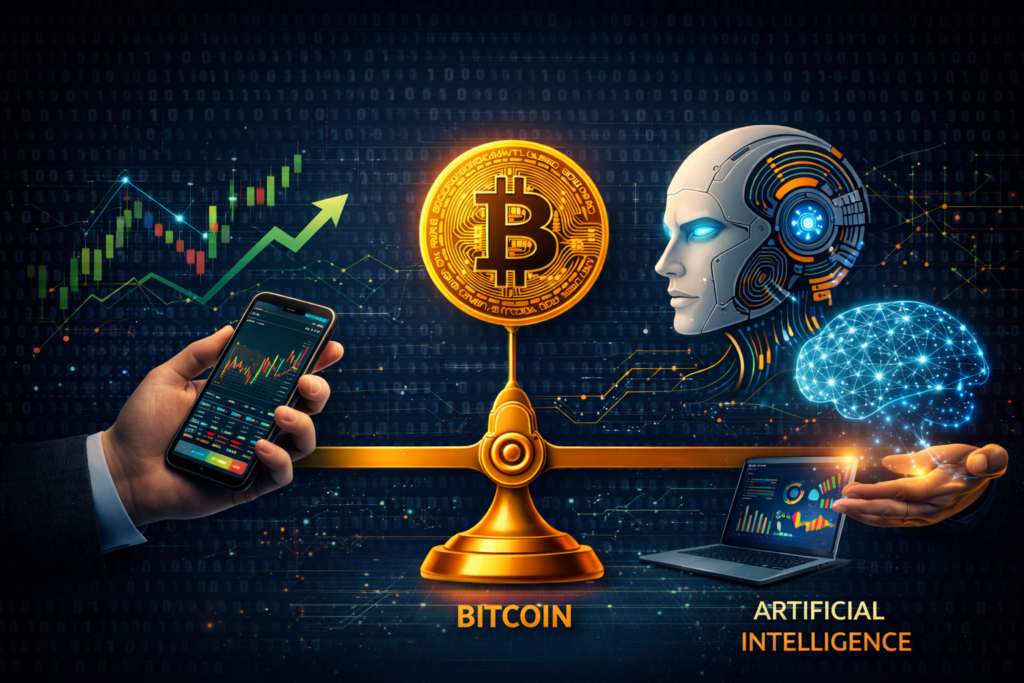
Bitcoin has introduced a new way to think about scarcity, ownership and trust. Artificial intelligence has transformed the speed at which information can be analyzed, patterns can be detected and investment ideas can be tested. One changes the nature of the asset. The other changes the tools used to evaluate it.
Together, they are creating a financial environment in which information is abundant, markets move continuously and confidence can spread faster than understanding.
The smartest investors will not necessarily be those who use the most sophisticated technology or react most quickly to every headline. They will be those who know what technology can do, recognize what it cannot do and build a strategy capable of surviving uncertainty.
Two Revolutions Moving at Different Speeds
Bitcoin and artificial intelligence are often mentioned in the same conversation because both are associated with technological disruption. Yet they play very different roles.
Bitcoin is an asset and a network. It was designed as a peer-to-peer electronic cash system that could operate without a traditional financial intermediary. Its supply follows predetermined rules, with a maximum limit of 21 million coins. No central bank can create additional bitcoins in response to a recession, a banking crisis or political pressure.
Artificial intelligence is not an asset in the same sense. It is a set of tools capable of processing information, identifying patterns and supporting decisions across industries. In finance, AI can be used to analyze market data, evaluate risks, monitor transactions, summarize news and test investment scenarios.
Bitcoin changes what investors can own. Artificial intelligence changes how investors can think.
The distinction matters because technology is only valuable when its purpose is understood. Buying a digital asset without understanding its risks is not innovation. Using an AI tool without questioning its assumptions is not intelligence.
Bitcoin: A Scarce Asset Without a Traditional Valuation Model
Stocks can be evaluated through revenue, profits and future cash flows. Bonds offer interest payments and a repayment schedule. Real estate can generate rent. Bitcoin does not fit comfortably into any of these categories.
It produces no earnings, distributes no dividends and offers no contractual cash flow. Its value depends largely on scarcity, adoption, liquidity, market confidence and the willingness of investors to treat the network as valuable.
That makes Bitcoin both fascinating and difficult to price.
Supporters often describe it as “digital gold” because its maximum supply is limited and it exists outside the control of any single government. The comparison is useful, but incomplete. Gold has played a monetary and cultural role for thousands of years. Bitcoin is a much younger asset with a shorter history and significantly greater volatility.
Bitcoin may eventually become a more established store of value. It may also continue to behave as a high-risk asset during periods of financial stress. A serious investor should be capable of considering both possibilities at the same time.
The goal is not to decide whether Bitcoin is either revolutionary or worthless. The better question is more practical: what role, if any, should an asset with unusual characteristics play within a diversified portfolio?
AI: A Telescope, Not a Crystal Ball
Artificial intelligence can process information at a scale that no individual investor could replicate manually.
An AI-powered system can study financial statements, compare historical market conditions, analyze changes in sentiment, identify correlations and evaluate large volumes of blockchain data. It can summarize complex information quickly and help investors explore scenarios that might otherwise be overlooked.
That is genuinely valuable.
However, a tool that processes more information does not automatically understand the future. AI systems learn from data, and data always reflects the past. Models can detect patterns that disappear when market conditions change. They can produce confident answers based on incomplete information. They can also reinforce the same assumptions already influencing other market participants.
The most useful way to think about AI is as a telescope rather than a crystal ball.
A telescope can help investors see further and more clearly. It cannot decide where they should go, how much risk they should take or what they should do when the landscape changes unexpectedly.
Human judgment remains essential because investing is not only a data problem. It is also a problem of incentives, patience, uncertainty and self-control.
The Paradox of Better Information
Modern investors have access to more information than any previous generation. Prices update instantly. Bitcoin trades around the clock. Financial news travels across social platforms within seconds. AI tools can summarize a week of market developments in minutes.
Yet better access to information does not always produce better decisions.
The difficulty is no longer finding data. It is identifying which data deserves attention.
An investor can now spend every hour monitoring charts, reading predictions and reacting to market commentary without improving the quality of a single decision. In fact, constant exposure to information can increase the temptation to trade emotionally.
This creates an overlooked advantage: the ability to ignore noise.
In a market that never sleeps, attention becomes a form of capital. Investors who allocate it carelessly may become exhausted, impulsive and vulnerable to narratives. Those who preserve it can focus on the few decisions that genuinely matter: asset allocation, diversification, costs, risk limits and time horizon.
Transparency Does Not Eliminate Uncertainty
Bitcoin’s blockchain offers a form of transparency that is unusual in traditional finance. Transactions are recorded on a public ledger, allowing analysts to study flows, wallet activity and other forms of on-chain data.
AI can turn this information into useful insights. It can help detect unusual movements, identify recurring patterns or compare blockchain activity with broader market conditions.
But transparency has limits.
A visible transaction does not always reveal the motivation behind it. A transfer to an exchange may indicate an intention to sell, but it may also reflect custody changes, internal movements or another strategy entirely. A model can identify activity without fully understanding its meaning.
The same principle applies to traditional markets. More data is not the same as more certainty.
Smart investors use data to improve their questions, not to manufacture false confidence.
A New Layer of Risk
The combination of digital assets and artificial intelligence creates opportunities, but it also introduces risks that traditional investment frameworks may overlook.
The first is market risk. Bitcoin can experience substantial price swings, and its volatility may intensify when liquidity becomes thinner or sentiment shifts abruptly.
The second is operational risk. Investors must consider how an asset is stored, which intermediary is involved and what happens if a platform, custodian or service provider fails.
The third is model risk. An AI tool may rely on incomplete data, misunderstand context or produce an apparently convincing analysis that contains important errors.
The fourth is concentration risk. If many institutions use similar models, datasets or technology providers, they may react to market shocks in similar ways. A tool designed to improve decision-making can unintentionally amplify herd behavior.
The fifth is behavioral risk—and it may be the most important of all. Technology can encourage overconfidence. Investors may assume that access to advanced tools makes them more capable of predicting markets than they really are.
A sophisticated dashboard does not protect an undisciplined strategy.
Building a Portfolio for an Uncertain Future
Smart investing is not about placing every available technology into a portfolio. It is about assigning each investment an appropriate role.
A useful framework is to think in layers.
The core of a portfolio should reflect long-term objectives, financial circumstances and tolerance for risk. It may include diversified exposure to established asset classes designed to provide resilience across different economic environments.
A satellite allocation can be used for investments with greater uncertainty but meaningful long-term potential. Depending on the investor, Bitcoin may belong in this category. The appropriate exposure should be small enough that a severe decline would not damage the overall financial plan.
A separate experimental allocation can be reserved for higher-risk ideas. This is the place for investments based on emerging themes, early-stage technologies or strategies that still require testing. The amount should be limited to capital the investor can genuinely afford to lose.
This layered approach allows curiosity without sacrificing stability.
It also creates a crucial psychological advantage: decisions are made before volatility appears. When markets become emotional, the investor already knows the purpose and limits of each position.
Suggested for You:
Avoiding the Illusion of Effortless Automation
AI tools can help investors screen companies, compare scenarios and detect inconsistencies. They can support research and reduce the time needed to process information.
But automation should not be confused with delegation of responsibility.
An investor should still ask basic questions. What data is the model using? Is the information current? What assumptions are hidden inside the analysis? Does the conclusion make sense in the real world? What could cause the model to fail?
These questions matter because markets are adaptive. Once a profitable pattern becomes widely recognized, it may weaken or disappear. Once many participants use similar tools, their behavior may become more correlated.
The most intelligent use of AI is not asking it to replace judgment. It is using it to challenge judgment.
A good system should help investors identify blind spots, test alternative scenarios and recognize uncertainty—not conceal it behind an impressive interface.
Long-Term Thinking in a Market Obsessed With Speed
Bitcoin trades every hour of every day. AI-powered systems can respond to market changes within seconds. Financial platforms are designed to make buying and selling frictionless.
None of this means that investors need to make more decisions.
The ability to act instantly is useful only when action is necessary. Otherwise, it can become a source of distraction.
Long-term investing still depends on timeless principles: diversification, patience, realistic expectations and the discipline to avoid decisions driven by fear or excitement. Technology may change the tools, but it does not eliminate the need for emotional control.
In many cases, the best response to a volatile market is not to move faster. It is to return to the original strategy and ask whether anything fundamental has actually changed.
Conclusion
Bitcoin and artificial intelligence are reshaping the investment landscape, but neither should be treated as a shortcut to financial success.
Bitcoin offers a distinctive combination of digital scarcity, global accessibility and independence from traditional monetary systems. It deserves serious consideration as part of the wider evolution of financial markets. However, its volatility, uncertain valuation framework and sensitivity to market sentiment make disciplined risk management essential.
Artificial intelligence can strengthen investment research by processing information, testing scenarios and identifying patterns at extraordinary speed. Yet it cannot eliminate uncertainty, guarantee returns or replace human responsibility. Its outputs remain dependent on data quality, model design and the judgment of the person using the tool.
The most objective conclusion is that smart investing in this new era requires balance.
Investors should remain open to innovation without becoming captivated by hype. They should use AI to improve their analysis without surrendering their critical thinking. They should study Bitcoin as a potentially meaningful asset without assuming that scarcity alone guarantees value.
The future of investing will be increasingly digital, data-driven and interconnected. But the investors most likely to navigate it successfully will still rely on qualities that technology cannot automate: patience, humility and the discipline to know when not to act.
Great read! I liked how it connects Bitcoin and AI with real investing ideas. Easy to follow and super relevant right now.