
The most dangerous investment strategy is often the one designed for only one version of the future.
A portfolio may perform well when inflation falls smoothly, interest rates decline and economic growth remains resilient. But what happens if energy prices rise again? What if central banks keep rates higher for longer? What if markets rally while the economy slows—or fall just as investors begin to feel confident?
Investing has never required perfect foresight.
Today, it requires something more useful: resilience.
The current economic climate is shaped by competing forces. Borrowing costs remain meaningful. Inflation has become harder to ignore. Geopolitical tensions can affect energy prices and investor confidence. Artificial intelligence is creating opportunities while also encouraging ambitious valuations in selected areas of the market.
The correct response is not paralysis.
Nor is it chasing every trend.
Smart investing means constructing a strategy capable of surviving uncertainty without abandoning the possibility of long-term growth.
Stop Searching for One Perfect Forecast
Investors often approach markets as if they are trying to solve a puzzle with one correct answer.
Will interest rates fall?
Will inflation remain elevated?
Will technology stocks continue rising?
Will bonds outperform equities?
Will the economy avoid a recession?
These are reasonable questions.
The mistake is building an entire portfolio around one prediction.
Economic forecasts are useful, but they are not promises. Markets also move according to expectations. Even when an investor correctly anticipates an event, the outcome may already be reflected in prices.
A stronger strategy begins with scenarios.
What would happen to the portfolio if inflation remained stubborn?
How would it respond to slower growth?
Could the investor tolerate a sharp equity decline?
Would there be sufficient liquidity to avoid selling during a difficult period?
The objective is not to know exactly what happens next.
It is to avoid being financially fragile when reality refuses to match the preferred forecast.
Build the Foundation Before Reaching for Returns
Before selecting investments, investors should establish a financial base.
An emergency reserve is not wasted money. It is a form of protection against forced decisions.
When an unexpected expense appears, investors without sufficient liquidity may need to sell assets during a downturn, borrow at an expensive interest rate or interrupt a long-term strategy at the worst possible moment.
The same principle applies to debt.
A portfolio does not operate in isolation from the rest of a person’s finances. Carrying high-interest debt while pursuing uncertain investment returns can weaken the entire plan.
Smart investing begins before the first asset is purchased.
It begins with stability.
Use a Core-and-Satellite Structure
One practical way to balance discipline with opportunity is to divide a portfolio into two layers.
The core is the foundation.
It should be diversified, cost-conscious and aligned with long-term goals. It may include broad exposure to equities, bonds and other suitable assets depending on the investor’s time horizon and tolerance for risk.
The satellite allocation is smaller and more selective.
It can be used for investments tied to specific themes, regions or opportunities: artificial intelligence, healthcare innovation, clean-energy infrastructure, emerging markets or other higher-conviction ideas.
This structure has an important psychological advantage.
It allows investors to remain curious without allowing every new trend to disrupt the entire portfolio.
Innovation deserves attention.
It does not deserve unlimited capital merely because the story is compelling.
Treat Cash as a Tool, Not a Permanent Strategy
Cash has a role in a portfolio.
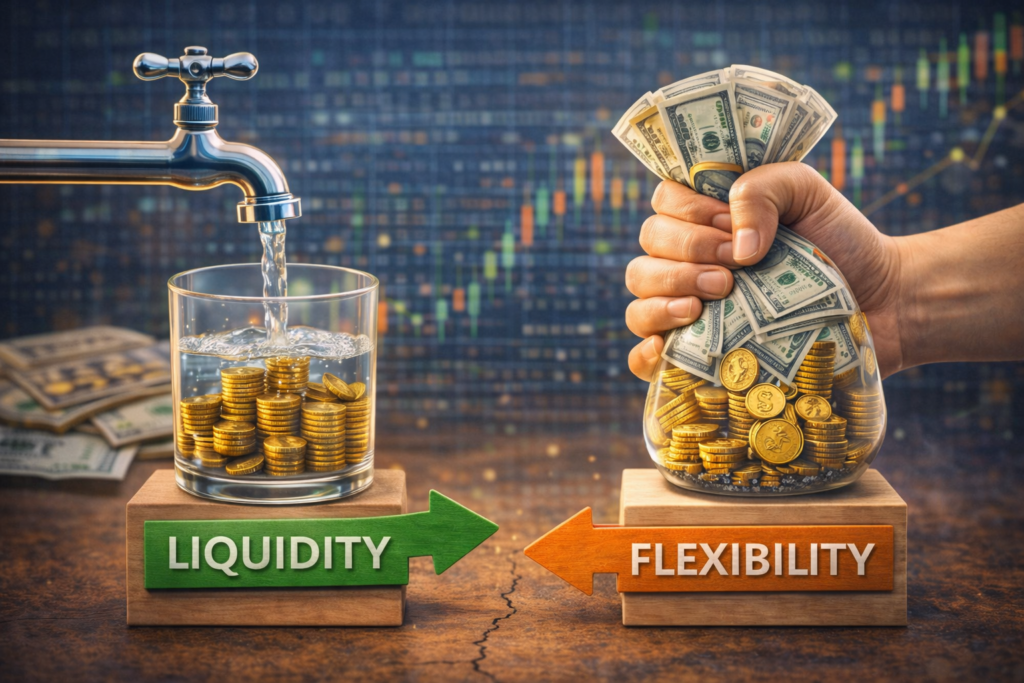
It provides liquidity, reduces stress and creates flexibility. It can cover short-term expenses or allow an investor to take advantage of opportunities during a downturn.
But cash also has a hidden cost.
Inflation reduces purchasing power. Money that feels safe in nominal terms may gradually lose value in real terms.
The correct approach is not to avoid cash entirely or hold excessive amounts indefinitely.
It is to assign cash a purpose.
A practical framework is to think in buckets:
Immediate liquidity: money for emergencies and short-term needs.
Intermediate stability: assets intended for goals within the next few years.
Long-term growth: investments capable of compounding over a much longer horizon.
Each bucket has a different job.
Confusing them creates risk.
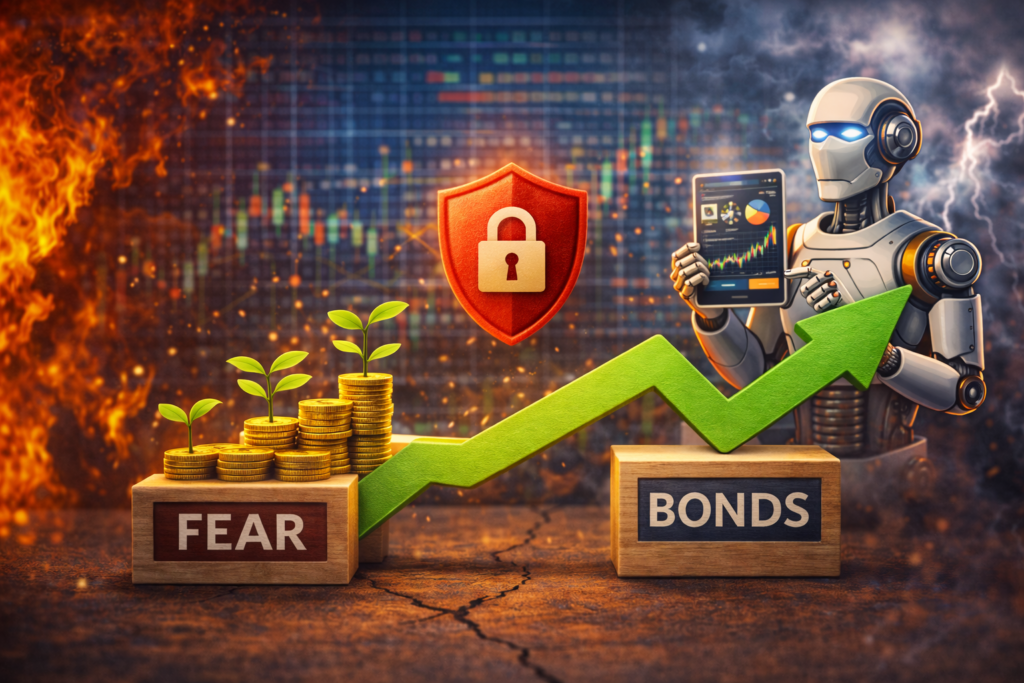
Bonds Deserve Attention Again
For years, many investors treated bonds as an uninspiring part of a portfolio.
Low yields made the trade-off difficult. Investors accepted limited income and sometimes took greater risks elsewhere in search of returns.
That calculation has changed.
Bonds can once again provide meaningful income and a stabilizing role within a diversified portfolio. They may be particularly useful for investors approaching retirement, preparing for a medium-term expense or seeking to reduce reliance on stock-market performance.
However, fixed income is not risk-free.
Longer-term bonds are generally more sensitive to changes in interest rates. Corporate bonds introduce credit risk. Fixed payments can lose purchasing power when inflation remains elevated.
The correct question is not whether bonds are safe.
It is which bond exposure fits the objective.
A laddered strategy—spreading investments across different maturity dates—can help reduce dependence on one large interest-rate prediction. As bonds mature, the capital can be reinvested or used for other purposes.
In uncertain conditions, flexibility has value.
Own Quality, Not Just Excitement
Higher borrowing costs place greater pressure on weak businesses.
Companies dependent on cheap financing may struggle when debt becomes more expensive. Businesses with fragile margins may find it difficult to absorb rising costs. Speculative companies valued primarily on distant promises can become vulnerable when investors demand evidence of profitability.
This creates a stronger case for quality.
Quality is not a fashionable label. It is a collection of characteristics:
A durable business model.
Manageable debt.
Consistent cash generation.
Pricing power.
Competent management.
A realistic valuation.
A strong company can still be a poor investment if the price is excessive.
A promising theme can still disappoint investors if expectations become unrealistic.
The objective is not to avoid growth.
It is to distinguish growth supported by a functioning business from growth supported mainly by a persuasive narrative.
Income Is Useful, but Dividends Are Not Magic
Dividend-paying companies can add income to a portfolio.
A history of stable or rising dividends may indicate financial strength, mature operations and disciplined capital allocation. Dividend income can also be psychologically reassuring during periods of market volatility.
But investors should not chase yield blindly.
An unusually high dividend yield may signal that a share price has fallen because the market expects the payment to become unsustainable. A company distributing too much cash may also underinvest in its future.
The same rule applies to bonds and dividend stocks:
Income should be evaluated together with risk.
A payment is valuable only when the underlying investment remains financially credible.
Diversify Across Sources of Risk
Diversification is one of the most repeated ideas in investing.
It is also one of the most misunderstood.
Owning several funds does not automatically create a diversified portfolio. Those funds may contain many of the same companies. Owning shares across different sectors may still leave a portfolio heavily dependent on one country or one economic scenario.
True diversification means spreading exposure across different sources of risk.
That can involve asset classes, industries, geographic regions, bond maturities and credit qualities.
Diversification cannot prevent every loss. During a broad market decline, several assets may fall together.
Its purpose is more realistic:
To reduce the probability that one mistake, one company or one forecast determines the investor’s entire financial future.
Diversification is not an absence of conviction.
It is a recognition that the future remains uncertain.
Look Beyond the Most Obvious Technology Winners
Artificial intelligence is reshaping the investment landscape.
The most visible opportunities are often the companies developing advanced models, semiconductor chips or cloud-computing infrastructure.
But a major technological transformation rarely creates value in only one place.
Opportunities may also appear in electricity generation, grid modernization, data-center cooling, cybersecurity, industrial automation and companies capable of using AI to improve productivity.
This broader perspective matters because the most popular investments often attract the highest expectations.
The obvious winner is not always the best investment at any price.
Smart investors look beyond the headline.
They ask which businesses provide the infrastructure, which industries gain efficiency and which companies have a realistic path from innovation to cash flow.
A powerful trend can be genuine while individual valuations remain difficult to justify.
Protect Purchasing Power Without Chasing Inflation Narratives
Inflation affects every portfolio.
It reduces the real value of cash. It weakens the purchasing power of fixed payments. It can increase costs for companies and create pressure on household budgets.
But there is no single perfect inflation hedge.
Stocks may provide long-term protection when companies can raise prices and preserve margins. Inflation-linked bonds may offer a more direct form of protection. Real assets may respond differently depending on the source of inflation and the economic environment.
The goal is not to make one dramatic bet.
It is to avoid building a portfolio that works only when prices remain stable.
Inflation awareness should influence strategy.
It should not become an excuse to chase whichever asset currently has the most attractive story.
Make Rebalancing a Rule, Not an Emotion
Market movements gradually change a portfolio.
If one asset performs exceptionally well, it may become a much larger part of the allocation than originally intended. The portfolio becomes more concentrated and more vulnerable without the investor consciously choosing to take additional risk.
Rebalancing restores the target allocation.
This may involve selling part of an asset that has grown disproportionately, directing new contributions toward underrepresented areas or reviewing the portfolio at regular intervals.
Rebalancing is not a prediction.
It is maintenance.
It creates a disciplined process for managing risk when emotions might otherwise encourage investors to chase recent winners.
A strategy should not depend on feeling calm during a market rally or courageous during a downturn.
It should contain rules written before those emotions arrive.
Use Technology to Reduce Friction, Not Create Noise
Digital platforms have made investing easier.
Investors can automate contributions, track goals, compare products and access diversified funds more efficiently than in the past.
These tools are valuable when they support good habits.
They become dangerous when they encourage constant reaction.
Notifications, charts and real-time commentary can create the impression that a portfolio requires daily intervention. In reality, long-term strategies often benefit from fewer decisions.
Technology should make discipline easier.
It should not transform investing into entertainment.
The best feature on an investment platform may not be the one that generates the most activity.
It may be the one that helps the investor do nothing unnecessarily.
Keep a Written Investment Policy
A simple written policy can prevent expensive improvisation.
It does not need to be complicated.
It may include:
The purpose of the portfolio.
The time horizon.
The target allocation.
The emergency reserve.
The schedule for regular contributions.
The rebalancing rule.
The maximum amount permitted for speculative investments.
The conditions that would justify a major strategic change.
This document acts as an anchor.
When markets fall, it prevents panic from rewriting the plan.
When markets rise, it prevents enthusiasm from redefining the investor’s tolerance for risk.
The strongest strategies are often built during calm periods and tested during uncomfortable ones.
Conclusion
Smart investing in today’s economic climate is not about predicting the next central-bank decision or identifying one asset capable of solving every problem.
It is about building a portfolio that remains useful under several possible futures.
The current environment rewards balance.
Cash provides flexibility but should not become a permanent hiding place. Bonds can offer income and stability but remain exposed to inflation, duration and credit risk. Equities support long-term growth, but quality and valuation matter more when financing costs are meaningful. Technological innovation creates opportunities, but the most compelling story is not always the most attractive investment.
The most objective conclusion is that adaptability should not be confused with constant activity.
A resilient investor does not change strategy every time the economic narrative shifts. They create a diversified framework, maintain sufficient liquidity, control costs and rebalance when necessary.
Markets will remain uncertain.
That is not a flaw in the system.
It is the reason a strategy is needed in the first place.