
Bitcoin was designed to operate without a central bank. It was not designed to operate without an economy.
That distinction has become increasingly important.
The Bitcoin network follows its own rules. No government can independently create additional bitcoins, reverse a confirmed transaction or change its maximum supply in response to an economic crisis. Yet the market price of Bitcoin is still determined by human decisions—and those decisions are influenced by interest rates, inflation, wars, financial instability and the availability of capital.
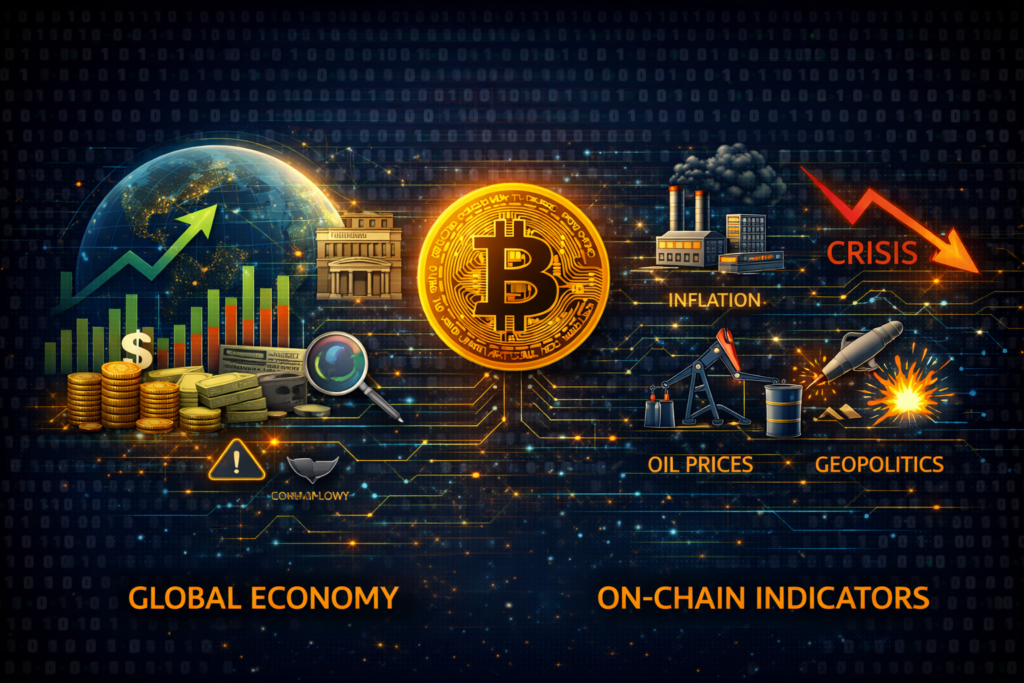
Bitcoin is decentralized at the technological level, but it trades inside an interconnected global financial system.
This creates one of the most interesting contradictions in modern markets. Bitcoin can be viewed as an alternative to traditional finance while reacting sharply to the same economic forces that move stocks, bonds, currencies and commodities.
Understanding this relationship requires more than asking whether a particular headline is “good” or “bad” for Bitcoin. The real question is how an event changes liquidity, risk appetite and confidence.
Bitcoin Has Entered the Macroeconomic Conversation
During Bitcoin’s early years, its price was largely shaped by events within the cryptocurrency ecosystem: technical developments, exchange failures, regulatory announcements and waves of speculative interest.
That world has changed.
Bitcoin is now accessible through regulated investment products, followed by institutional investors and discussed alongside other global assets. As its connection with mainstream finance has deepened, its sensitivity to economic conditions has become more visible.
This does not mean that Bitcoin behaves exactly like a technology stock, a commodity or a traditional currency. It means that it has entered the same gravitational field.
When economic conditions change, investors reconsider how much risk they are willing to take. Bitcoin is increasingly part of that calculation.
Inflation: A Powerful Narrative With an Imperfect Track Record
Bitcoin’s maximum supply is limited to 21 million coins. Its issuance follows predetermined rules rather than the decisions of a central authority.
These characteristics have helped create one of its most influential narratives: Bitcoin as protection against the long-term erosion of purchasing power.
The idea is intuitive. If the supply of an asset is limited while the supply of traditional currencies can expand, Bitcoin may appear attractive during periods of persistent inflation or concern about currency debasement.
However, the relationship is not automatic.
Inflation can increase interest in Bitcoin as a scarce digital asset. But inflation can also force central banks to keep interest rates higher, tighten financial conditions and reduce investor appetite for volatile investments.
This produces a paradox. The same inflationary shock that strengthens Bitcoin’s long-term narrative can create short-term pressure on its price.
A serious analysis must hold both ideas at once.
Bitcoin may attract investors who are worried about the future value of money, but it does not behave like a stable inflation hedge in every market environment.
Interest Rates Change the Price of Patience
Bitcoin does not pay interest. It does not generate dividends or predictable cash flows.
That makes central bank policy especially relevant.
When interest rates are low, investors receive limited returns from safer assets. This can encourage them to search for growth, alternative investments and higher-risk opportunities. Bitcoin may benefit from that environment.
When rates rise, the calculation changes.
Government bonds and cash-like instruments become more attractive. Borrowing becomes more expensive. Investors apply greater scrutiny to assets whose value depends heavily on future adoption and market confidence.
Interest rates do not directly determine the price of Bitcoin. Markets are too complex for that. But they change the cost of waiting and the attractiveness of risk.
A useful way to think about this relationship is simple: central banks do not control Bitcoin, but they influence the financial weather in which Bitcoin trades.
Liquidity: The Invisible Tide Beneath the Market
Some of the most important economic forces are difficult to see.
Global liquidity is one of them.
Liquidity describes the availability of capital and the ease with which money moves through financial markets. When financial conditions are supportive, investors are often more willing to take risks. Capital can flow into technology shares, emerging markets, speculative assets and cryptocurrencies.
When liquidity tightens, the tide moves in the opposite direction.
Investors reduce exposure. Leveraged positions become more vulnerable. Assets with greater volatility may fall more sharply as traders search for safety or cash.
Bitcoin’s round-the-clock trading and global accessibility can amplify these movements. Unlike traditional stock exchanges, the Bitcoin market does not close at the end of the business day. It continues processing fear, optimism and new information through nights, weekends and holidays.
This constant availability is one of Bitcoin’s strengths. It is also one reason why the asset can react so violently when market sentiment shifts.
Geopolitical Shocks Reveal Bitcoin’s Dual Identity
Wars, sanctions and trade disputes create a more complicated test for Bitcoin.
In theory, a decentralized and borderless asset should become more attractive when political uncertainty rises. Bitcoin can be transferred without relying on a single national banking system. Its supply cannot be altered by a government seeking to finance higher spending.
In practice, geopolitical shocks often produce two competing effects.
The first is the alternative-asset effect. Some investors become more interested in assets that exist outside conventional monetary structures.
The second is the risk-off effect. Other investors sell volatile assets, reduce leverage and move toward instruments perceived as safer or more liquid.
Bitcoin can be influenced by both forces at the same time.
This explains why its behavior during geopolitical crises can appear inconsistent. A conflict may reinforce the long-term case for a borderless asset while still producing sharp short-term volatility.
Bitcoin does not have one permanent identity. Depending on the circumstances, it can behave like a speculative asset, a liquidity-sensitive investment or an alternative financial instrument.
The Energy Channel Matters More Than It First Appears
Geopolitical conflicts often influence Bitcoin indirectly through energy markets.
When oil and gas prices rise, transportation, manufacturing and household costs may also increase. Inflation expectations can worsen. Central banks may find it harder to reduce interest rates. Economic growth may weaken as consumers and businesses face higher expenses.
Bitcoin can therefore react to an energy shock even when the network itself has not changed.
The chain of transmission is important:
A geopolitical crisis disrupts energy supply.
Energy prices rise.
Inflation becomes more difficult to control.
Interest-rate expectations shift.
Investors reassess risk.
Bitcoin responds.
This is a broader lesson for anyone analyzing markets. The most important influence on an asset is not always the most obvious one.
Trade Tensions and Economic Fragmentation
Global trade disputes also shape the environment in which Bitcoin operates.
Tariffs, export restrictions and political tensions can increase costs, weaken confidence and create uncertainty for companies operating across borders. They can also encourage governments and businesses to reconsider their exposure to particular currencies, payment systems and financial infrastructures.
Bitcoin is not a solution to every problem created by trade fragmentation. It remains volatile and cannot replace the scale of conventional international finance.
However, the debate matters.
As the global economy becomes more fragmented, interest in alternative settlement systems, digital assets and new forms of cross-border transfer may increase. Bitcoin forms part of that wider conversation, even when it is not the primary tool being used.
Its relevance comes partly from what it represents: a global asset that does not belong to any single country.
Currency Depreciation and Capital Controls
Bitcoin’s value proposition can look very different depending on where an investor lives.
In countries with relatively stable currencies, reliable institutions and accessible banking systems, Bitcoin may be viewed primarily as a speculative investment or a long-term alternative asset.
In countries facing severe currency depreciation, capital controls or restrictions on international transfers, the calculation may change.
Bitcoin can offer a way to move value across borders or gain exposure to an asset outside the domestic monetary system. This does not eliminate volatility, transaction costs or regulatory risks. It does, however, help explain why adoption cannot be understood only through the lens of investors in wealthier economies.
The same asset can serve different purposes in different places.
For one investor, Bitcoin is a portfolio allocation. For another, it may represent an imperfect but accessible financial escape route.
Banking Crises Create Attention, Not Certainty
Bitcoin was introduced in the aftermath of the 2008 global financial crisis. Its history is closely tied to skepticism toward financial intermediaries.
Periods of banking stress naturally revive that conversation.
When depositors worry about the safety of banks or investors question the resilience of the financial system, Bitcoin can regain attention as an asset that can be held without depending on a traditional bank account.
But acute crises also create a demand for cash.
When investors face losses elsewhere, they may sell liquid assets—including Bitcoin—to raise capital. This means that a banking crisis can strengthen Bitcoin’s narrative while still increasing its volatility.
Narrative and price do not always move in the same direction at the same time.
Institutional Access Has Changed the Transmission Mechanism
Bitcoin’s relationship with global events has also been altered by the growth of institutional access.
Regulated exchange-traded products have made it easier for many investors to gain exposure through conventional brokerage accounts. This has helped connect Bitcoin more closely with traditional portfolio decisions.
The change has advantages.
Access is simpler. Market participation can broaden. Institutional infrastructure may improve custody and liquidity.
But integration also creates a new transmission mechanism.
When investors reduce exposure to risk across their portfolios, Bitcoin can become part of the same selling process. When optimism returns, it may benefit from renewed capital flows.
Bitcoin’s integration with finance does not weaken its decentralized network. It changes the behavior of the market surrounding that network.
A 2026 Case Study: When Several Shocks Collide
The events of early 2026 illustrate why simplistic explanations are not enough.
A major conflict in the Middle East disrupted energy markets and increased uncertainty around inflation and economic growth. At the same time, Bitcoin had already been affected by a wider retreat from growth-sensitive assets and by pressure in technology shares.
Bitcoin experienced a substantial decline from its 2025 highs. Yet its response to the geopolitical escalation was not one-directional. It also showed periods of recovery as investors reassessed the meaning of the shock.
This episode captures Bitcoin’s modern identity.
It is not consistently a safe haven.
It is not merely a technology trade.
It is not detached from the financial system.
Bitcoin is a hybrid asset whose behavior changes depending on which force dominates: scarcity, liquidity, fear, leverage or demand for alternatives.
What Investors Should Monitor
A useful macroeconomic framework for Bitcoin should focus on several questions.
Are central banks expected to tighten or loosen financial conditions?
Is inflation falling, or are energy and supply shocks creating renewed pressure?
Are investors increasing their appetite for risk or moving toward liquidity?
Are geopolitical events strengthening demand for alternative assets, or triggering a broad market sell-off?
Are institutional flows reinforcing the move?
The goal is not to react impulsively to every headline.
It is to understand the chain of consequences connecting an event to investor behavior.
Conclusion
Bitcoin does not exist outside the global economy. It exists inside it in an unusual way.
Its network is decentralized, its supply is limited and its rules are not determined by central banks. These qualities make Bitcoin fundamentally different from traditional financial assets.
Yet its market price is still shaped by liquidity, interest rates, inflation expectations, geopolitical tensions and investor psychology.
The most objective conclusion is that Bitcoin should not be described permanently as either a safe haven or a risk asset.
Its behavior depends on the nature of the event and the response of the market. Inflation can strengthen its scarcity narrative while higher interest rates reduce demand. A banking crisis can increase interest in financial alternatives while forcing investors to sell liquid assets. A geopolitical shock can highlight Bitcoin’s borderless structure while pushing traders toward safer instruments.
This complexity is not evidence that Bitcoin has failed to establish an identity. It is evidence that the asset has matured enough to become part of the global financial conversation.
For investors, the lesson is clear: understanding Bitcoin now requires understanding the world around it.
Nice article!