
Bitcoin spent its early years outside the gates of traditional finance.
It was traded by technology enthusiasts, debated by economists and dismissed by many established institutions as a speculative experiment. Banks worried about compliance. Asset managers questioned its valuation. Corporate boards saw volatility, reputational risk and an unfamiliar form of custody.
The skepticism was understandable.
Bitcoin does not generate dividends, interest payments or predictable cash flows. Its price can move sharply within short periods. Its underlying technology requires investors to think differently about ownership, security and risk.
Yet the conversation has changed.
Bitcoin has not become a conventional asset, and institutions have not embraced it without hesitation. But it has moved from the margins of finance into a more serious phase of evaluation and integration.
The most important shift is not that every institution now believes in Bitcoin. They do not.
The real change is that Bitcoin can no longer be ignored.
Institutional Adoption Is Not a Single Event
The phrase “institutional adoption” is often used as if it described one simple trend.
In reality, it refers to several different developments.
An asset manager offering a Bitcoin exchange-traded product is not making the same decision as a company placing Bitcoin on its balance sheet. A bank providing custody services is not necessarily predicting that its price will rise. A hedge fund trading Bitcoin futures may be pursuing a short-term strategy rather than expressing long-term conviction.
These activities belong to the same ecosystem, but they should not be confused.
Institutional adoption can be understood in four layers:
Investment access: Financial products allow investors to gain exposure through familiar brokerage accounts.
Market infrastructure: Custodians, exchanges and service providers make it easier to hold, trade and report digital assets securely.
Portfolio allocation: Professional investors consider whether a limited Bitcoin position fits within a broader investment strategy.
Corporate treasury adoption: A smaller group of companies purchases Bitcoin directly as part of a balance-sheet strategy.
This layered approach provides a more realistic picture.
Bitcoin is becoming more institutionalized, but that does not mean every institution uses it for the same purpose—or accepts the same risks.
The Exchange-Traded Product Changed the Conversation
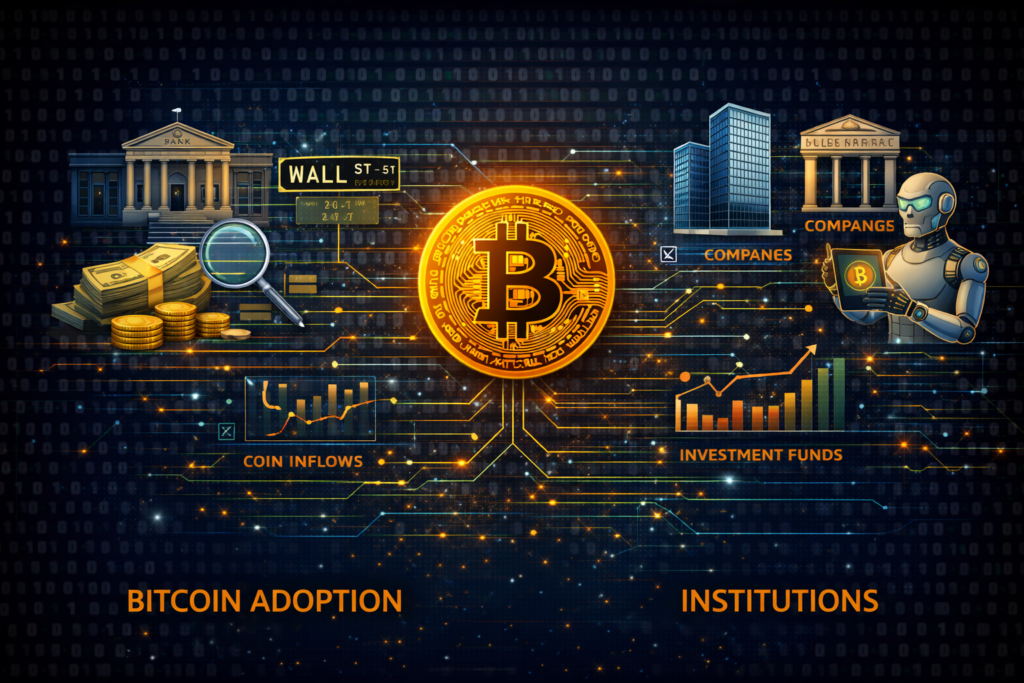
One of the most important turning points came with the expansion of regulated Bitcoin exchange-traded products.
These vehicles allow investors to gain exposure to Bitcoin through conventional financial accounts without directly managing wallets, private keys or cryptocurrency exchanges.
The underlying asset remains volatile. The structure does not transform Bitcoin into a low-risk investment. But it removes some of the operational friction that previously discouraged investors who were interested in exposure but uncomfortable with direct ownership.
This matters because institutions are built around procedures.
Portfolio managers must consider reporting requirements. Compliance departments need clear rules. Risk teams need reliable valuations. Investment committees need products that can fit within existing mandates and operational systems.
A regulated investment vehicle does not answer every question about Bitcoin.
It makes the questions easier to ask inside a traditional financial institution.
The Quiet Revolution Is Infrastructure
Price movements receive most of the attention, but the less visible transformation may be more important.
Institutional participation requires an ecosystem.
Large investors need secure custody, reliable execution, liquidity, insurance arrangements, reporting systems and compliance processes. They need to understand how assets are stored, who controls access and what protections exist if something goes wrong.
This is very different from the experience of an individual investor purchasing Bitcoin through a mobile application.
Institutional infrastructure is not exciting in the way a price rally is exciting. It develops gradually. It involves legal agreements, operational controls and risk-management procedures.
But this quiet work matters.
Markets become more mature not only when more capital arrives, but when the systems surrounding that capital become more resilient.
Bitcoin’s growing connection with traditional finance is therefore not just a story about demand. It is a story about plumbing.
Scarcity Is Attractive, but It Is Not a Valuation Model
Bitcoin has a maximum supply of 21 million coins.
For some institutions, that predictable scarcity is one of its most compelling characteristics. It contrasts with national currencies, whose supply can expand in response to monetary policy decisions.
This feature has encouraged comparisons with gold and strengthened the argument that Bitcoin may serve as a long-term alternative asset.
However, scarcity alone does not guarantee value.
A limited supply matters only when demand remains strong. Bitcoin does not produce earnings. It does not generate rent. It does not offer a contractual repayment schedule. Its valuation depends heavily on adoption, liquidity, confidence and the willingness of market participants to continue assigning value to the network.
This is why institutions tend to approach Bitcoin cautiously.
The relevant question is not whether scarcity is real. It is.
The relevant question is how much an investor should pay for exposure to that scarcity—and how much volatility the portfolio can tolerate while the market searches for an answer.
From Core Holdings to Satellite Allocations
Bitcoin is often discussed as though investors must choose between complete rejection and total commitment.
Professional portfolio construction rarely works that way.
For many institutions, the more realistic question is whether Bitcoin could serve as a satellite allocation: a limited position with the potential to improve returns or provide exposure to a distinct source of risk, without becoming the foundation of the portfolio.
This distinction is important.
A core investment is expected to provide stability, income or long-term diversification across economic scenarios. A satellite investment is allowed to be more uncertain because its size is controlled.
Bitcoin’s volatility makes position sizing essential.
An asset does not need to be low-risk to deserve consideration. It needs to occupy an appropriate place within the wider strategy.
A carefully limited allocation can express curiosity without turning a portfolio into a bet.
Corporate Treasuries Are Visible but Still Unusual
Some companies have gone much further than limited portfolio exposure.
They have incorporated Bitcoin into corporate treasury strategies, using their balance sheets—and in some cases additional financing—to accumulate substantial holdings.
These decisions attract enormous attention because they are easy to understand and difficult to ignore. A public company purchasing Bitcoin creates a clear headline.
However, corporate treasury adoption should not be mistaken for a universal blueprint.
Companies have different cash-flow needs, debt structures, risk tolerances and responsibilities to shareholders. A strategy that fits one business may be unsuitable for another.
Holding Bitcoin on a corporate balance sheet can create upside if the asset appreciates. It can also intensify volatility, complicate financial analysis and expose shareholders to risks that have little connection with the company’s original business.
The correct lesson is not that every company should copy the most aggressive adopters.
It is that Bitcoin has become significant enough for boards and shareholders to debate whether it belongs in corporate finance at all.
Institutions Bring Capital—and New Sensitivities
Institutional participation can deepen liquidity and improve market infrastructure.
But it also changes Bitcoin’s behavior.
When professional investors incorporate Bitcoin into broader portfolios, the asset becomes more exposed to the same forces affecting stocks, bonds and commodities. Interest-rate expectations, risk appetite, economic growth and access to liquidity all influence allocation decisions.
This helps explain why Bitcoin can fall alongside technology shares during periods of market stress.
Its decentralized network has not changed. Its supply rules have not changed. Yet the group of investors surrounding the asset has evolved.
Bitcoin can still attract interest as an alternative to traditional finance while simultaneously behaving like a risk-sensitive asset within traditional portfolios.
That apparent contradiction is part of its modern identity.
Regulation Is Becoming a Competitive Variable
Institutional investors value clarity.
They need to understand which products are permitted, which disclosures are required and which legal responsibilities apply to intermediaries. Uncertainty can discourage participation even when interest exists.
Regulation is therefore not simply a barrier or a benefit. Its quality matters.
Rules that protect investors, clarify responsibilities and improve transparency can support confidence. Poorly designed rules may push activity toward less transparent markets or create unnecessary complexity.
Different jurisdictions are moving at different speeds.
This creates a form of regulatory competition. Financial centers that establish credible frameworks may attract businesses, capital and talent. Those that remain unclear may lose activity to other markets.
For Bitcoin, the next phase of adoption will depend not only on technological development or price performance. It will also depend on whether regulation can become more consistent without abandoning appropriate safeguards.
Institutionalization Does Not Eliminate Risk
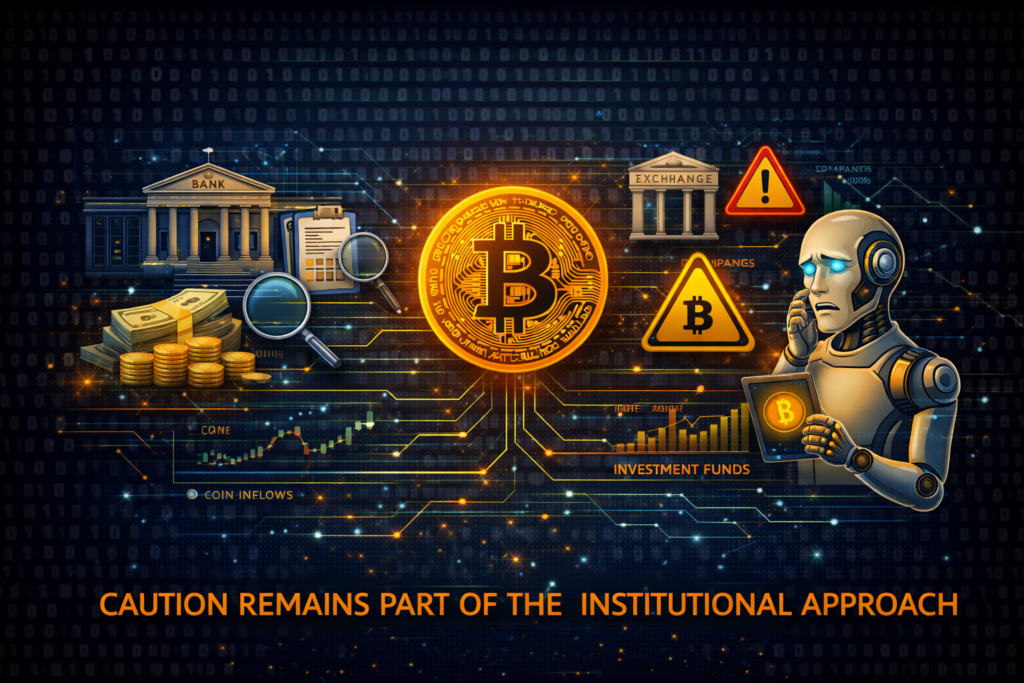
One of the most dangerous misconceptions is that institutional participation automatically makes Bitcoin safe.
It does not.
A familiar financial wrapper can simplify access, but it cannot remove the volatility of the underlying asset. Professional custody can reduce certain operational risks, but it cannot guarantee price stability. Larger markets can improve liquidity, but they can still experience abrupt changes in sentiment.
Institutions also make mistakes.
They can underestimate risk, follow crowded strategies and respond to market shocks in similar ways. Their presence does not eliminate speculation. In some circumstances, it may connect Bitcoin more closely to global risk cycles.
The arrival of sophisticated participants should encourage a more disciplined discussion, not blind confidence.
Institutional adoption is evidence of relevance.
It is not proof of guaranteed returns.
What Investors Should Watch Next
The most useful signals are not limited to price movements.
Investors should monitor whether regulated products continue to attract capital over time, whether custody and trading infrastructure becomes more robust and whether regulation develops with greater consistency across jurisdictions.
They should also distinguish between different forms of adoption.
A growing exchange-traded product market indicates expanding access. A bank offering services reflects client demand. A company purchasing Bitcoin for its treasury expresses a much stronger balance-sheet conviction.
These signals matter, but they do not tell the same story.
The quality of institutional adoption is more important than the number of headlines attached to it.
Conclusion
Bitcoin’s growing institutional adoption represents a meaningful change in the financial landscape.
The asset has moved beyond its origins as a niche technological experiment. Regulated investment products have simplified access. Custody and compliance infrastructure have improved. Financial institutions are increasingly capable of evaluating Bitcoin within established investment frameworks.
These developments strengthen Bitcoin’s relevance.
However, they do not resolve every uncertainty surrounding it.
Bitcoin remains volatile. Its valuation is difficult to anchor because it produces no cash flows. Its performance can be influenced by liquidity, interest rates and investor sentiment. Corporate treasury strategies involving Bitcoin may be appropriate for a limited number of businesses, but they are not a universal model.
The most objective conclusion is that institutional adoption should be interpreted as a sign of maturation, not a guarantee of success.
Bitcoin is no longer an outsider knocking on the door of traditional finance. The door has partially opened.
What happens next will depend on whether institutions can integrate the asset responsibly—without confusing growing accessibility with the disappearance of risk.