
Artificial intelligence is no longer a futuristic idea waiting for the next decade.
It is becoming part of the infrastructure of the global economy.
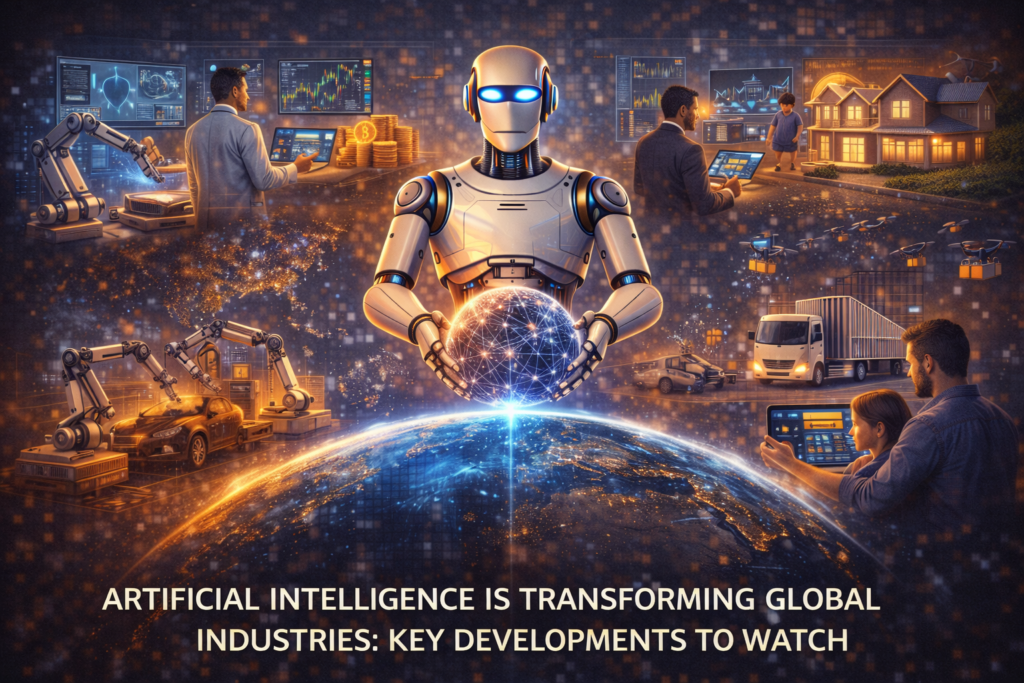
Banks use AI to identify unusual transactions. Hospitals evaluate tools that can support the interpretation of medical images. Manufacturers analyze equipment data to anticipate failures. Retailers forecast demand. Logistics companies optimize routes. Energy providers study how to balance increasingly complex electricity systems.
The most important transformation is not that machines suddenly possess human intelligence.
It is that AI can process information at a scale and speed that changes how organizations make decisions.
This creates opportunity.
It also creates pressure.
Businesses need to distinguish useful innovation from expensive experimentation. Workers need to understand how their roles may evolve. Governments need to protect citizens without preventing responsible progress. Investors need to recognize that the most visible AI companies are only one part of a much larger economic shift.
The next phase of artificial intelligence will not be defined by one dramatic breakthrough.
It will be defined by how deeply AI becomes embedded inside ordinary industries.
The Shift From Tools to Workflows
The first stage of widespread AI adoption focused heavily on individual tasks.
A system generated a piece of text. A chatbot answered a question. A model analyzed an image. A tool prepared a summary.
The next stage is more ambitious.
AI systems are increasingly being integrated into workflows.
A business may use AI to collect information, classify requests, prepare a draft response and direct the most complicated cases to an employee. A manufacturer may combine sensor data, maintenance records and production schedules to identify potential problems before they interrupt operations. A financial institution may use AI to detect suspicious behavior and help an analyst prioritize investigations.
This shift matters because value rarely comes from performing one task in isolation.
It comes from reducing friction across an entire process.
The companies that benefit most will not necessarily be those purchasing the greatest number of AI tools.
They will be those capable of redesigning work intelligently around them.
Healthcare: Innovation With a Higher Burden of Proof
Healthcare is one of the most promising areas for artificial intelligence.
It is also one of the least suitable environments for careless experimentation.
AI can help analyze medical images, organize patient information and support research. It may assist clinicians in identifying patterns that deserve closer attention. Generative systems may help reduce administrative workloads by summarizing consultations or preparing structured notes.
These applications could create meaningful value.
Doctors and nurses often work under intense time pressure. A tool that reduces repetitive paperwork safely may create more time for patient care.
However, healthcare illustrates an essential principle:
A prediction is not a diagnosis.
A model may perform well in one clinical setting and less effectively in another. Data may fail to represent the population being treated. An apparently confident output may still be wrong.
AI should support medical judgment, not quietly replace it.
The greater the consequences of an error, the stronger the requirements should be for testing, transparency, privacy and human oversight.
In healthcare, efficiency matters.
Trust matters more.
Finance: Faster Decisions and Faster Risks
The financial industry has used algorithms for years.
Artificial intelligence is expanding their reach.
Banks can analyze large volumes of transactions to detect fraud. Insurance companies can examine patterns associated with risk. Financial institutions can improve customer service through automated assistants. Supervisors and central banks can process complex datasets more efficiently.
The benefits are substantial.
But the sector also demonstrates how AI can introduce new vulnerabilities.
A credit model may rely on data that disadvantages certain groups indirectly. A chatbot may provide misleading financial information. An automated trading strategy may react to a market shock at the same time as many similar systems.
When several institutions rely on comparable models, datasets or cloud providers, efficiency can become concentration.
During calm periods, automation may improve execution.
During a crisis, correlated behavior may intensify volatility.
Financial AI therefore needs more than accuracy under normal conditions.
It needs resilience when normal conditions disappear.
Manufacturing: The Quiet Transformation of Physical Industry
Manufacturing rarely receives the same attention as generative AI or consumer chatbots.
Yet it may become one of the clearest examples of practical AI adoption.
Factories generate enormous amounts of operational data. Machines produce signals. Production lines reveal bottlenecks. Quality-control systems identify defects. Supply chains respond to disruptions.
AI can turn this information into useful decisions.
Predictive-maintenance systems can analyze equipment behavior and identify warning signs before a failure occurs. Computer-vision tools can inspect products for defects. Demand forecasts can help companies manage inventory and reduce waste. Supply-chain analysis can reveal vulnerabilities earlier.
This is not science fiction.
It is operational improvement.
But adoption remains uneven.
Many manufacturers operate with older systems, fragmented data and limited technical expertise. Integrating AI into a factory requires more than installing software. It may require sensors, reliable connectivity, employee training and changes to existing processes.
The lesson is important.
AI adoption is not only about access to powerful models.
It is about whether an organization has the infrastructure required to use them well.
Retail and Logistics: Efficiency at Scale
Retailers and logistics companies operate in an environment filled with small decisions.
How much stock should be ordered?
Which products are likely to sell?
Where should inventory be stored?
Which delivery route is most efficient?
When will demand rise unexpectedly?
AI can help answer these questions more quickly.
Retailers may use recommendation systems to personalize shopping experiences. Forecasting tools can reduce shortages and excess inventory. Logistics companies can analyze traffic, weather and delivery patterns to improve routes.
These improvements may appear incremental.
At scale, they matter.
A modest reduction in wasted fuel, delayed deliveries or unsold products can create significant value.
But personalization introduces ethical questions.
A recommendation system can help consumers discover relevant products. It can also encourage impulsive behavior, exploit vulnerabilities or collect more information than users reasonably expect.
The most efficient system is not automatically the most responsible one.
Energy: AI Is Digital, but Its Footprint Is Physical
Artificial intelligence is often discussed as though it exists entirely in the cloud.
The cloud still requires buildings, hardware and electricity.
Advanced AI systems depend on data centers. Data centers need processors, cooling systems, grid connections and reliable power supplies. As demand for computing expands, the relationship between AI and energy is becoming more important.
This creates two parallel trends.
First, AI can help improve energy systems.
It can support electricity-demand forecasting, manage variable renewable generation and identify opportunities to reduce waste in buildings or industrial processes.
Second, AI itself creates additional energy demand.
This is a defining contradiction.
AI may help economies use energy more efficiently while requiring large amounts of electricity to operate.
The next wave of AI investment will therefore extend far beyond software.
Electricity grids, cooling technologies, energy storage, semiconductors and data-center infrastructure will all become part of the story.
The future of AI will be shaped partly by code.
It will also be shaped by cables, transformers and power plants.
Scientific Research: The Most Important Breakthroughs May Be Invisible
Some of AI’s most valuable applications may never become popular consumer products.
In science, AI can help researchers explore complex problems more efficiently.
Models can support the analysis of biological data, molecular interactions and potential materials. They can narrow the range of experiments worth pursuing and help scientists identify patterns hidden inside enormous datasets.
This does not replace laboratories or human expertise.
A prediction still needs validation.
But AI can reduce the cost of searching through possibilities.
The social impact could be substantial.
Faster research may influence drug development, agriculture, energy storage and materials science.
The most meaningful AI achievement of the next decade may not be a chatbot used by millions of people.
It may be a tool used quietly by a small research team to solve a difficult problem.
Professional Services: Expertise Is Becoming More Scalable
Lawyers, accountants, consultants and other professionals spend considerable time reviewing documents, organizing information and preparing initial drafts.
AI can help with these tasks.
This may improve productivity and allow smaller teams to accomplish more.
But professional services depend on responsibility.
A fluent answer is not necessarily a correct one. A generated legal reference may be inaccurate. A financial summary may omit an important detail. A persuasive report may contain an unsupported assumption.
The stronger the tool becomes, the more important verification becomes.
AI can make expertise more scalable.
It should not create the illusion that expertise is unnecessary.
The most valuable professionals will not be those who accept every output automatically.
They will be those who know what needs to be checked.
The Workforce Will Change Through Tasks
The debate about AI and employment often focuses on job losses.
That concern is legitimate.
But the more immediate transformation is happening inside jobs.
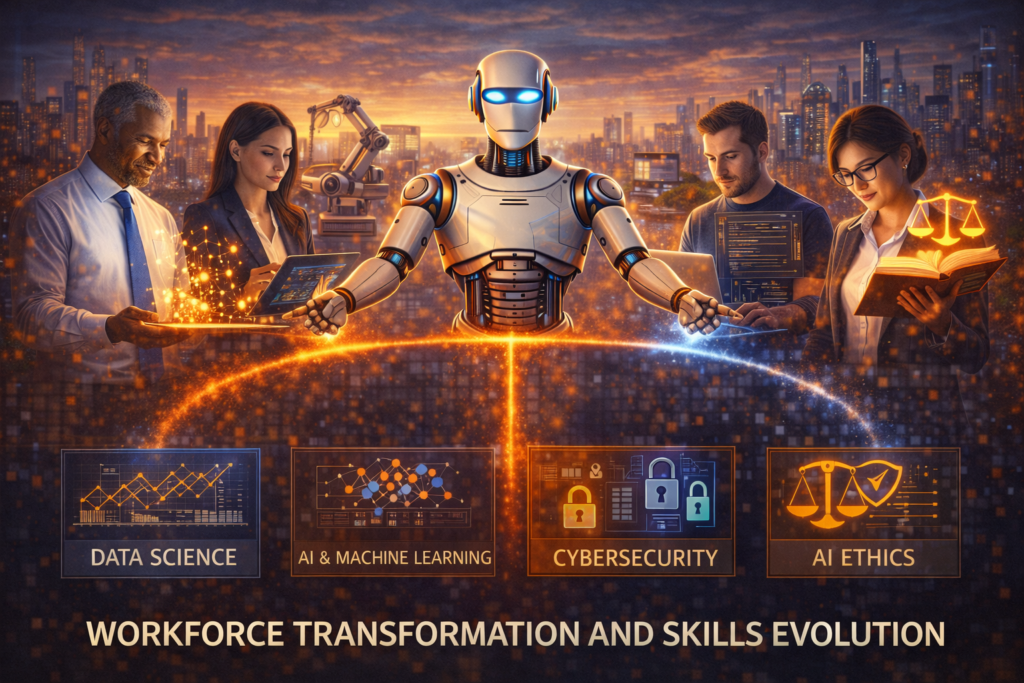
Many professions consist of several tasks. Some are repetitive. Others require judgment, communication, empathy or physical presence.
AI may automate selected activities without eliminating the occupation entirely.
An employee may spend less time preparing routine reports and more time interpreting results. A customer-service worker may handle fewer basic requests and more complicated cases. A developer may write code faster while becoming increasingly responsible for reviewing security and quality.
This can make work more productive.
It can also make work more demanding.
Employers may use AI to reduce administrative burdens. They may also use it to monitor performance more closely or increase workloads.
Technology does not determine which outcome occurs.
Management decisions do.
Data Governance Will Become a Competitive Advantage
AI depends on data.
Poor-quality data creates poor-quality decisions, even when the system appears sophisticated.
A hospital may lack representative patient information. A manufacturer may operate with incomplete maintenance records. A retailer may collect customer data without a clear purpose. A bank may use variables that function as indirect proxies for sensitive characteristics.
Organizations need to ask basic questions before deploying AI.
Where did the data come from?
Is it accurate?
Is it current?
Is its use proportionate?
Does it represent the people affected by the decision?
Who is responsible when the system fails?
Data governance can sound bureaucratic.
In reality, it is operational discipline.
The companies that manage information responsibly will be better positioned to build trustworthy systems and adapt to regulation.
Regulation Is Moving Closer to Daily Business
AI governance is becoming more concrete.
Regulators are increasingly distinguishing between low-risk tools and systems capable of affecting safety, rights or access to essential services.
This risk-based approach is practical.
An AI tool generating a draft product description should not face the same obligations as a system influencing employment, credit or healthcare decisions.
But businesses need visibility.
They should know which tools employees are using, what information enters those tools and which decisions are influenced by automated systems.
AI cannot remain an invisible layer inside ordinary software.
The more important the decision, the more visible the responsibility must become.
The Global AI Divide Could Widen
AI may increase productivity and create new industries.
Its benefits will not automatically reach every company or country equally.
Advanced AI development depends on capital, skilled workers, computing infrastructure, energy and data. These resources remain concentrated.
Large companies may adopt AI more easily than smaller businesses. Wealthier economies may build infrastructure faster than developing countries. Regions lacking reliable electricity, connectivity or technical expertise may struggle to capture the same benefits.
This creates a strategic challenge.
AI could reduce certain barriers to knowledge and productivity.
It could also widen existing gaps.
The success of the technology should not be measured only by the capabilities of the most advanced models.
It should also be measured by how widely useful access is distributed.
Key Developments to Watch
The next phase of AI adoption will be shaped by several developments.
From assistants to agents: AI systems will increasingly move beyond generating responses toward coordinating tools and completing multi-step workflows.
The rise of physical infrastructure: Data centers, energy systems, semiconductors and cooling technologies will become increasingly important.
Sector-specific regulation: Industries with higher consequences for errors will face stronger requirements for testing, transparency and oversight.
Data quality and cybersecurity: Organizations will need to protect the information used by AI systems and monitor how those systems behave after deployment.
Workforce redesign: Companies will need to rethink roles, training and early-career development as repetitive tasks become easier to automate.
The global access gap: Governments and businesses will need to address unequal access to infrastructure, skills and computing capacity.
These developments matter because AI is not one industry.
It is becoming a layer inside many industries.
Conclusion
Artificial intelligence is transforming global industries, but its impact will be neither uniform nor automatic.
Healthcare can benefit from better analysis and reduced administrative burdens, but patient safety and professional judgment must remain central.
Finance can use AI to detect fraud and improve risk assessment, but excessive reliance on similar models may create new vulnerabilities.
Manufacturing, retail and logistics can become more efficient through better forecasting and automation, but implementation requires infrastructure, reliable data and employee training.
Energy companies can use AI to manage increasingly complex systems, while the rapid expansion of data centers creates new demands on electricity grids.
The most objective conclusion is that AI should not be judged by how many tasks it can automate.
It should be judged by whether it creates durable value without weakening accountability.
The next wave of innovation will reward companies that understand the difference between adopting AI and using it wisely.
Technology can process information faster.
The responsibility to make good decisions remains human.