
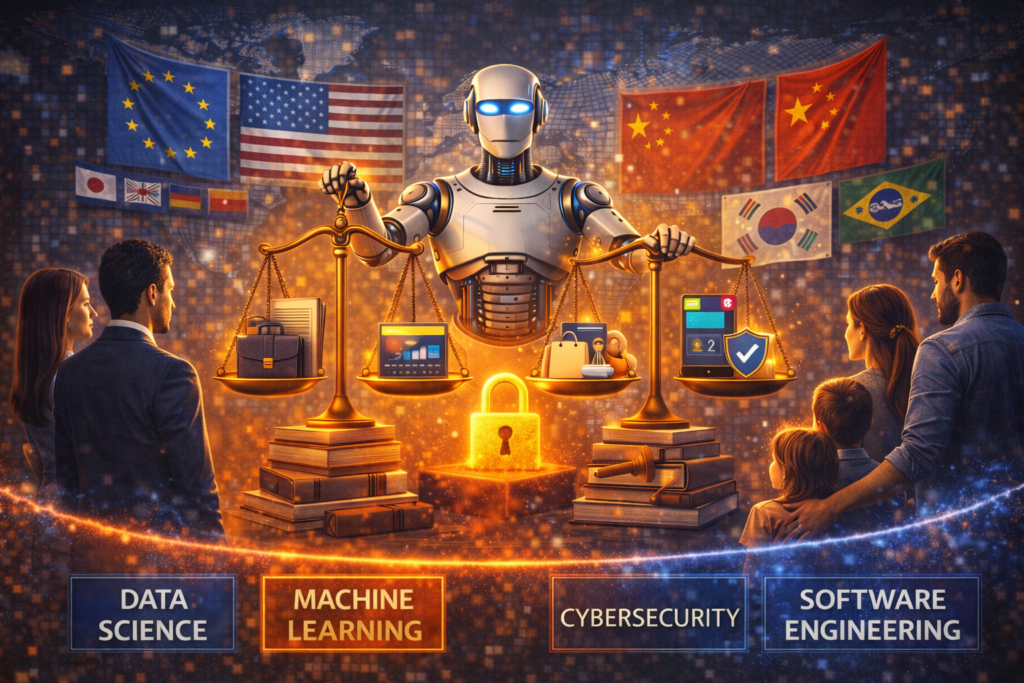
Artificial intelligence is moving from experimentation to infrastructure.
AI systems increasingly help companies write software, screen job applications, detect fraud, generate content, personalize services and organize large volumes of information. In healthcare, finance, education and public administration, algorithms are beginning to influence decisions with real consequences for people’s lives.
This transformation creates an obvious opportunity.
It also creates a governance problem.
What happens when an AI system makes a serious mistake? Who is responsible when an automated tool discriminates unfairly, exposes personal information or generates deceptive content? Should a company be allowed to use the same technology for recommending music and evaluating access to credit without facing different obligations?
Governments around the world are now trying to answer these questions.
AI regulation is advancing, but it is not developing through one universal model. Different regions are drawing the line in different places. Some emphasize comprehensive legal rules. Others prefer voluntary standards, sector-specific oversight or policies designed to accelerate innovation while managing selected risks.
For businesses, this means that AI adoption can no longer be treated as a purely technical decision.
For consumers, it means that the systems shaping daily life may gradually become more visible, more accountable and easier to question.
Regulation Is Moving From Principles to Practice
For years, the AI debate focused heavily on ethical principles.
Transparency.
Fairness.
Privacy.
Human oversight.
Accountability.
These ideas remain important.
But principles alone do not tell a company what to do when introducing an AI tool into recruitment, customer support or medical administration.
Practical governance requires more specific questions.
Which uses are permitted?
Which systems need a risk assessment?
What information must be documented?
When should customers be told that they are interacting with AI?
Which decisions require meaningful human supervision?
What happens when a model fails?
The regulatory conversation is shifting from broad aspirations toward operational rules.
This is a sign of maturity.
AI governance is becoming less about promising responsible innovation and more about proving that responsibility exists inside everyday business processes.
Europe Has Chosen a Risk-Based Legal Framework
The European Union has taken the most comprehensive regulatory approach so far.
The EU AI Act organizes artificial-intelligence systems according to the risks they may create.
This is a sensible distinction.
An AI tool recommending a film does not require the same level of oversight as a system influencing access to employment, education, healthcare or financial services.
The European framework therefore imposes different obligations depending on the use case.
Some practices are considered unacceptable and prohibited.
Certain high-risk systems face stricter requirements related to risk management, data quality, documentation, traceability, transparency, human oversight, accuracy and cybersecurity.
Other systems face more limited transparency obligations. For example, users may need to know when they are interacting with a chatbot. Certain artificially generated or manipulated content may also require clear disclosure.
The regulation also addresses general-purpose AI models, including powerful models capable of supporting many different applications.
For businesses, the key lesson is straightforward:
The legal risk depends not only on the model being used, but on what the company does with it.
A general-purpose tool used to prepare an internal draft creates a different risk profile from the same technology used to rank job applicants or influence access to credit.
Context matters.
The United States Is Taking a Different Path
The United States has not adopted a single comprehensive federal AI law equivalent to the EU AI Act.
Its approach is more fragmented.
Existing agencies continue to apply consumer-protection, competition, civil-rights and sector-specific rules to AI-related activities. At the same time, federal policy has increasingly emphasized innovation, infrastructure, national security and technological competitiveness.
This difference matters for businesses operating internationally.
A company may encounter detailed, horizontal legal obligations in Europe while facing a more sector-based mix of federal and state requirements in the United States.
But a more flexible framework does not mean that companies can ignore accountability.
A misleading claim about an AI product can still create legal risk. A discriminatory hiring system can still attract scrutiny. A consumer-facing chatbot can still raise questions about safety, advertising and data handling.
The absence of one universal law does not create the absence of rules.
It creates a more complex map.
Asia Is Not Following One Model
It is tempting to speak about “Asian AI regulation” as though the region shared a single strategy.
It does not.
China, Japan and Singapore illustrate three different approaches.
China introduced interim measures for generative-AI services with the stated objectives of promoting development, standardizing applications, safeguarding national security and protecting legitimate rights and interests.
Japan has emphasized business guidelines intended to encourage safe and secure AI use throughout the technology lifecycle. The approach gives companies practical guidance while retaining a strong voluntary component.
Singapore has developed governance frameworks designed to help organizations deploy AI responsibly. Its work has evolved from generative AI toward agentic systems capable of making decisions and completing tasks with greater autonomy.
These examples reveal an important trend.
Regulation is no longer focused only on static models that produce an answer when prompted.
Governments and regulators are beginning to think about systems that can act.
That shift will become increasingly important as AI tools move from generating content to completing workflows.
International Coordination Is Growing
National regulation alone cannot solve every problem.
AI systems can be developed in one country, hosted in another and used globally within seconds. A model deployed across multiple markets may face different rules concerning privacy, transparency, copyright, safety and consumer protection.
This creates complexity for businesses.
It also creates a need for common principles.
The Council of Europe opened the first international legally binding treaty on AI, human rights, democracy and the rule of law for signature in September 2024. The framework aims to ensure that activities throughout the AI lifecycle remain consistent with fundamental rights while allowing technological progress and innovation.
One particularly important principle is the ability to challenge consequential decisions.
People affected by AI-supported decisions should receive sufficient information to question the outcome and, where appropriate, submit a complaint to a competent authority.
This principle deserves wider attention.
A system should not become unaccountable simply because its internal logic is technically complex.
What Regulation Means for Businesses
For companies, AI regulation is not merely a legal issue.
It is a management issue.
An organization may use AI without realizing how widely it has spread. Employees may paste confidential information into external tools. Marketing teams may generate images or text without checking ownership questions. Human-resources departments may adopt software that influences recruitment. Customer-service teams may rely on automated responses that occasionally provide inaccurate information.
The first step is visibility.
A business needs to know where AI is being used.
This may sound obvious.
It is not.
AI is increasingly embedded inside ordinary software products. Companies may be using AI indirectly through tools for analytics, productivity, communication or customer management.
A useful inventory should identify:
Which AI systems are in use.
Which teams use them.
What information they process.
Whether outputs affect customers, employees or essential decisions.
Which provider is responsible for the underlying technology.
What happens when the system produces an error.
Without an inventory, governance remains theoretical.
Not Every AI Use Requires the Same Controls
A risk-based internal approach is useful even when regulation does not explicitly require it.
A tool used to improve the wording of an internal email may require basic privacy safeguards and employee training.
A system used to generate public content requires additional review for accuracy, intellectual property and reputational risk.
A system influencing hiring, credit, healthcare or access to essential services needs much stronger controls.
The level of oversight should reflect the consequences of failure.
This principle prevents two mistakes.
The first is underreaction: treating every AI tool as harmless.
The second is overreaction: creating such heavy processes for minor uses that employees simply avoid approved systems and use unmonitored tools instead.
Responsible governance should be proportionate.
It should make safe behavior easier.
Documentation Is Becoming a Competitive Advantage
Regulation often sounds like paperwork.
Sometimes it is.
But documentation serves a practical purpose.
A company should be able to explain why it selected a particular AI tool, which data it uses, how it was tested, who reviews its outputs and how incidents are handled.
This information becomes valuable when a customer complains, an employee challenges a decision or a regulator asks questions.
Documentation also improves internal decision-making.
It forces the organization to identify assumptions before those assumptions become problems.
The strongest companies will not treat governance as a final obstacle added after development.
They will build it into the design process.
Trust is easier to create before a crisis than after one.
Smaller Businesses Face a Real Challenge
Large companies may have legal teams, technical experts and compliance departments.
Small and medium-sized businesses often do not.
This creates a risk that complex regulation could become harder for smaller organizations to navigate, even though they also benefit from accessible AI tools.
The answer should not be ignoring risk.
It should be simplifying responsible adoption.
A smaller business can begin with practical steps:
Use approved tools.
Avoid entering sensitive data without understanding how it is handled.
Review customer-facing outputs.
Train employees on common errors.
Keep a record of higher-impact uses.
Seek specialist advice when AI affects employment, finance, healthcare or legal obligations.
A small company does not need an enormous governance department.
It does need rules.
What Regulation Means for Consumers
For consumers, better regulation can increase transparency.
People should not always be required to guess whether they are interacting with a machine. They should understand when synthetic content has been generated or manipulated. They should receive clearer information when AI plays a meaningful role in a decision that affects them.
This matters because AI systems can appear more authoritative than they really are.
A chatbot may sound confident while providing inaccurate information. A personalized recommendation may feel neutral while being designed to maximize engagement. An automated decision may appear objective while relying on incomplete or biased data.
Transparency creates the opportunity for skepticism.
But transparency alone is not enough.
A label informing somebody that AI was used does not automatically protect them.
Consumers also need meaningful routes to challenge important outcomes.
The Right to Question a Decision Matters
One of the most valuable principles emerging from AI governance is contestability.
A person affected by a consequential automated decision should be able to ask:
Was AI involved?
What information influenced the result?
Can somebody review the decision?
How can an error be corrected?
Where can a complaint be submitted?
This is especially important in employment, credit, healthcare, insurance, education and public services.
An appeals process should not exist only on paper.
A real person needs the authority, information and time to reconsider the outcome.
Human oversight is not meaningful when the human simply approves whatever the algorithm recommends.
A signature cannot become decoration attached to an automated process.
Deepfakes and Synthetic Content Will Test Transparency Rules
Generative AI has made it easier to produce convincing images, videos, voices and text.
This creates creative opportunities.
It also creates new forms of deception.
A synthetic voice may imitate a family member. A manipulated video may circulate during an election or crisis. A fabricated image may appear authentic. A genuine recording may be dismissed as fake by somebody seeking to avoid accountability.
The challenge is broader than detecting individual deepfakes.
It is preserving trust in evidence.
Transparency rules, content marking and provenance tools can help. Digital platforms and AI providers also need stronger safeguards.
But regulation cannot solve the problem alone.
Consumers will need new habits.
Verify urgent requests through a separate channel.
Pause before sharing emotionally charged content.
Treat realism as insufficient proof of authenticity.
In an AI-driven information environment, skepticism is not cynicism.
It is self-defense.
Regulation Can Support Innovation
Regulation is often presented as the enemy of innovation.
That framing is too simplistic.
Poor regulation can create unnecessary costs, discourage experimentation and favor large companies capable of navigating complexity.
But the absence of rules creates costs as well.
Businesses hesitate when legal responsibilities are unclear. Consumers resist technologies they do not trust. Harmful incidents damage entire industries, including companies that behaved responsibly.
Clear rules can reduce uncertainty.
They can also create a market for trustworthy AI.
A company capable of demonstrating safe, transparent and accountable systems may gain an advantage over competitors relying on vague promises.
Responsible innovation is not slower innovation.
It is innovation designed to survive scrutiny.
For more information click here:
A Practical Checklist for Businesses
Organizations preparing for evolving AI regulation can begin with a simple framework.
Map AI use
Identify tools, teams, providers, data sources and affected people.
Classify the risk
Distinguish low-impact productivity tools from systems affecting rights, safety or essential services.
Protect data
Confirm what information enters the system, where it is processed and whether its use is justified.
Keep humans responsible
Define who reviews outputs and who has authority to reject the model’s recommendation.
Document decisions
Record testing, limitations, incidents and corrective actions.
Train employees
AI literacy is not optional when tools are used professionally.
Monitor regulatory developments
Rules vary by jurisdiction and will continue evolving.
Preserve the right to challenge
Create a realistic appeals process for important decisions.
These steps do more than reduce legal exposure.
They improve the quality of AI adoption.
Conclusion
AI regulation is advancing worldwide because artificial intelligence is no longer a distant technological experiment.
It increasingly influences how people work, communicate, obtain information and access important services.
The most objective conclusion is that regulation should not attempt to stop innovation.
It should determine where greater responsibility is required.
Low-risk uses deserve room to develop. High-impact systems require stronger safeguards. Consumers should know when AI is involved in consequential decisions. Businesses should understand where their tools come from, what information they use and who remains accountable when something goes wrong.
The global regulatory landscape will remain fragmented.
Europe, the United States and Asian economies will continue following different paths. International coordination will expand gradually rather than appear overnight.
But one principle should remain clear across every model:
Artificial intelligence should not become a way to make responsibility disappear.
A trustworthy AI economy will not be built only by creating more capable systems.
It will be built by ensuring that people can understand, question and challenge the systems that increasingly shape their lives.