
Artificial intelligence is entering a new phase.
The first wave was defined by experimentation. Companies tested chatbots, automated routine tasks and explored whether algorithms could extract useful patterns from enormous datasets.
The next wave will be more consequential.
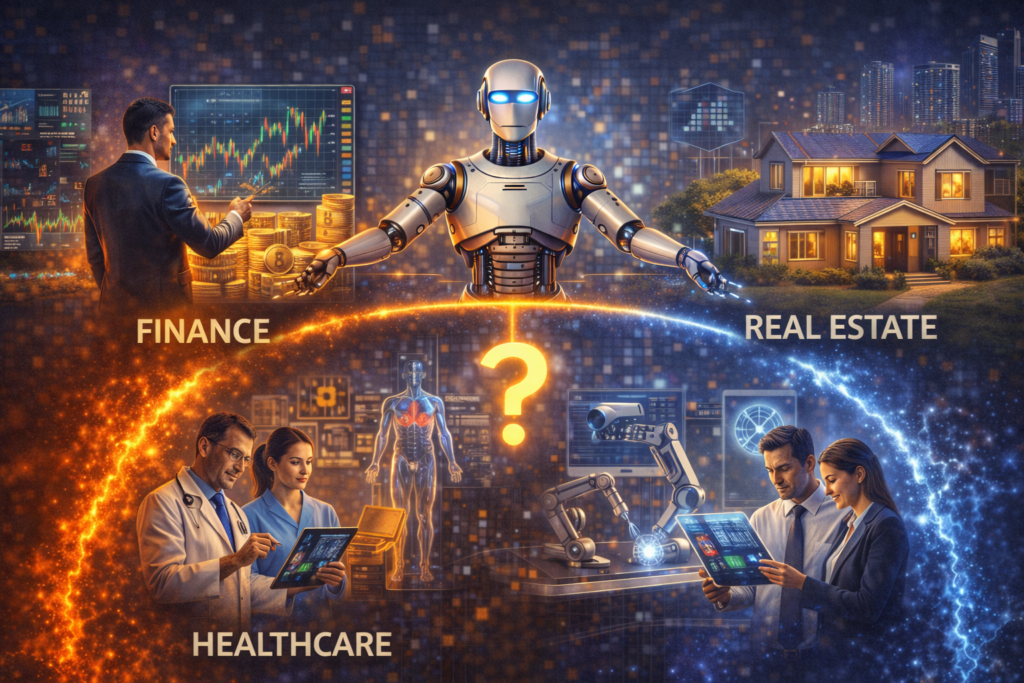
AI is becoming part of the infrastructure supporting decisions in finance, healthcare and real estate—three industries that influence some of the most important moments in people’s lives.
A financial model may affect access to credit. A medical system may support the interpretation of an image or organize information used during treatment. A property-valuation tool may influence the price of a home, the approval of a mortgage or the strategy behind a real-estate investment.
These applications can improve efficiency and reveal insights that would be difficult to obtain manually.
But they also raise a crucial question:
When AI becomes more capable, who remains responsible for the final decision?
The next wave of innovation will not be defined only by accuracy or speed.
It will be defined by whether technology can improve essential services without weakening trust.
Three Industries, Three Different Types of Risk
Finance, healthcare and real estate share several characteristics.
They generate large quantities of data. They rely heavily on professional judgment. They operate within regulated environments. They also affect decisions with long-term consequences.
However, the risks are not identical.
In finance, a poorly designed model may deny credit unfairly, underestimate risk or amplify market instability.
In healthcare, an inaccurate recommendation may influence a diagnosis, delay treatment or create a false sense of confidence.
In real estate, a flawed valuation may distort the price of a property or overlook local factors that cannot be captured easily in a dataset.
This distinction matters because AI should not be evaluated only by what it can do under normal conditions.
It should be evaluated by what happens when it is wrong.
The higher the cost of an error, the more important human oversight becomes.
AI in Finance: Better Analysis, New Vulnerabilities
Financial institutions have used algorithms for years.
Banks analyze transactions for signs of fraud. Insurance companies assess risk. Investment firms study market behavior. Digital platforms personalize services and answer routine customer questions.
AI expands these capabilities.
A modern system can process large volumes of data, identify unusual patterns and respond more quickly than a human analyst working alone. This may help financial institutions detect suspicious transactions, improve internal controls and identify emerging risks.
The opportunity is significant.
So is the temptation to trust the model too much.
Credit Decisions Require More Than a Score
AI can support credit assessment by analyzing complex information and identifying patterns that traditional methods may overlook.
This could improve access for applicants whose financial circumstances do not fit neatly into conventional models.
But alternative data introduces difficult questions.
Which information is relevant?
Was it collected fairly?
Could it act as a proxy for protected characteristics?
Can an applicant understand why the decision was made?
Is there a meaningful way to challenge an error?
A model may be statistically effective while still producing unfair outcomes.
Efficiency is not the same as legitimacy.
When AI influences access to credit, the system needs transparency, testing and human accountability.
Fraud Detection Is a Race Between Attackers and Defenders
AI can help detect suspicious payments by identifying unusual behavior in real time.
This becomes increasingly valuable as financial activity moves online.
But the same technology can strengthen cybercrime.
Fraudulent messages can become more personalized. Voice cloning can make scams more persuasive. Automated attacks can operate at greater speed and scale.
The result is an arms race.
Financial institutions will need to use AI not only to improve customer experience, but also to protect the trust on which digital finance depends.
Automation Can Amplify Market Stress
AI may also influence how financial markets behave.
If several institutions rely on similar models, datasets or technology providers, they may react to a shock in similar ways. During calm periods, this can appear efficient.
During a crisis, it can become a vulnerability.
Automated strategies may sell assets simultaneously, withdraw liquidity or intensify volatility.
A faster market is not automatically a safer market.
The financial sector will need systems capable of identifying when efficiency begins to create fragility.
AI in Healthcare: From Administrative Relief to Clinical Support
Healthcare may be one of the most valuable areas for responsible AI adoption.
Medical professionals work in environments filled with complex information. They analyze images, review patient histories, interpret test results and make decisions under time pressure.
AI can support this work.
It can help organize records, reduce administrative burdens and identify patterns that deserve closer attention.
The objective should not be replacing healthcare professionals.
It should be helping them focus on the work that requires human expertise, empathy and responsibility.
Medical Imaging and Pattern Recognition
AI systems can assist clinicians by analyzing medical images and identifying suspicious patterns.
In fields such as radiology, ophthalmology and pathology, this may help professionals prioritize cases or detect findings that require further investigation.
But a prediction is not a diagnosis.
Medical systems need careful testing across different populations and clinical settings. A tool that performs well in one hospital may not behave identically elsewhere.
Data quality matters.
So does context.
An algorithm can support a doctor.
It cannot understand the patient’s life in the way a doctor should.
Administrative Work Is an Underrated Opportunity
Not every important healthcare application needs to be dramatic.
Doctors and nurses spend substantial time documenting care, organizing information and managing administrative tasks.
AI may help summarize consultations, structure records and reduce repetitive work.
This matters because time is a scarce clinical resource.
A system that reduces paperwork safely can create more space for patient care.
The most valuable use of AI may not always be the most visible one.
Sometimes innovation means allowing professionals to spend less time looking at a screen and more time listening to a person.
Generative AI Needs Strong Boundaries
Large multimodal models may eventually support clinical research, public health and drug development.
But healthcare is a difficult environment for systems that can produce confident errors.
Patients should not receive unreliable medical advice simply because a chatbot sounds reassuring. Sensitive health data should not be entered into external tools without a clear understanding of how it will be handled.
The principle is straightforward:
The more serious the decision, the less appropriate it is to rely on an unsupervised output.
AI in Real Estate: Turning Buildings Into Data
Real estate may appear less digital than finance or healthcare.
A property has a physical location. Its value depends on the neighborhood, the condition of the building, local demand and countless details that cannot be understood fully through a spreadsheet.
Yet AI is becoming increasingly relevant.
Real-estate professionals can use automated valuation models, analyze market patterns, organize lease information and improve property management. Building owners can monitor energy use, anticipate maintenance needs and understand how spaces are being used.
The industry is becoming more data-driven.
It should not become less human.
Valuation Models Can Improve Consistency
AI can help process large quantities of information: previous sales, rental income, local market trends, building characteristics and other relevant data.
This can make valuation faster and more consistent.
But a property is not only a collection of variables.
An algorithm may miss unusual characteristics, structural problems, regulatory changes or subtle differences between two locations. It may rely too heavily on historical data during a period when the market is changing.
A valuation model should support professional judgment.
It should not become an excuse to avoid it.
Smarter Buildings Can Reduce Waste
AI can also improve how buildings operate.
Sensors and intelligent systems may help optimize heating, cooling, lighting and maintenance. A property manager can identify unusual energy consumption or anticipate when equipment is likely to fail.
This has financial and environmental value.
Lower operating costs can improve the attractiveness of a building. Better maintenance can reduce disruption. More efficient energy use can support sustainability goals.
The future of real estate is not only about predicting property prices.
It is also about managing buildings more intelligently after they have been purchased.
Housing Decisions Need Particular Care
AI tools used in real estate can influence more than investment returns.
They may affect tenant screening, access to housing or the information used during mortgage decisions.
This creates a higher ethical burden.
A system should not quietly reproduce historical discrimination. A person should not be rejected without a meaningful explanation or a realistic path to challenge an error.
Housing is not merely another product.
It is an essential part of life.
Innovation should respect that difference.
The Real Competitive Advantage Is Better Data
Across finance, healthcare and real estate, AI depends on data.
The quality of the output cannot exceed the quality of the information used to generate it.
Poor data creates poor decisions with an impressive interface.
A financial institution may rely on incomplete customer records. A hospital may train a system on data that does not represent the population it serves. A property model may struggle in areas with limited transaction history.
Organizations need to ask difficult questions before deployment.
Where did the data come from?
Is it accurate?
Is it current?
Does it represent the people affected by the system?
Is its use proportionate and lawful?
Who checks for errors?
The most advanced model cannot compensate for weak governance indefinitely.
Human Oversight Must Be More Than a Formality
Many organizations promise to keep a human “in the loop.”
That phrase is reassuring.
It is not always meaningful.
A person reviewing an AI recommendation may have limited time, insufficient information or little authority to disagree. If the employee simply approves whatever the system proposes, human oversight exists only on paper.
Real oversight requires training.
The reviewer needs to understand the tool’s limitations. They need enough time to assess the recommendation. They need access to relevant information. They need the authority to reject the result.
Most importantly, they need to know when the system should not be used at all.
An AI model can support professional judgment.
It cannot absorb professional responsibility.
You can access this other article related to this one:
Regulation Will Shape Adoption
AI regulation is moving from broad principles toward practical obligations.
This is especially important in sectors where automated systems can influence access to financial resources, healthcare or essential services.
A risk-based approach makes sense.
A tool generating a first draft of a property description does not create the same risk as a system evaluating creditworthiness or assisting with a medical decision.
The more important the decision, the stronger the requirements should be.
Responsible regulation should not attempt to prevent innovation.
It should ensure that innovation earns trust.
A Practical Framework for Businesses
Organizations considering AI in finance, healthcare or real estate can follow a simple sequence.
Begin with a real problem
Do not adopt AI merely because competitors are experimenting with it.
Identify a process where the technology can create measurable value.
Measure the consequences of failure
The level of oversight should reflect the seriousness of a potential error.
Evaluate the data
Confirm that the information is accurate, representative, protected and appropriate for the task.
Keep responsibility visible
Define who approves the use of the system, who monitors performance and who responds when something goes wrong.
Test before expanding
A limited pilot can reveal problems before they affect customers, patients or tenants at scale.
Preserve the right to challenge
People affected by important AI-supported decisions need a meaningful way to understand and dispute the outcome.
Conclusion
Artificial intelligence is reshaping finance, healthcare and real estate because all three industries depend on information, judgment and trust.
The opportunities are substantial.
Financial institutions can detect fraud more effectively and process complex information more quickly. Healthcare professionals can receive support when reviewing medical data and reduce time spent on administrative work. Real-estate firms can improve valuations, manage buildings more efficiently and identify maintenance needs earlier.
But the most objective conclusion is that AI should not be judged by efficiency alone.
A faster decision is not necessarily a better decision.
A sophisticated prediction is not automatically a fair one.
A confident output is not the same as a reliable answer.
The next wave of innovation will succeed only if AI strengthens professional judgment rather than quietly replacing it.
Finance, healthcare and real estate affect people’s money, health and homes.
Those areas are too important for responsibility to disappear inside an algorithm.
Great article! It does an excellent job explaining how AI is driving innovation across finance, healthcare, and real estate in a clear and engaging way. Very insightful and easy to follow.