
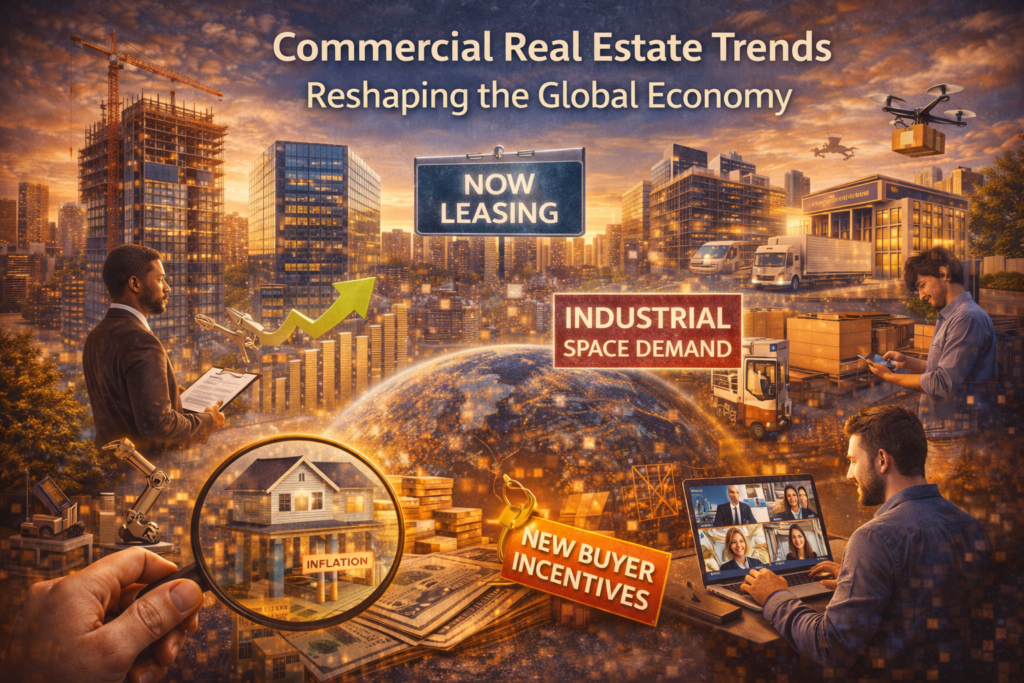
Commercial real estate is not merely a collection of buildings.
It is part of the operating system of the economy.
Offices influence where people work and how city centers function. Shopping areas shape local employment and consumer activity. Warehouses support supply chains and online commerce. Hotels respond to tourism and business travel. Data centers provide the physical infrastructure behind cloud computing and artificial intelligence.
When commercial real estate changes, the effects spread far beyond property investors.
Banks reassess risk. Companies reconsider their locations. Cities face new questions about tax revenue, transport and land use. Energy providers need to prepare for rising electricity demand. Older buildings may lose tenants while newer properties attract a premium.
The sector is therefore not experiencing one simple cycle.
It is undergoing a structural transformation.
Higher financing costs have exposed weaknesses created during the era of cheap money. Remote work has challenged traditional office models. Digital commerce has changed the purpose of physical retail. Artificial intelligence has made data centers strategically important. Sustainability requirements are separating efficient buildings from assets that may require expensive upgrades.
The most important question is no longer whether commercial real estate will recover.
It is which properties will remain economically useful in a changing world.
A Recovery With Uneven Foundations
Commercial real estate entered a difficult period after interest rates rose sharply across many economies.
Property values are sensitive to financing conditions because buildings are frequently purchased with debt. When borrowing becomes more expensive, buyers cannot justify the same prices without accepting lower returns. Owners approaching refinancing dates may face higher monthly costs. Developers may postpone projects because the economics no longer work.
This can reduce transaction activity.
Buyers wait for clearer pricing.
Sellers hesitate to accept lower valuations.
Banks become more cautious.
The market appears frozen.
Lower interest rates can gradually provide relief, but they do not solve every problem. Some pressures are cyclical. Others are structural.
An office building suffering temporarily because financing is expensive may recover when conditions improve.
An office building suffering because tenants no longer want its location, layout or energy profile faces a more difficult question.
A lower interest rate cannot make an obsolete building useful again.
Refinancing Risk Has Become a Central Issue
Commercial property loans do not always remain fixed for decades.
Many owners need to refinance periodically. A building purchased or financed during a low-rate period may therefore encounter a very different environment when the loan matures.
The consequences can be significant.
A property that previously generated comfortable cash flow may become much less profitable. If rental income has weakened or occupancy has fallen, the owner faces pressure from both sides: lower revenue and higher financing costs.
This is where leverage matters.
Debt can improve returns when values rise and income remains stable.
It can also amplify losses when the market changes.
Investors should not evaluate a commercial property only by its current rent roll or market valuation. They need to understand the debt structure.
When does refinancing occur?
Is the rate fixed or variable?
How much would interest costs increase under a less favorable scenario?
Could the building remain viable if occupancy falls?
A resilient asset should survive more than one version of the future.
Offices Are Splitting Into Two Markets
The office sector has become the clearest example of divergence.
Remote and hybrid work have changed how companies use space. Many employers no longer need the same number of desks every day. Some have reduced their office footprint. Others have moved toward flexible layouts and collaborative spaces.
This does not mean offices are disappearing.
It means tenants have become more selective.
High-quality offices in strong locations may remain attractive because they offer something employees cannot obtain easily at home: collaboration, professional networks, meeting spaces and access to urban amenities.
Older properties face a harder challenge.
A poorly located office with inefficient energy systems, inflexible layouts and limited transport access may struggle to attract tenants even at a discount.
This creates a flight to quality.
The difference between a modern building and an outdated one is becoming more important than the distinction between “office” and “non-office.”
Some older assets may need substantial renovation.
Others may require a different use entirely.
Converting Offices Into Homes Is Useful—but Not Simple
The difficulties facing older offices have encouraged a logical idea:
Why not convert empty buildings into housing?
In selected cases, this can be valuable.
Cities need homes. Some central areas need more permanent residents. Mixed-use neighborhoods can become more resilient when they do not depend entirely on commuters arriving every morning and leaving every evening.
But conversion is not a universal solution.
Office buildings were not designed as apartments.
Floor plates may be too deep for natural light. Plumbing systems may be unsuitable. Windows may not open. Local zoning rules may complicate the process. Renovation costs can become prohibitive.
The strongest candidates tend to have suitable structures, realistic economics and locations where residential demand is genuine.
Conversion should be treated as one tool among several.
Sometimes the right answer is renovation.
Sometimes it is conversion.
Sometimes the building no longer justifies the capital required to rescue it.
Retail Is Not Dying—It Is Becoming More Selective
Online shopping changed retail property permanently.
Consumers no longer need to visit a store for every transaction. This has weakened some traditional shopping locations and placed pressure on retailers without a clear purpose.
But physical retail has not disappeared.
Successful spaces increasingly provide something the internet cannot reproduce fully.
Experience.
Convenience.
Social interaction.
Food, entertainment and services.
A well-located retail park anchored by essential goods may remain valuable. A city-center street with strong foot traffic can still attract demand. A shopping center offering dining and leisure may function as a destination rather than merely a collection of shops.
The weak middle is more vulnerable.
Retail properties without a clear identity, attractive location or realistic adaptation strategy can struggle.
The future of retail is not simply online or offline.
It is a more demanding combination of both.
Logistics Has Become Strategic Infrastructure
Warehouses were once treated as relatively unremarkable industrial buildings.
That perception has changed.
E-commerce, faster delivery expectations and supply-chain disruptions have made logistics real estate strategically important. Businesses need warehouses, distribution hubs and last-mile facilities positioned close enough to customers and transport networks.
But the sector is also becoming more selective.
Not every warehouse meets modern requirements.
Tenants increasingly value efficient layouts, suitable ceiling heights, reliable access, energy performance and proximity to transport corridors. Older properties may need repositioning.
The most attractive logistics assets do more than store products.
They reduce friction inside the supply chain.
This matters for the wider economy.
Efficient logistics lower delivery times, improve inventory management and help businesses respond more effectively when trade patterns change.
Commercial property is not only a passive asset.
In logistics, it becomes part of the productive system.
Data Centers Are Turning Electricity Into a Real-Estate Issue
Artificial intelligence appears digital.
Its infrastructure is physical.
AI systems, cloud computing and streaming services depend on data centers. These facilities require land, specialized equipment, cooling systems, fiber-optic connections and large quantities of reliable electricity.
This is changing the geography of commercial real estate.
A suitable location is not simply a place with available land.
It needs power.
It needs grid capacity.
It needs connectivity.
It may need planning approval and community acceptance.
Electricity availability is increasingly becoming a constraint. In some markets, demand for data-center capacity is rising faster than new power connections can be delivered.
This creates opportunities for developers and investors.
It also creates difficult trade-offs.
Data centers can attract investment and support the digital economy. But they compete for land, electricity and infrastructure. Their benefits need to be assessed realistically alongside their local costs.
The next generation of commercial real estate will be shaped partly by location.
It will also be shaped by the grid.
Energy Efficiency Is Becoming a Financial Variable
Buildings account for a substantial share of global energy use.
This makes energy efficiency more than an environmental issue.
It is a financial issue.
A building that consumes less energy can reduce operating costs. It may become more attractive to tenants facing sustainability targets or high utility bills. It may require fewer expensive upgrades when regulation changes.
An inefficient building faces a different future.
Energy costs may increase. Renovation requirements may become more demanding. Tenants may prefer modern alternatives. Investors may apply a discount because the asset carries hidden capital expenditure.
This creates another dividing line in the market.
A green premium may reward efficient buildings.
A brown discount may punish those requiring substantial upgrades.
The difference is not merely cosmetic.
It affects rent, vacancy, financing and long-term value.
Hotels and Hospitality Depend on a Different Cycle
Hotels are commercial properties, but they do not behave like offices or warehouses.
Their income can change quickly because rooms are rented one night at a time.
Tourism, business travel, major events, energy costs and consumer confidence all influence performance.
This creates greater responsiveness to economic conditions.
A strong location can benefit from recovering travel demand.
A weaker property can struggle when visitors become more cautious or operating expenses increase.
Hotels also require active management.
They are not simply buildings collecting rent.
This distinction matters for investors.
Different commercial-property categories may share the same interest-rate environment while carrying very different operational risks.
The label “commercial real estate” can conceal more than it reveals.
Banks and Financial Stability Remain Connected to CRE
Commercial real estate matters because it is closely linked to the financial system.
Banks provide loans to property companies and developers. Investment funds hold commercial-property assets. Insurance companies and pension funds may also carry exposure.
When property values decline, the effects can spread.
A building may no longer provide the same collateral value.
An owner may struggle to refinance.
A bank may tighten lending standards.
Developers may postpone projects.
Construction slows.
The local economy feels the pressure.
This does not mean every correction becomes a financial crisis.
But concentration matters.
A smaller bank with substantial exposure to one local property market may face a different risk profile from a diversified global institution.
The most important lesson is that commercial real estate cannot be analyzed only through property prices.
It belongs inside the wider discussion about leverage, credit and financial resilience.
Cities Need to Adapt to a Different Rhythm
Commercial real estate shapes urban life.
A city center designed around office workers may struggle when fewer employees commute every day. Cafés, restaurants and retailers lose foot traffic. Public-transport patterns change. Municipal revenue may come under pressure if commercial values weaken.
But change also creates an opportunity.
Cities can become more mixed.
Housing, offices, schools, leisure spaces, shops and public services can coexist more closely. Central areas can become places where people live, not only places they visit for work.
This does not happen automatically.
Planning rules matter.
Public transport matters.
Safety matters.
Public space matters.
The most resilient cities will not attempt to recreate the exact working patterns of 2019.
They will adapt to the reality of a more flexible economy.
Investors Need a More Demanding Checklist
Commercial-property investment requires more than identifying a popular trend.
A warehouse is not attractive merely because logistics matters.
An office is not worthless merely because hybrid work exists.
A data center is not a guaranteed success merely because AI demand is growing.
Investors should examine the details.
For any commercial property, ask:
Who is the tenant?
How financially resilient is the tenant?
How long is the lease?
Can the rent adjust over time?
When does the debt need refinancing?
What capital expenditure is likely?
How efficient is the building?
Could regulation change the economics?
Does the location serve a durable purpose?
Could the asset be repurposed if demand changes?
How liquid is the market?
What happens during a vacancy period?
Commercial real estate is not only about owning a building.
It is about owning a building somebody will still need in the future.
Conclusion
Commercial real estate is reshaping the global economy because the purpose of physical space is changing.
Offices are dividing between high-quality buildings and obsolete stock. Retail is evolving toward experience, convenience and omnichannel strategies. Logistics properties have become essential infrastructure for trade and e-commerce. Data centers are turning electricity capacity into a central property-market issue. Energy efficiency increasingly affects value, tenant demand and long-term viability.
The sector still faces important risks.
Higher financing costs can make refinancing difficult. Falling valuations can pressure property owners and lenders. Structural changes in office demand may persist even when interest rates decline. Buildings that require major upgrades may lose value as tenants become more selective.
The most objective conclusion is that commercial real estate is not disappearing.
It is becoming more specialized.
The era in which almost any well-financed building could benefit from rising markets has ended.
The next phase will reward assets with a clear economic purpose, sustainable financing and the flexibility to adapt.
Commercial real estate is no longer simply about location.
It is about relevance.