
Investing can seem intimidating from the outside.
Markets move constantly. Financial news is filled with predictions. Social media rewards dramatic opinions. New investors are surrounded by charts, unfamiliar terminology and confident voices claiming to know which stock, cryptocurrency or economic trend will define the future.
This creates a misleading impression: that successful investing requires exceptional intelligence, perfect timing or access to information that ordinary people do not have.
In reality, long-term investing is usually less exciting—and more achievable—than it appears.
It is not about predicting every market movement. It is about creating a financial system that can continue working when predictions fail. It means setting clear goals, investing consistently, keeping costs under control and building a portfolio that does not depend on one company, one country or one fashionable idea.
The most valuable advantage a beginner can have is not speed.
It is time.
Start With a Foundation, Not an Investment
Before deciding what to invest in, it is important to ask a more basic question:
Are your finances prepared for investing?
Money that may be needed for rent, bills or an unexpected expense should not be placed in volatile assets. Markets do not follow personal schedules. A portfolio may fall at precisely the moment when an investor needs access to cash.
An emergency fund creates breathing room. It reduces the risk of being forced to sell investments during a downturn or borrow money at an expensive interest rate when an unexpected cost appears.
High-interest debt also deserves attention. Paying expensive interest while attempting to earn uncertain investment returns can undermine a financial plan before it has properly begun.
Long-term investing is not the first floor of a financial house.
It is built on top of the foundation.
Define the Destination Before Choosing the Vehicle
An investment is not a goal.
Retirement is a goal. Building a deposit for a home is a goal. Creating long-term financial independence is a goal. Paying for education or preparing for a major life change can also be goals.
Different objectives require different strategies.
Money needed within the next year should generally be treated differently from money that will not be needed for several decades. A short time horizon leaves little room to recover from a decline. A longer horizon may allow an investor to accept more volatility in exchange for the possibility of greater growth.
Before investing, ask three questions:
What is this money for?
When will I need it?
How much uncertainty can I realistically accept?
These questions sound simple. But they are more important than finding the most exciting investment of the month.
A portfolio should be designed around a life plan, not around a headline.
Understand the Difference Between Risk Tolerance and Risk Capacity
Many beginners describe themselves as comfortable with risk when markets are rising.
The real test arrives during a decline.
Risk tolerance is emotional. It reflects how much volatility an investor can experience without panicking, losing sleep or abandoning a well-designed strategy.
Risk capacity is financial. It reflects how much loss an investor can absorb without damaging an essential goal.
A person may feel comfortable taking risks but have limited capacity to do so because the money will be needed soon. Another person may have a long time horizon and stable finances but feel deeply uncomfortable watching the value of a portfolio fluctuate.
A successful investment strategy must respect both realities.
The best portfolio is not the one with the highest theoretical return. It is the one an investor can continue holding through uncomfortable periods without placing important financial goals in danger.
Asset Allocation Is the Architecture of a Portfolio
Beginners often focus on individual investments.
They ask which stock will rise, which fund is best or whether a particular trend has already gone too far.
A more important decision comes first: asset allocation.
Asset allocation means deciding how a portfolio is divided among broad categories such as stocks, bonds and cash.
Stocks represent ownership in companies. They can support long-term growth, but their prices may fluctuate substantially.
Bonds are loans made to governments or organizations. They can provide income and reduce some of the volatility associated with stocks, although they also carry risks.
Cash and cash-like investments may offer stability and accessibility, but inflation can gradually reduce their purchasing power.
There is no universally correct allocation.
A younger investor saving for retirement several decades away may accept more exposure to stocks. Someone preparing to use the money in the near future may require a more conservative approach.
The correct mix depends on the goal, the time horizon and the investor’s ability to tolerate uncertainty.
Diversification Is an Admission of Humility
No one knows with certainty which company, sector or country will outperform over the next decade.
Diversification begins with accepting that fact.
A diversified portfolio spreads risk across different investments rather than relying excessively on a small number of outcomes. If one company struggles, another may perform better. If one sector enters a difficult period, other parts of the portfolio may provide balance.
Diversification does not guarantee profits. It cannot prevent every decline. During a broad market crisis, several asset classes may fall at the same time.
Its purpose is more realistic: to reduce the damage caused by being wrong about one specific investment.
This is why diversified funds can be useful for beginners. A single fund may provide exposure to many companies, sectors or regions, reducing the need to build a portfolio one stock at a time.
Diversification is not a sign that an investor lacks conviction.
It is recognition that the future deserves respect.
Simple Does Not Mean Unsophisticated
Investing is often presented as a search for the next hidden opportunity.
But complexity is not always an advantage.
A portfolio containing numerous products, overlapping funds and frequently traded positions can become difficult to understand. Investors may pay unnecessary fees, take risks they cannot clearly explain and react emotionally when performance disappoints.
A simple portfolio can be powerful.
Diversified funds, a suitable asset allocation and regular contributions may be enough to create a disciplined long-term strategy. The objective is not to own the maximum possible number of investments.
It is to understand why each investment is there.
Every position should have a role.
If an investor cannot explain that role in plain language, the portfolio may be more complicated than it needs to be.
Compounding Rewards Time More Than Excitement
Compounding is one of the most important ideas in long-term investing.
Returns can generate additional returns. Over time, this creates a snowball effect: growth gradually builds on previous growth.
At first, the progress may appear slow.
This is normal.
Compounding becomes more powerful when it has years or decades to operate. Starting earlier can therefore matter more than starting with a large amount of money.
Small, consistent contributions are not insignificant. They are the raw material from which long-term wealth can be built.
The early years may feel uneventful. But that is often where the most valuable work is taking place: the investor is developing habits, extending the time horizon and allowing the process to gain momentum.
Long-term investing is closer to planting a tree than winning a race.
The earliest progress happens below the surface.
Regular Investing Removes an Impossible Decision
Many beginners delay investing because they are waiting for the perfect moment.
The problem is that the perfect moment is usually visible only in hindsight.
When markets are rising, investors may fear buying too late. When markets are falling, they may fear that prices will continue to decline. There is always a reason to wait.
Regular investing offers a practical alternative.
By contributing a fixed amount at consistent intervals, investors reduce the need to guess where the market is heading next. They buy more units when prices are lower and fewer when prices are higher.
This approach does not guarantee profits or protect against losses. Its value is behavioral.
It turns investing into a routine rather than a recurring emotional decision.
Automation can make this even more effective. A contribution scheduled shortly after payday removes friction and reduces the temptation to spend the money elsewhere.
A strong financial habit is often more valuable than a clever prediction.
Costs Are Small Numbers With Large Consequences
Investment fees can appear harmless.
A difference of less than one percentage point may not seem important during a single year. Over decades, however, costs compound in the opposite direction from returns.
Every amount paid in fees is money that is no longer invested and no longer capable of generating future growth.
Beginners should examine expense ratios, platform charges, trading commissions, currency-conversion costs and advisory fees. They should understand what they are paying and what value they receive in return.
The cheapest option is not automatically the best option.
But costs should never be invisible.
An investment must work harder to compensate for unnecessary expenses. Keeping costs reasonable allows a greater share of the portfolio’s returns to remain with the investor.
Market Declines Are Not a Design Flaw
A falling market can feel like evidence that the strategy has stopped working.
It is not.
Volatility is part of investing. Stocks can decline because of recessions, interest-rate changes, geopolitical shocks, disappointing earnings or shifts in investor sentiment.
The emotional temptation is to sell, wait for clarity and return when conditions feel safer.
The difficulty is that markets often begin recovering before the news becomes reassuring. Selling during a downturn and attempting to re-enter later requires two correct decisions: when to leave and when to return.
That is harder than it sounds.
This does not mean investors should ignore every change. A portfolio may need adjustments when goals, income or personal circumstances evolve.
But a short-term market decline is not automatically a reason to abandon a long-term plan.
A well-designed strategy should be capable of surviving periods when confidence is scarce.
Rebalancing Turns Discipline Into a Process
Over time, different investments grow at different speeds.
A portfolio originally designed with a particular balance may gradually drift away from that target. If stocks rise substantially, for example, the portfolio may become more aggressive than intended.
Rebalancing means restoring the desired allocation.
This can involve selling part of an investment that has grown disproportionately, directing new contributions toward an underrepresented area or making adjustments at regular intervals.
The objective is not to maximize short-term gains.
It is to maintain a level of risk that remains consistent with the investor’s plan.
Rebalancing introduces discipline into a process that might otherwise be dominated by emotion. It encourages investors to make deliberate adjustments rather than chase whatever has recently performed best.

Technology Should Reduce Friction, Not Encourage Impulse
Investing has become more accessible.
Digital platforms make it possible to open an account, automate contributions and monitor a portfolio with ease. Educational resources are more widely available. Diversified funds can simplify portfolio construction.
These developments are useful.
But convenience has a darker side.
A platform designed to make trading effortless may encourage investors to act too frequently. Notifications, charts and constant updates can create the illusion that a portfolio requires daily attention.
Long-term investing does not need to feel like a video game.
Technology is most valuable when it makes good habits easier: automating contributions, tracking goals and maintaining a suitable allocation.
The purpose of an investment platform should not be to keep the investor entertained.
It should be to help the investor remain consistent.
Know When Professional Advice Adds Value
Some investors are comfortable building a simple portfolio independently.
Others may benefit from professional guidance.
Advice can be particularly valuable when financial circumstances become more complex: retirement planning, taxation, inheritance, major life changes or uncertainty about risk.
A professional should not merely recommend products.
Good advice should help an investor define goals, understand trade-offs, control unnecessary costs and remain disciplined during difficult markets.
The most important question is not whether advice costs money.
It is whether the value received justifies the cost.
Conclusion
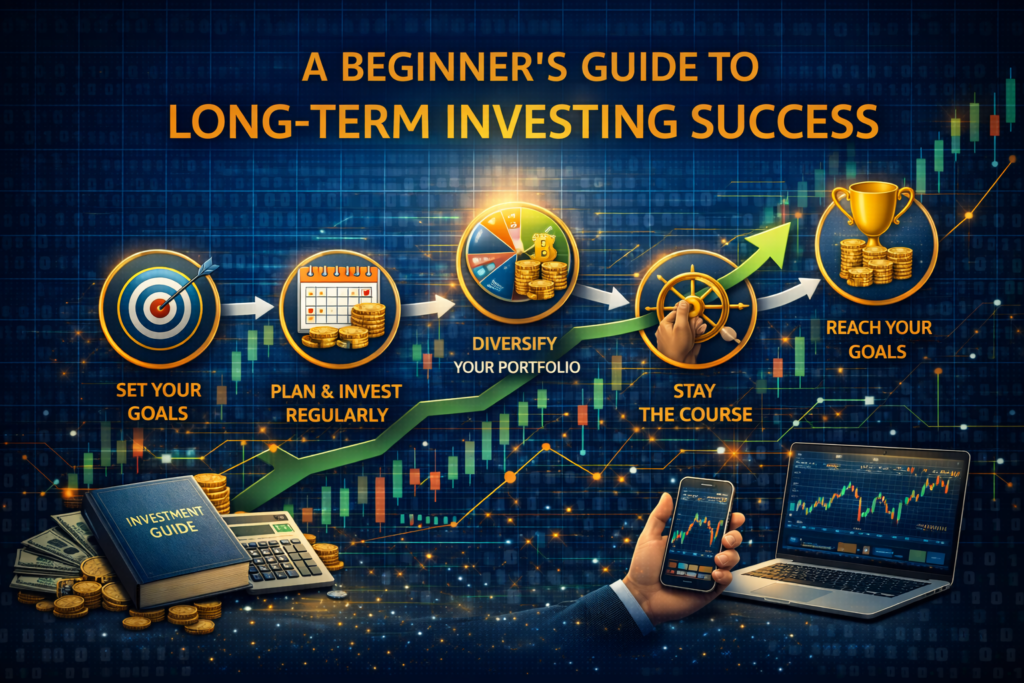
Long-term investing success is not built on perfect predictions.
It is built on a sequence of reasonable decisions repeated consistently over time.
A beginner does not need to identify the next market winner. They need a financial foundation, a clear objective, an appropriate level of risk and a diversified portfolio they can understand.
They need to respect costs, invest regularly and resist the temptation to treat every market movement as an emergency.
The most objective conclusion is that long-term investing is powerful, but it is not effortless.
Markets can fall. Returns are not guaranteed. Diversification reduces risk without eliminating it. Patience is valuable only when it is supported by a sensible strategy.
The goal is not to create the most exciting portfolio.
It is to build a system that continues working quietly in the background while life moves forward.
For most beginners, success will not come from making one brilliant decision.
It will come from making ordinary decisions remarkably consistently.