
For years, investors had a relatively simple reason to favor stocks.
Interest rates were unusually low, many bonds offered limited income and companies with strong growth prospects attracted capital from investors searching for higher returns.
That environment has changed.
Bonds have become more relevant again. Interest rates remain high enough for fixed-income investments to offer meaningful income, while inflation, geopolitical uncertainty and uneven economic growth continue to complicate the outlook for financial markets.
At the same time, stocks remain essential for investors seeking long-term growth.
This creates an important question:
Should investors favor stocks or bonds right now?
The most useful answer is not a dramatic one.
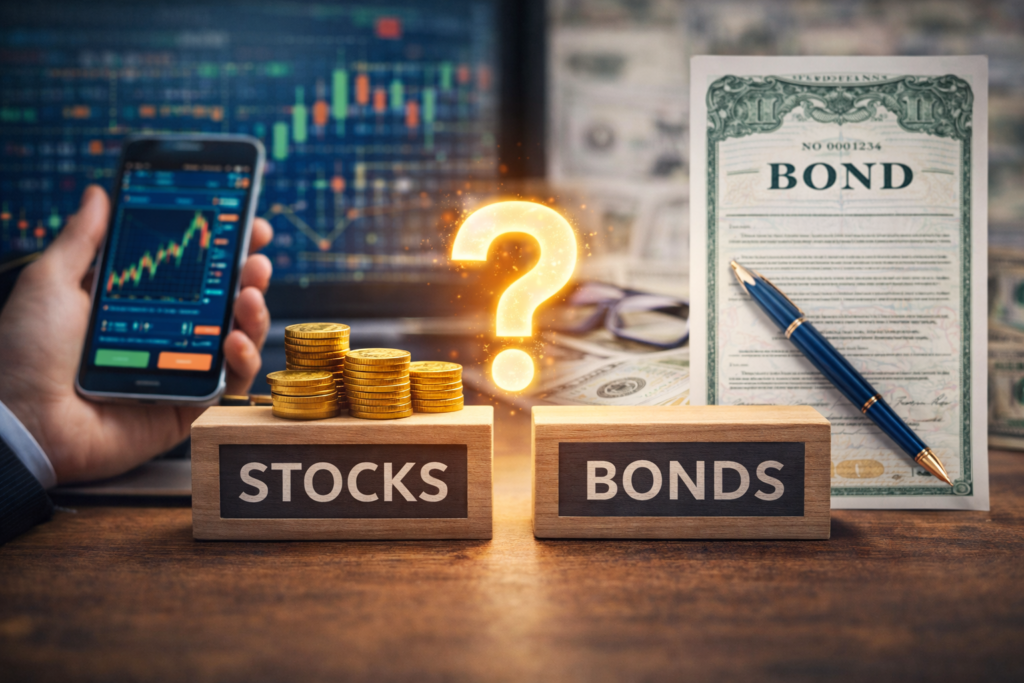
For many people, the correct decision is not choosing one winner. It is understanding what each asset is designed to do—and building a portfolio in which both can serve a clear purpose.
Stocks and Bonds Are Different Tools
A stock represents ownership in a company.
When investors purchase shares, they gain exposure to the future of that business. If the company grows its revenue, improves its profitability and becomes more valuable, shareholders may benefit through rising share prices or dividends.
Stocks can create wealth over long periods, but they are not stable by nature. Their prices react to corporate results, economic conditions, interest rates and investor expectations.
A bond is different.
When investors purchase a bond, they lend money to a government, company or other issuer. In return, they generally receive interest payments and the repayment of the principal when the bond matures.
Bonds are not ownership assets. They are contractual obligations.
This distinction shapes their role inside a portfolio.
Stocks are primarily engines of growth.
Bonds are primarily tools for income, capital preservation and risk management.
Neither category is automatically superior.
The relevant question is which tool is more appropriate for the job.
Why Bonds Are Interesting Again
For much of the period following the global financial crisis, bonds faced an obvious challenge: yields were extremely low.
Investors seeking income often had to accept limited returns or take greater risks. Some moved toward stocks, real estate or more speculative assets because safer fixed-income investments appeared less attractive.
Higher interest rates have changed the calculation.
Newly issued bonds can provide more meaningful income than they did during the lowest-rate years. This creates an opportunity for investors who value predictable cash flows, particularly those approaching retirement or seeking to reduce portfolio volatility.
The change is easy to underestimate.
A bond does not need to produce spectacular returns to become useful. Its purpose may be to provide stability while other assets fluctuate, generate income for a future expense or create a reserve that can be reallocated when markets become more attractive.
Bonds have not suddenly become exciting.
They have become relevant again.
The Hidden Risk Inside a “Safe” Bond
Bonds are often described as safer than stocks.
That is generally reasonable, but incomplete.
A bond still carries risk.
There is credit risk: the possibility that the issuer may struggle to repay investors.
There is inflation risk: the possibility that fixed interest payments will lose purchasing power over time.
There is interest-rate risk: the possibility that the market price of an existing bond will fall when newly issued bonds offer more attractive yields.
This last point is especially important.
Imagine holding a bond paying a relatively low rate of interest. If new bonds begin offering substantially higher payments, other investors will be less willing to purchase the older bond unless its price falls.
The effect tends to be greater for longer-term bonds because investors must wait longer to recover their principal. This sensitivity is often described through duration.
A government bond held until maturity may still repay its principal as expected, assuming the issuer remains able to meet its obligations. But an investor who needs to sell before maturity may face a loss.
Bonds can reduce risk.
They do not eliminate it.
Why Stocks Still Matter
If bonds have become more attractive, does that mean investors should abandon stocks?
For most long-term investors, the answer is no.
Stocks provide exposure to economic growth, innovation and corporate profitability. Companies can adapt, increase prices, launch products and expand into new markets. Over long periods, this growth potential makes equities an important tool for building wealth.
Stocks also offer a degree of flexibility in an inflationary world.
A strong business may be able to raise prices, improve efficiency or protect margins when costs increase. This does not mean every company can overcome inflation. Businesses with weak balance sheets, limited pricing power or excessive debt may struggle.
The distinction between high-quality businesses and speculative companies becomes more important when borrowing costs are elevated.
In a low-rate environment, investors may be willing to pay high prices for distant promises of future growth.
In a more demanding environment, cash flow matters more.
The Interest-Rate Question Cuts Both Ways
Interest rates affect both stocks and bonds, but through different mechanisms.
For bonds, higher rates can improve the income available from new investments while reducing the price of older bonds.
For stocks, higher rates can increase borrowing costs and reduce the present value investors assign to future profits.
The effect is not identical across all companies.
A mature business with consistent cash flow, manageable debt and strong demand may be relatively resilient.
A highly indebted company may find refinancing more expensive.
A speculative growth company whose valuation depends on profits many years into the future may become more vulnerable when investors can earn reasonable returns from safer assets.
This environment encourages selectivity.
It does not make stocks unattractive.
It makes unrealistic expectations more expensive.
Inflation Complicates the Decision
Inflation is one of the most important variables for both asset classes.
Fixed-rate bonds can become less appealing when consumer prices rise because the purchasing power of future payments declines. An investor may receive the promised interest while still becoming poorer in real terms.
Stocks may offer better protection over long periods because businesses can sometimes adapt their prices and earnings. But this protection is imperfect.
Inflation can increase wages, energy costs and financing expenses. It can reduce consumer spending and squeeze profit margins. Some businesses pass higher costs on to customers. Others cannot.
Investors should therefore avoid simplistic assumptions.
Bonds are not automatically safe when inflation remains elevated.
Stocks are not automatically protected from inflation.
Cash is not risk-free if its purchasing power is steadily declining.
The correct response is not to search for one perfect asset.
It is to build resilience across different scenarios.
Time Horizon Changes the Answer
The decision between stocks and bonds should begin with the investor’s objective.
Someone saving for a retirement several decades away can usually tolerate more short-term volatility. A diversified stock allocation may play a larger role because the investor has time to recover from market declines and benefit from long-term economic growth.
Someone preparing to purchase a home within two years faces a different reality.
Money required in the near future should not depend heavily on the stock market recovering at the right moment. Stability becomes more important than maximizing returns.
An investor approaching retirement may also prioritize bonds more heavily, particularly if the portfolio will soon need to generate income.
This does not mean age determines everything.
Income stability, emergency savings, debt, personal goals and emotional tolerance for volatility also matter.
A suitable portfolio is personal because risk is personal.
The Yield Curve Is a Map, Not a Recommendation
Bond investors also face a choice between short-term and long-term maturities.
Shorter-term bonds generally allow investors to recover their principal sooner. They may offer flexibility if interest rates remain uncertain.
Longer-term bonds can lock in income for a greater period, but their prices are usually more sensitive to changes in interest rates.
This creates a trade-off.
Locking in a yield may become attractive if rates decline later. Remaining flexible may be more valuable if rates stay elevated or rise again.
Investors do not need to predict the next central-bank decision perfectly.
A laddered approach can reduce the pressure to do so. A bond ladder spreads investments across different maturity dates. As shorter bonds mature, the capital can be reinvested or used for other purposes.
This transforms one large timing decision into several smaller ones.
In uncertain markets, flexibility has value.
Diversification Is More Than Owning Two Asset Classes
A portfolio containing one stock and one bond is technically diversified.
It is not necessarily well diversified.
Stocks should generally be spread across companies, industries and regions. Bonds may also require diversification across issuers, maturities and credit quality.
The objective is not to own as many products as possible.
It is to avoid allowing one mistake, one company or one economic scenario to determine the entire outcome.
Diversification cannot prevent every loss. During severe market stress, several asset classes may fall simultaneously.
Its purpose is more realistic:
To reduce dependence on a single prediction.
This is especially important today because the outlook contains competing possibilities.
Inflation may remain persistent. Economic growth may weaken. Interest rates may fall more slowly than investors expect. Technology-driven productivity gains may support corporate earnings. Geopolitical events may alter energy prices and investor confidence.
A resilient portfolio does not require one forecast to be completely correct.
A Practical Framework for Investors
Instead of asking whether stocks or bonds will perform better over the next few months, investors can ask a more useful series of questions.
What is the money for?
A retirement portfolio, a home deposit and an emergency fund require different approaches.
When will the money be needed?
A shorter horizon generally calls for greater stability.
How much volatility can the investor tolerate?
A strategy that looks perfect on paper may fail if the investor abandons it during a decline.
What role should each asset play?
Stocks can support long-term growth. Bonds can provide income, reduce volatility and preserve capital for nearer-term needs.
Is the portfolio diversified?
The answer should consider asset classes, sectors, regions, maturities and credit quality.
Are costs reasonable?
Fees reduce returns regardless of whether the investment is a stock fund or a bond fund.
This framework is less exciting than predicting the next market winner.
It is also more useful.
What Makes Sense Right Now?
The current environment does not provide one universal answer.
Bonds are more attractive than they were during the lowest-rate years because they can offer meaningful income and a clearer role inside a diversified portfolio.
Stocks remain essential for many long-term investors because they provide exposure to corporate growth and innovation.
For conservative investors, people approaching a major financial goal or those seeking income, increasing attention to bonds may be sensible.
For investors with long time horizons and the ability to tolerate volatility, stocks may still deserve a substantial role.
For many people, the strongest answer is a combination of both.
The allocation should depend less on market predictions and more on personal circumstances.
Conclusion
The debate between stocks and bonds is often framed as a contest.
That is the wrong way to think about it.
Stocks and bonds solve different problems.
Stocks can create long-term growth, but they require patience and a willingness to tolerate volatility.
Bonds can generate income and reduce risk, but they remain exposed to inflation, interest-rate changes and credit quality.
The most objective conclusion is that bonds deserve renewed attention in the current environment, but stocks have not lost their purpose.
Investors should not abandon a long-term plan simply because one asset class has recently become more attractive. They should review whether their portfolio still matches their goals, time horizon and tolerance for risk.
A well-designed portfolio does not need to predict the future perfectly.
It needs to remain useful when the future refuses to cooperate.