
Generative artificial intelligence has developed at a remarkable speed.
Only a few years ago, the most visible systems were largely treated as technological curiosities. They could produce short pieces of text, simple images or basic lines of software code. Their outputs were often impressive enough to attract attention, but unreliable enough to remain outside many serious professional workflows.
That situation has changed.
Generative AI can now assist with research, summarize complex documents, create visual concepts, translate content, draft software code and support customer-service teams. It is becoming increasingly embedded in the tools used by businesses, professionals, students and creators.
But the most important shift is not simply that AI can generate more content.
It is that AI is beginning to influence how work is organized, how information is trusted and how quickly an idea can become a finished product.
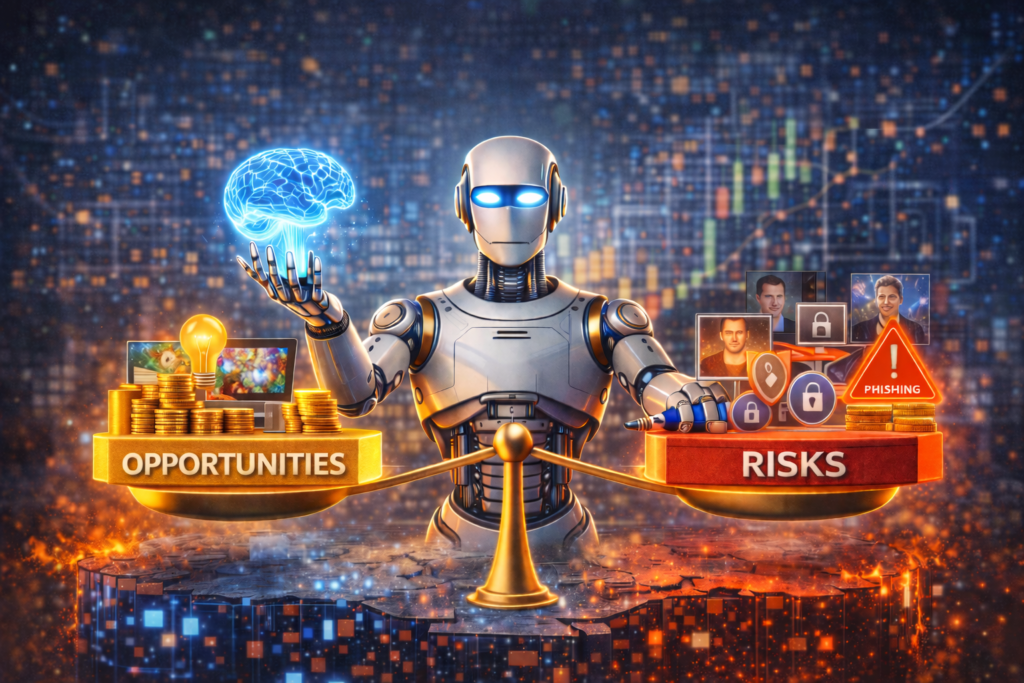
This creates a powerful opportunity.
It also creates a difficult responsibility.
The future of generative AI will depend not only on what these systems can produce, but on whether people learn when to use them, when to question them and when to keep a human firmly in control.
Generative AI Is Becoming an Interface for Work
Generative AI is often described as a technology for creating text, images, audio, video or software code.
That definition is accurate, but increasingly incomplete.
The next phase is about workflows.
A professional may use an AI system to summarize a document, identify gaps, compare alternatives and prepare an initial draft. A software developer may ask it to generate code, explain an error and create tests. A small business may use it to respond to routine customer questions, organize information or produce marketing material more efficiently.
The technology is moving from isolated tasks toward connected processes.
This does not mean that generative AI can perform every process reliably from beginning to end.
It means that the boundary between creation, analysis and execution is becoming less clear.
The greatest productivity gains may come not from asking AI to replace a profession, but from identifying the repetitive steps that prevent skilled people from concentrating on more valuable work.
Productivity Is Real, but It Is Uneven
Generative AI can save time.
It can prepare a first draft, organize notes or reduce the effort required to begin a difficult task. In fields such as customer support, software development and consulting, experimental research has already identified measurable productivity improvements.
But productivity is not automatic.
A tool can accelerate the creation of low-quality work just as easily as it can improve efficiency. A company may produce more content while weakening its brand. An employee may complete a report faster while overlooking an important error. A team may add an AI platform without solving the underlying problem in its workflow.
The correct question is not:
How much can AI produce?
It is:
How much useful work remains after the output has been reviewed?
This distinction matters because speed is valuable only when quality survives.
The strongest organizations will treat generative AI as a tool for reducing friction, not as permission to lower standards.
Creativity Is Expanding, Not Becoming Effortless
Generative AI has lowered the cost of experimentation.
A designer can explore several concepts before refining one. A writer can test different structures. A marketing team can adapt an idea for multiple audiences. A small company can produce visual prototypes without the resources available to a large corporation.
This is valuable.
AI can help people move more quickly from an empty page to a workable starting point.
But the empty page was never the only challenge.
Creative work also requires taste, context and judgment. It requires knowing which idea deserves attention and which should be discarded. It requires understanding the audience and recognizing when something feels generic, misleading or emotionally flat.
Generative AI can produce many options.
It cannot guarantee that any of them are worth using.
The future of creativity will not be a competition between humans and machines.
It will be a competition between people who use AI thoughtfully and people who confuse unlimited generation with meaningful creation.
Smaller Teams Can Accomplish More
One of the most significant opportunities involves small and medium-sized businesses.
Generative AI gives smaller teams access to capabilities that once required more time, money or specialized staff. A local business can draft product descriptions, translate communication, summarize customer feedback or organize internal documentation more efficiently.
This can help reduce the gap between large corporations and smaller competitors.
But access does not guarantee advantage.
A business that adopts too many overlapping tools may create confusion. Employees may enter sensitive information into unapproved systems. Customers may receive inaccurate responses. Subscription costs may accumulate without producing measurable value.
The best approach is selective.
Begin with a specific problem.
Test one tool.
Measure the result.
Establish boundaries.
Expand only when the evidence justifies it.
AI adoption should not become a race to appear innovative.
It should remain a practical effort to improve the business.
Knowledge Is Becoming Easier to Access—and Harder to Verify
Generative AI can explain difficult ideas in accessible language.
It can summarize long documents, translate information and help users explore unfamiliar subjects. This can support education, professional development and access to knowledge.
However, generative AI can also produce inaccurate information with impressive confidence.
This is one of its most important limitations.
A fluent answer feels trustworthy. A polished paragraph looks finished. A detailed explanation appears authoritative.
None of these qualities guarantees accuracy.
Users need to develop a new habit: treating AI-generated information as a starting point rather than an unquestionable conclusion.
Verification matters most when the consequences of an error are serious.
Medical guidance, legal decisions, financial advice, academic research and public communication require reliable sources and human review.
Generative AI can reduce the time required to understand a question.
It should not eliminate the effort required to confirm the answer.
Software Development Will Become Faster—and More Demanding
Generative AI is changing software development.
It can generate code, suggest corrections, explain unfamiliar functions and help developers create prototypes more quickly. This may allow smaller teams to build products that would previously have required more resources.
Yet faster development introduces a new form of technical debt.
AI-generated code may contain vulnerabilities, unnecessary complexity or subtle errors. A developer who accepts suggestions without understanding them can create systems that are difficult to maintain and unsafe to deploy.
The lesson extends beyond programming.
AI can produce useful first drafts in many fields.
But someone still needs to understand the final result.
The more powerful the tool becomes, the more important human expertise remains.
The Information Environment Is Under Pressure
Generative AI has dramatically reduced the cost of creating convincing content.
That includes useful material.
It also includes misinformation.
Synthetic images, cloned voices, fabricated videos and highly personalized messages can make deception more persuasive. False content can circulate quickly during elections, conflicts, financial events or public-health emergencies.
This creates a deeper problem than the existence of individual deepfakes.
It weakens trust in the information environment itself.
When realistic content becomes easy to fabricate, people may begin to distrust authentic evidence as well. A genuine recording can be dismissed as artificial. A real image can be treated as manipulated. The line between skepticism and cynicism becomes harder to maintain.
The response will require more than detection tools.
Digital platforms, news organizations, public institutions and technology companies will need stronger methods for establishing provenance and communicating uncertainty.
Individuals will also need to become more cautious.
The ability to create content is becoming widespread.
The ability to verify it is becoming essential.
Cybercrime Is Becoming More Personalized
Generative AI can improve cybersecurity by helping organizations detect anomalies, summarize threats and respond to incidents.
It can also support attackers.
A fraudulent email no longer needs to be poorly written. A scam message can imitate a familiar tone, adapt to a target and appear more convincing. Voice cloning can add urgency. Synthetic images or videos can create credibility.
This makes ordinary caution more important.
Unexpected requests for money, credentials or confidential information should be verified through a separate channel. Companies should train employees to recognize social-engineering attempts and define clear procedures for sensitive actions.
A business may invest heavily in advanced security systems.
One convincing message sent to the wrong person can still create a serious problem.
Technology changes.
The human element remains central.
Copyright Questions Will Continue to Shape the Debate
Generative AI has created unresolved questions about creative ownership.
Models may be trained on enormous amounts of material. Users can generate text, images, music and video in seconds. Creators want to understand how their work is used. Businesses want clarity about whether AI-generated outputs can be commercialized safely.
The legal debate contains several distinct questions.
Can copyrighted works be used to train a model?
When does an output become too similar to an existing work?
Who owns content produced with AI assistance?
How much human contribution is required before a work receives copyright protection?
The answers may vary across jurisdictions and depend on the facts of each case.
This uncertainty matters for businesses.
A company should not assume that an AI-generated image, article or design is automatically free from legal risk.
Speed is attractive.
Due diligence is still necessary.
Bias Can Scale Quietly
Generative AI systems learn patterns from data.
Data reflects the world as it exists, including its inequalities, blind spots and stereotypes.
This creates a risk.
An AI system may produce biased outputs even when nobody deliberately designed it to discriminate. The bias may appear through language, assumptions, recommendations or the information that the system overlooks.
The problem becomes more serious when AI is embedded inside decisions affecting employment, education, credit or access to services.
Automation can make an unfair decision appear neutral.
It can also allow the same problem to spread quickly.
Responsible use requires testing, monitoring and human oversight.
The objective is not merely to ask whether a model works most of the time.
It is to ask who may be harmed when it does not.
Jobs Will Change Through Tasks
Generative AI is likely to transform work.
But the most realistic short-term picture is not the complete disappearance of entire professions.
It is the redistribution of tasks.
Administrative work, document preparation, translation, analysis and routine communication may become faster. Some jobs will require fewer repetitive activities. Others may become more productive. Certain entry-level tasks may shrink or change significantly.
This creates opportunities and tensions.
Workers who learn to use AI effectively may become more capable. Companies may expand output without expanding teams at the same rate. New roles may emerge around oversight, evaluation, data governance and integration.
But the transition will not affect everyone equally.
The value of a task depends not only on whether AI can perform it.
It also depends on whether a human remains necessary for trust, responsibility, context and judgment.
Regulation Is Becoming Operational
AI governance is moving beyond broad principles.
In the European Union, the AI Act introduces obligations according to the level of risk associated with a system. Rules for general-purpose AI models address areas such as transparency, copyright, safety and security. Additional transparency obligations for certain AI-generated content are also approaching implementation.
This matters because generative AI is becoming normal business infrastructure.
Companies need practical rules.
Which tools can employees use?
What data can be entered?
Which outputs require human approval?
When should customers be informed that AI is involved?
Who is accountable when a mistake occurs?
Responsible adoption is not a document published once and forgotten.
It is an operating model.
The most trustworthy organizations will not wait for regulation to answer every question.
They will create internal standards before a problem forces them to do so.
A Practical Framework for Responsible Use
Businesses and individuals can approach generative AI with a simple framework.
Use it for the right tasks
Start with work that is repetitive, time-consuming and easy to review.
Avoid delegating high-impact decisions without meaningful human supervision.
Protect sensitive information
Do not enter confidential data into a system without understanding how that information is stored, processed and reused.
Verify important outputs
Treat generated content as a draft.
Check facts, sources, calculations and legal implications when the consequences matter.
Preserve accountability
A human should remain responsible for customer-facing, professional and high-impact decisions.
Measure value honestly
Evaluate time saved, costs, quality and error rates.
Using AI frequently is not the same as using it successfully.
Conclusion
Generative AI is evolving from an impressive creative tool into a layer of digital infrastructure.
It can support productivity, accelerate software development, improve access to knowledge and help smaller businesses accomplish more with limited resources. It can give creators new ways to experiment and allow professionals to concentrate on work requiring deeper judgment.
These benefits are significant.
So are the risks.
Generative AI can produce errors with confidence, weaken trust in digital content, amplify bias, create new opportunities for cybercrime and raise difficult questions about copyright and responsibility.
The most objective conclusion is that generative AI should be adopted neither with fear nor with blind enthusiasm.
It should be used selectively.
The best applications are not those that automate the greatest number of tasks. They are those that improve useful work while preserving quality, privacy and human accountability.
The future of generative AI will not depend only on whether systems become more capable.
It will depend on whether people become more discerning.
The central question is no longer what AI can generate.
It is what humans should choose to trust.