
Finding a place to rent is becoming a test of endurance in many housing markets.
A listing appears online and receives dozens of inquiries within hours. Prospective tenants arrive at viewings carrying payslips, references and identification documents. Some households accept smaller homes, longer commutes or higher monthly costs simply because the alternatives are limited.
The problem is not confined to a handful of expensive global cities.
Rental pressure is spreading across metropolitan areas, university towns, tourist destinations and smaller communities that once offered more affordable alternatives.
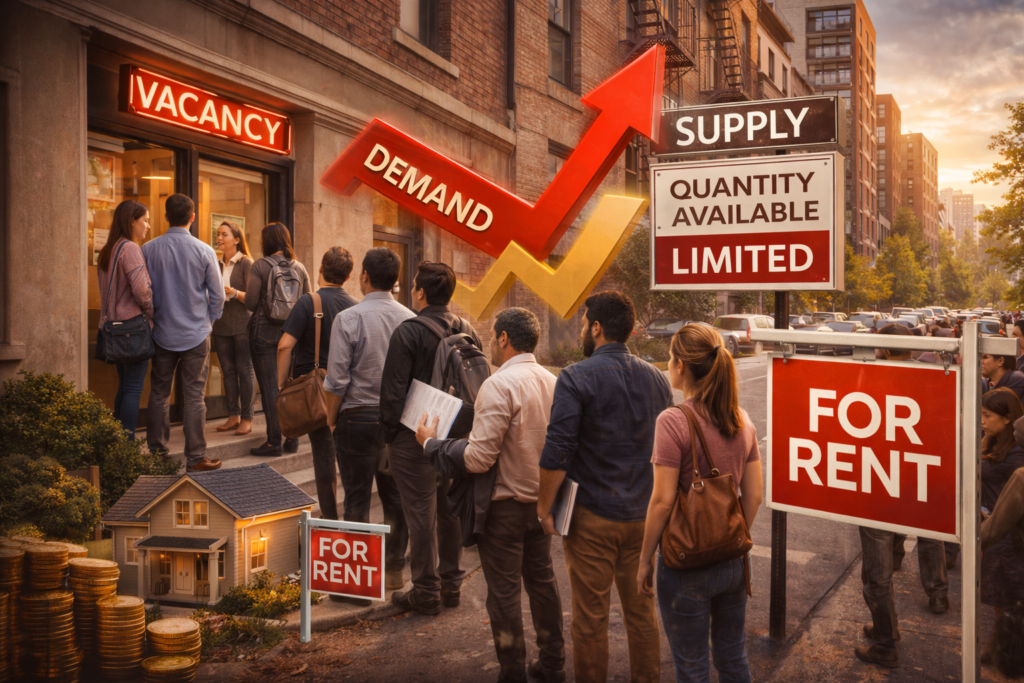
The underlying equation appears simple:
More households need rental homes than the market can provide.
But the causes are more complex.
Higher mortgage costs are keeping potential buyers in the rental sector for longer. New housing supply is slow to arrive. Construction has become more expensive. Planning rules can limit density in desirable locations. Some properties remain vacant or move into short-term accommodation markets. Population changes and employment opportunities concentrate demand in particular places.
The result is a housing market under strain.
Renting is no longer a brief transitional stage for many households.
It is becoming a long-term reality.
Renting Is Becoming a Permanent Part of Adult Life
For previous generations, renting was often treated as a temporary step between leaving the family home and purchasing a property.
That pathway has become harder to follow.
High home prices, elevated mortgage costs and deposit requirements have delayed homeownership for many households. People who expected to buy remain tenants for longer. Younger adults compete with families, professionals and older households for the same limited supply of rental homes.
This creates a chain reaction.
When fewer tenants leave the rental sector to become homeowners, fewer properties become available for new renters. Demand accumulates.
A rental market can tighten even without a dramatic increase in population.
It may simply stop releasing homes at the rate it once did.
This distinction matters because rental-market pressure is not only a question of how many people arrive.
It is also a question of how difficult it has become for existing tenants to move forward.
Higher Mortgage Rates Have Created “Missing Buyers”
Interest rates affect rental markets indirectly.
When mortgages become more expensive, some households can no longer borrow enough to purchase the home they would previously have considered affordable.
Their preference may not have changed.
Their financial capacity has.
A prospective first-time buyer remains in the rental market, continuing to occupy a home that might otherwise have become available to another tenant.
This effect is especially important when lending standards restrict the share of income that households can devote to mortgage payments.
Higher interest rates do not simply cool the sales market.
They redirect part of the pressure toward renting.
This helps explain an apparent contradiction:
A housing market can experience weaker home sales and rising rents at the same time.
The two trends are not opposing stories.
They are often connected.
Housing Supply Responds Slowly
Demand can change quickly.
Housing supply cannot.
A new apartment building requires land, financing, planning permission, design, construction workers, materials and time. Even when a city recognizes a shortage, years may pass before enough homes reach the market.
This delay is one of the defining characteristics of housing.
A technology company can expand a digital service quickly when demand rises.
A city cannot create thousands of suitable homes overnight.
The lag becomes more severe when construction costs increase or financing becomes expensive. Developers may postpone projects because projected rents no longer justify the cost. Smaller projects may become unprofitable. Shortages of skilled workers can add further delays.
This creates a frustrating cycle.
Strong demand raises rents.
Higher rents signal that more housing is needed.
But the homes required to relieve the pressure take years to build.
During that interval, tenants continue competing for what already exists.
The Difference Between Total Housing and Available Housing
A city may contain many properties and still suffer from a shortage of homes available for long-term residents.
This is because the total housing stock and the effective housing supply are not the same thing.
Some homes remain vacant.
Others are used only seasonally.
Some are converted into short-term tourist accommodation.
Others require renovation before anybody can live in them safely.
This distinction is especially important in tourist destinations and cities with substantial numbers of second homes.
A property can exist physically without serving the local rental market.
The solution is not always building from scratch.
In some locations, the more immediate opportunity lies in using the existing stock more efficiently: renovating empty homes, improving incentives for long-term rentals and examining whether short-term accommodation is reducing the number of properties available to residents.
Housing policy needs to ask not only how many homes exist.
It needs to ask who can actually live in them.
Cities Concentrate Opportunity—and Pressure
Rental stress is usually most visible in cities because cities concentrate jobs, universities, hospitals, public transport and social opportunities.
People accept higher costs because location provides access.
But this creates a difficult trade-off.
If essential workers cannot afford to live near employment centers, they travel farther. Commutes become longer. Employers struggle to recruit. Young adults delay forming independent households. Families leave neighborhoods where they once expected to remain.
Housing affordability becomes an economic issue.
A city cannot function efficiently when the people who maintain it are gradually pushed beyond its reach.
Teachers, nurses, hospitality workers, office employees and public-sector staff all need realistic housing options.
A rental market is not merely a financial marketplace.
It is part of the infrastructure that allows a local economy to work.
Pressure Is Spreading Beyond Major Cities
When central neighborhoods become unaffordable, demand does not disappear.
It moves.
Households search in outer districts, suburbs, commuter towns and secondary cities. Remote and hybrid work have made some people more willing to live farther from traditional employment centers.
This can create opportunities for smaller markets.
It can also export the affordability problem.
A town that once provided a lower-cost alternative may experience rapid rental growth when more households arrive. Existing residents then face greater competition. Local infrastructure may struggle to keep pace. The next group of renters searches even farther away.
Housing pressure can spread outward like ripples in water.
But each ripple changes the place it reaches.
The result is not simply a city-center problem.
It is a regional housing problem.
Rental Costs Are More Than Monthly Rent
Tenants experience the housing crisis through a monthly payment.
Landlords experience it through a wider balance sheet.
Maintenance costs rise. Insurance premiums increase. Property taxes may change. Energy-efficiency upgrades can require investment. Variable-rate financing can become more expensive.
These costs matter because rental income and rental profit are not the same thing.
A landlord may raise the rent because demand allows it.
They may also raise the rent because the property has become more expensive to operate.
This does not mean every increase is justified or affordable.
It means the market contains a difficult tension.
Tenants need stability.
Landlords need a financially sustainable property.
Policymakers need to protect households without discouraging the maintenance and creation of rental supply.
A durable solution needs to take all three realities seriously.
Rent Control Can Help—and Create Trade-Offs
When rents rise sharply, governments often face pressure to intervene.
Rent caps, limits on increases and stronger tenant protections can provide immediate relief for households already renting a home. They may reduce the risk of sudden displacement and create greater stability.
These benefits matter.
But rent regulation also involves trade-offs.
If rules are poorly designed, investors may become less willing to provide long-term rental housing. Landlords may delay maintenance or leave the market. Existing tenants may remain in properties that no longer match their needs because moving would mean losing a favorable contract.
The result can be a market with protected insiders and frustrated outsiders.
Young adults, newcomers and households searching for a first rental home may still face limited supply.
This does not mean tenant protections should be abandoned.
It means they should form part of a wider strategy.
Emergency protection can reduce immediate harm.
It cannot substitute indefinitely for building, renovating and releasing more homes.
Building More Housing Requires More Than Construction Targets
The phrase “build more homes” sounds straightforward.
The reality is more demanding.
New housing needs land, transport, utilities and local services. Planning processes need to be predictable enough for viable projects to proceed. Density may need to increase in places where demand is strongest. Empty buildings may need renovation. Public and social housing may need greater investment.
The type of housing matters as well.
A market does not benefit equally from every new unit.
A luxury apartment aimed at occasional visitors does not solve the same problem as a reasonably priced long-term rental home near jobs and transport. A distant development without schools, healthcare or reliable connections may add numerical supply without improving everyday life sufficiently.
Housing is not only a building.
It is a building connected to a neighborhood.
A useful housing policy measures more than the number of construction cranes.
It measures whether people can afford the homes being created.
Social and Affordable Housing Still Matters
The private market cannot solve every housing problem alone.
Some households need additional support because their incomes are too low relative to local rents. Others face temporary hardship, disability, family disruption or unstable employment.
Social and affordable housing can provide a necessary layer of protection.
Housing allowances may also help vulnerable households meet costs more realistically.
But support needs careful design.
If subsidies increase demand without expanding supply, part of the benefit may eventually be absorbed by higher rents. If social housing is too limited, waiting lists become long and access becomes difficult.
The challenge is not choosing between public support and private development.
A resilient rental system requires both.
Private investment can expand supply.
Public policy can protect households whom the market does not serve adequately.
Short-Term Rentals Need Local Solutions
Short-term accommodation has created income opportunities for property owners and supported tourism in many regions.
But the effect varies by location.
In a city or coastal market where long-term rental supply is already limited, a substantial shift toward holiday rentals can increase pressure on residents.
The correct response should be local and evidence-based.
A small town with abundant empty homes does not face the same problem as a dense neighborhood with a severe shortage of long-term rentals.
Policymakers need reliable data.
How many homes are used for short stays?
Where are they concentrated?
Are they replacing properties that would otherwise serve residents?
How important is tourism to the local economy?
Housing policy works poorly when it treats every place identically.
The rental crisis is global.
Its solutions remain local.
Investors Need to Look Beyond Rising Rents
Tight rental markets can appear attractive to investors.
Demand is strong. Vacancy may be low. Rents may be rising.
But a successful investment requires more than identifying pressure.
An investor should examine:
Local incomes.
Tenant affordability.
Employment diversity.
Housing supply in development.
Regulation.
Financing costs.
Insurance.
Maintenance requirements.
Energy efficiency.
Transport connections.
The quality of the neighborhood.
A market where rents rise much faster than incomes may look profitable in the short term.
It may also become politically unstable, socially damaging and financially difficult to sustain.
Responsible property management is not merely an ethical preference.
It is part of risk management.
A good rental investment needs tenants who can realistically remain.
What Renters Can Do in a Tight Market
Individual tenants cannot solve a structural shortage.
They can prepare strategically.
Starting the search early helps.
So does having documentation ready: proof of income, references and identification where appropriate.
Flexibility may widen the available options. A well-connected neighborhood outside the most obvious area can offer better value. A longer lease may provide greater stability when the conditions are reasonable.
But personal preparation has limits.
A household cannot budget its way out of a market where supply is fundamentally insufficient.
The burden should not fall entirely on renters.
Housing affordability is a collective policy challenge.
What Policymakers Should Prioritize
The strongest housing strategies combine short-term protection with long-term supply reforms.
They may include:
Faster and clearer planning procedures.
Greater housing density in well-connected areas.
Investment in social and affordable housing.
Renovation of vacant or underused properties.
Balanced regulation of short-term rentals where they materially reduce residential supply.
Targeted support for vulnerable households.
Predictable rules for long-term landlords.
Better transport links between homes and employment centers.
Energy-efficiency improvements that reduce long-term operating costs.
No single measure will solve every problem.
Housing systems are too complex for one dramatic intervention.
The objective should be balance.
Protect tenants today.
Create more homes for tomorrow.
Conclusion
Rental markets are under pressure because several forces are converging at the same time.
Homeownership has become less accessible. Mortgage costs keep potential buyers renting for longer. New construction cannot respond quickly enough. Planning constraints, rising costs and financing conditions limit development. In some locations, vacant properties and short-term rentals reduce the effective supply available to residents.
The most objective conclusion is that rising rents are not merely a temporary inconvenience.
They are evidence of a structural imbalance.
Tenant protections can provide necessary relief, especially during periods of sharp increases. But protection alone cannot create homes. Market incentives can attract investment, but the market alone will not guarantee affordability for every household.
A durable solution requires both.
More housing.
Better use of the homes that already exist.
Targeted support for vulnerable renters.
Predictable rules for responsible landlords.
Rental markets function best when they are not designed only for the property owner or only for the tenant.
They need to serve the wider economy and the communities built around them.
A home is more than an asset.
For the person renting it, it is the foundation of everyday life.