
Central banks are often described as the guardians of economic stability.
They influence the cost of borrowing, the return available to savers and the conditions under which businesses decide whether to invest. Their decisions affect mortgage payments, currency values, government budgets and financial markets around the world.
Yet the current moment is unusually difficult.
Central banks are no longer responding to one clear economic problem.
Inflation remains uncomfortable in several regions. Growth is weakening. Energy prices have become more volatile. Governments carry heavier debt burdens. Financial markets remain sensitive to every change in expectations.
The result is not a coordinated global shift toward higher or lower interest rates.
It is divergence.
Some central banks are raising rates again. Others are holding steady. A few are considering whether slower growth will eventually justify easing. Each decision reflects a different version of the same dilemma:
How do you control inflation without weakening the economy more than necessary?
The Era of Easy Answers Is Over
During the years of unusually low interest rates, monetary policy appeared relatively predictable.
Inflation remained subdued across many advanced economies. Borrowing was inexpensive. Investors searched for returns in stocks, real estate and other assets. Governments could finance debt at manageable costs.
That world has changed.
The pandemic disrupted supply chains. Energy shocks pushed costs higher. Consumer demand shifted rapidly. Inflation returned with a force that many households had not experienced for years.
Central banks responded by tightening policy.
Higher rates helped reduce some inflationary pressure, but they also exposed weaknesses that cheap money had allowed the economy to overlook.
Mortgages became less affordable.
Property developers faced more expensive financing.
Companies with large debt burdens needed to reconsider expansion plans.
Governments found that servicing public debt consumed a larger share of their budgets.
Now policymakers face an even more complicated problem.
Inflation has not disappeared, but the economy has less room to absorb additional pressure.
Why Central Banks Are Moving in Different Directions
The global economy is interconnected.
Monetary policy remains national or regional.
This creates an important tension.
An energy shock can affect many countries at once, but the consequences are not identical. A country that imports most of its energy may face a sharper rise in costs. An economy with weaker growth may struggle more under higher rates. A market where variable-rate mortgages are common may transmit policy changes to households faster than one dominated by long-term fixed loans.
Central banks therefore need to examine their own economies rather than follow a universal script.
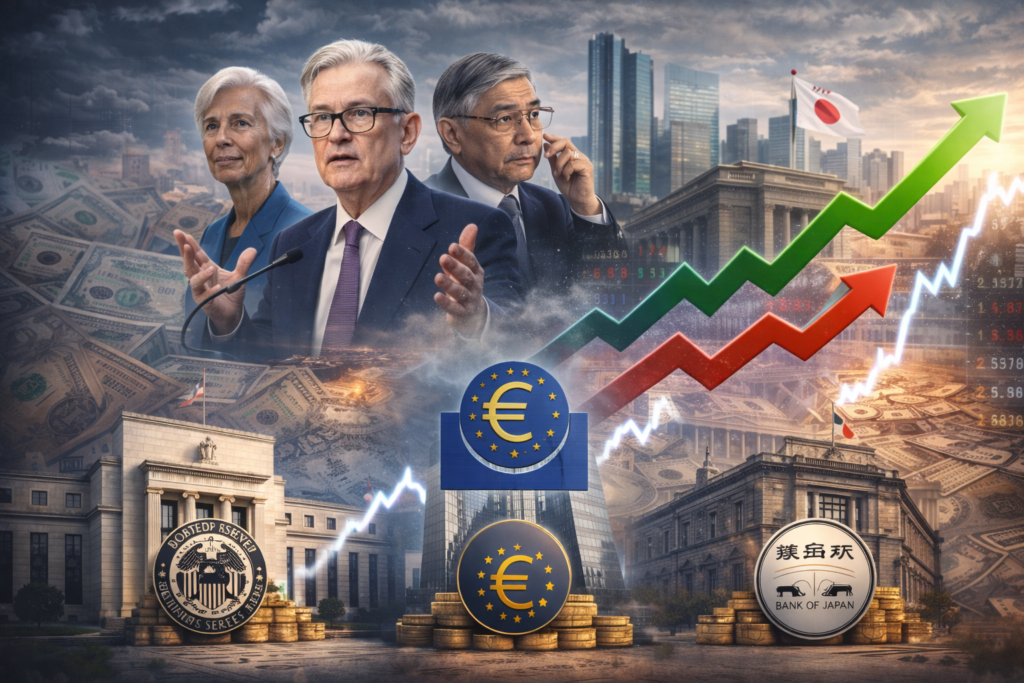
The European Central Bank may respond to renewed inflationary pressure.
The Federal Reserve may prefer to wait for clearer evidence before changing course.
The Bank of England may hesitate because inflation remains above target while growth looks fragile.
The Bank of Japan operates in a very different environment after decades of unusually loose monetary policy.
The Reserve Bank of Australia may tighten because domestic inflation proves more persistent than expected.
These differences should not be interpreted as confusion.
They reflect the reality that the global economy has become more uneven.
Inflation Is Still the Central Problem
Central banks care deeply about inflation because persistent price increases affect the entire economy.
Households lose purchasing power.
Businesses struggle to set prices and plan investments.
Workers demand higher wages to protect their living standards.
Savers watch the real value of their money decline.
Inflation is especially difficult when it spreads from one sector into many others.
An increase in oil prices does not remain confined to petrol stations. It affects transport, manufacturing, agriculture and logistics. A company paying more for energy may pass part of that cost to customers. Food prices may rise. Inflation expectations can become harder to manage.
The danger is not simply that prices increase temporarily.
The deeper risk is that businesses and households begin behaving as though high inflation will remain normal.
Once that happens, bringing inflation down becomes more painful.
Central banks therefore try to act before a temporary shock becomes embedded in everyday decisions.
Energy Has Returned to the Center of Monetary Policy
Energy is one of the most uncomfortable variables for central banks.
Higher interest rates cannot produce more oil, gas or electricity.
They cannot repair a damaged shipping route.
They cannot end a geopolitical conflict.
Yet policymakers cannot ignore energy-driven inflation either.
If they leave rates too low while prices rise sharply, inflation may spread.
If they tighten too aggressively, they risk slowing an economy already weakened by higher energy costs.
This creates a difficult balancing act.
An energy shock reduces purchasing power at the same time as it complicates the fight against inflation.
Households spend more on essentials.
Businesses face thinner margins.
Governments feel pressure to provide support.
Central banks worry that inflation expectations may drift upward.
There is no perfect response.
Monetary policy can limit second-round effects.
It cannot remove the original cause.
Growth Is Slowing, but the Picture Is Uneven
The global economy is still expanding.
That does not mean it is comfortable.
Some countries continue to benefit from strong domestic demand, investment or favorable demographics. Others are more exposed to weak trade, elevated debt and higher energy costs.
This matters because tight monetary policy affects economies differently.
A resilient economy with strong employment may absorb higher rates for longer.
A weaker economy may experience declining investment, slowing consumption and rising unemployment more quickly.
Central banks need to avoid reacting only to headline inflation while ignoring the condition of the wider economy.
The objective is not to reduce inflation at any cost.
It is to restore price stability without creating unnecessary damage.
That sounds simple.
It rarely is.
Communication Has Become a Policy Tool
Central banks do not influence markets only through actions.
They influence them through words.
A press conference can move bond yields.
A change in one sentence can affect currency markets.
A cautious reference to future risks can alter mortgage expectations before any official rate decision takes place.
This is why central-bank communication receives so much attention.
Investors examine every phrase.
Will rates remain higher for longer?
Is inflation improving?
Are policymakers more worried about growth?
Could another rate increase arrive?
Will cuts come later than markets expected?
Forward guidance can help reduce uncertainty by giving businesses and households a clearer sense of the likely direction of policy.
But it also creates risk.
If a central bank sounds too confident and the economy changes unexpectedly, reversing course may damage credibility. If communication becomes excessively vague, markets may react sharply to every new data release.
The challenge is to provide clarity without pretending to predict the future perfectly.
The Impact Reaches Ordinary Households
Monetary policy may sound distant from everyday life.
It is not.
A rise in interest rates can affect the monthly payment on a variable-rate mortgage. A homebuyer may qualify for a smaller loan. A household carrying credit-card debt may pay more interest. A saver may finally receive a more meaningful return on a deposit account.
The effect depends on the household.
A homeowner who locked in a favorable fixed mortgage years ago may feel relatively protected.
A first-time buyer entering the market today faces a different reality.
A family with substantial debt may need to reduce spending.
A retiree holding cash savings may benefit from higher deposit rates.
The same interest-rate decision creates winners and losers.
This is one reason monetary policy can become politically sensitive.
A central bank is not merely adjusting an abstract economic lever.
It is changing the financial conditions surrounding millions of personal decisions.
Businesses Need to Reconsider the Cost of Growth
For companies, interest rates influence which investments remain worthwhile.
When borrowing is cheap, a business may finance expansion more comfortably. It may open a new location, purchase machinery or invest in technology.
When borrowing costs rise, the calculation becomes more demanding.
A project needs to generate a higher return to justify the loan.
Companies with strong cash flow and manageable debt retain flexibility.
Highly leveraged businesses face a harder environment.
Small and medium-sized companies can be especially exposed because they may lack easy access to capital markets or large cash reserves.
This can slow hiring and investment.
It can also improve discipline.
The low-rate era allowed some projects to survive despite weak economics. Higher rates force businesses to distinguish between useful investment and expansion pursued mainly because financing was easy to obtain.
Investors Are Repricing the Future
Interest rates also change how financial markets value assets.
Stocks, bonds, currencies and real estate respond differently, but the underlying principle is similar.
When safer assets offer higher yields, investors become less willing to pay extreme prices for distant future profits.
This matters particularly for growth-oriented companies.
A technology business may still have a promising future.
Its share price may decline if investors decide they previously paid too much for that promise.
Property markets feel a similar effect.
Higher financing costs can reduce the price investors are willing to pay for buildings, especially when rental income does not rise fast enough to compensate.
Bond markets react quickly because yields reflect expectations about inflation and future central-bank policy.
Currency markets respond when investors compare the likely direction of interest rates across countries.
One central-bank decision can therefore trigger movements far beyond the domestic economy.
Divergence Creates Currency Risk
When central banks move in different directions, exchange rates can become more volatile.
A country raising rates may attract capital because investors can earn a higher return on assets denominated in that currency.
A country expected to reduce rates may experience the opposite effect.
But the relationship is not automatic.
Investors also care about economic growth, political stability and financial risk.
Currency movements matter because they influence prices.
A weaker currency makes imports more expensive. That can push inflation higher, especially in countries dependent on foreign energy, food or manufactured goods.
A stronger currency can reduce imported inflation but create difficulties for exporters.
The effect spreads beyond financial markets.
A business paying suppliers in another currency may see its costs rise unexpectedly.
A household planning a trip abroad may notice that its money buys less.
An international investor may discover that a profitable asset produces a disappointing return after currency conversion.
Financial Stability Limits How Far Central Banks Can Go
Central banks cannot focus exclusively on inflation.
They also need to consider financial stability.
Higher rates can expose vulnerabilities in banks, property markets, investment funds and heavily indebted companies. Falling asset values may weaken collateral. Refinancing can become difficult. Investors may withdraw money rapidly during a period of fear.
This does not mean central banks should avoid raising rates whenever financial markets become uncomfortable.
It means they need to understand where leverage and liquidity risks have accumulated.
The task is complicated.
Keeping rates low for too long can encourage excessive risk-taking.
Raising them too quickly can reveal fragilities abruptly.
Monetary policy always involves trade-offs.
The art lies in deciding which risks deserve attention first.
Governments and Central Banks Have Different Responsibilities
Central banks influence demand through interest rates.
They cannot solve every economic problem.
They cannot build electricity grids, increase housing supply or improve productivity through monetary policy alone.
Governments remain responsible for many of the structural decisions that shape long-term growth.
Energy policy matters.
Housing policy matters.
Education, infrastructure and regulation matter.
Fiscal policy also matters because governments may need to support vulnerable households during a shock.
But support should be targeted carefully.
If fiscal measures stimulate demand too broadly while central banks are trying to reduce inflation, the two arms of economic policy may begin pulling in opposite directions.
The strongest response requires coordination without confusing responsibilities.
Central banks protect price stability.
Governments shape the wider economy.
What Households Should Watch
Households do not need to follow every central-bank speech.
They should understand how policy affects their finances.
Several questions matter.
Is the mortgage fixed or variable?
When will the interest rate reset?
Which debts carry the highest cost?
Is enough cash available for an emergency?
Does the savings account offer a competitive return?
Would a major purchase remain affordable if rates stayed elevated?
The goal is not to predict the next policy decision perfectly.
It is to avoid a financial plan that depends entirely on rate cuts arriving quickly.
A household with manageable debt and an emergency reserve is better prepared for uncertainty than one stretching its budget based on an optimistic forecast.
What Investors Should Watch
Investors should pay attention to more than whether rates move up or down.
The reason for the decision matters.
A rate cut caused by improving inflation can support markets differently from a rate cut driven by a sharp recession.
A rate increase linked to strong economic activity is not identical to one caused by an external energy shock.
Context matters.
Investors should monitor:
Inflation trends.
Energy prices.
Labor-market conditions.
Credit quality.
Government debt.
Currency movements.
Corporate cash flow.
Central-bank communication.
Market valuations.
A portfolio should remain resilient across several possible outcomes.
The aim is not to place one enormous bet on the next central-bank move.
It is to avoid being destroyed if that prediction proves wrong.
Conclusion
Central banks are signaling policy shifts because the global economy has entered a more complicated phase.
Inflation remains a concern.
Growth is slowing unevenly.
Energy shocks have returned.
Debt is more expensive.
Financial markets remain sensitive to changes in expectations.
The most objective conclusion is that monetary policy is unlikely to follow one simple global direction.
Some central banks may tighten.
Others may wait.
Some may eventually ease if inflation improves and economic activity weakens.
This divergence is not a sign that policymakers have lost control.
It is a reminder that the global economy contains many different realities.
For households, the practical lesson is to avoid excessive debt and prepare for several possible rate paths.
For businesses, it is to evaluate investments using realistic financing costs.
For investors, it is to focus on diversification, cash flow and risk rather than trying to predict every central-bank decision.
Monetary policy will continue to shape the months ahead.
But resilience matters more than forecasting.
The strongest financial plan is not the one that depends on central banks making the perfect decision.
It is the one capable of surviving when they do not.