
Stock markets are often treated like giant scoreboards.
An index rises.
Another falls.
A company reports earnings.
Oil moves sharply.
A central bank changes a few words in a statement.
By the end of the day, investors are told that markets are optimistic, cautious or fearful.
But stock-market movements are rarely explained by one emotion or one headline.
Markets are conversations about the future.
Every price reflects thousands of judgments about what may happen next: whether inflation will remain elevated, whether interest rates will fall, whether a company can justify its valuation, whether an energy shock will fade or whether a new technology will create lasting profits.
That is why the market can seem inconsistent.
Stocks may rally even when inflation data looks uncomfortable.
A profitable company may fall after reporting strong results.
A geopolitical development taking place thousands of kilometers away may change the value investors assign to airlines, banks, manufacturers or technology businesses within minutes.
The market is not simply reacting to what has happened.
It is constantly trying to anticipate what comes next.
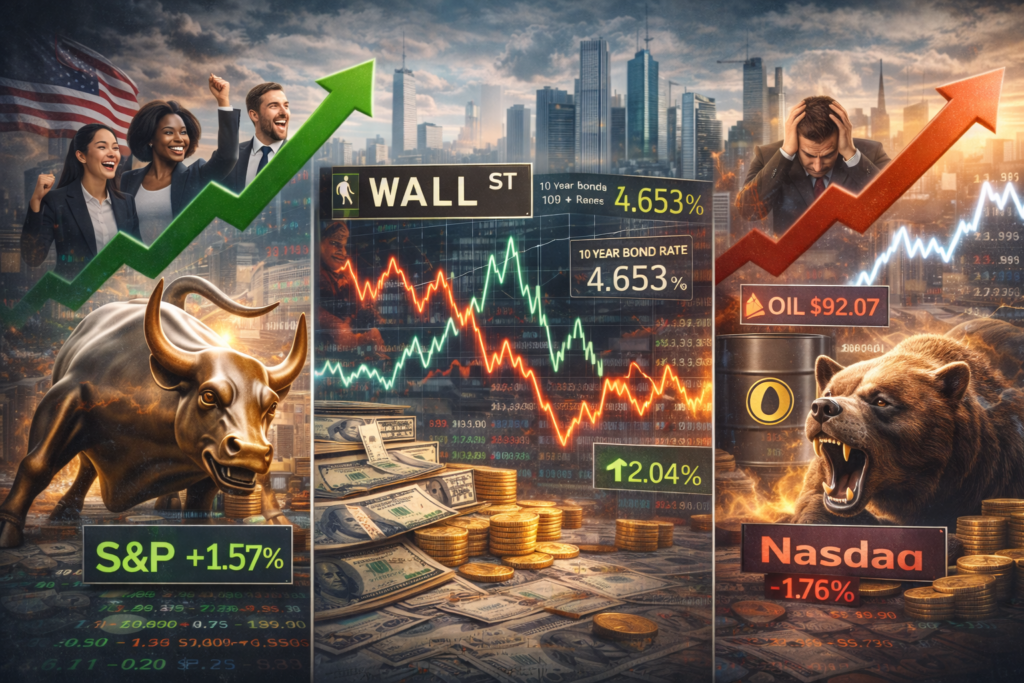
The Market Is Trading on Confidence, Not Certainty
Investor sentiment can change quickly because markets operate in an environment where certainty is rare.
A promising diplomatic development can improve confidence and push stock prices higher. A sudden rise in oil prices can revive fears about inflation. A strong employment report can be interpreted positively because the economy remains resilient—or negatively because it may encourage central banks to keep interest rates higher for longer.
This is one of the most important lessons for anyone trying to understand daily market movements:
Good economic news is not always good news for stocks.
Bad news is not always bad news either.
The market cares about the relationship between the data and existing expectations.
If investors expect a weak earnings report and the company performs slightly better than feared, the stock may rise.
If investors expect perfection and the company delivers merely strong results, the stock may fall.
Markets do not trade on reality alone.
They trade on the gap between reality and expectation.
Oil Prices Have Returned to the Center of the Story
Energy prices remain one of the fastest ways for geopolitical uncertainty to reach financial markets.
When oil rises sharply, the impact spreads far beyond energy companies.
Airlines face higher fuel costs.
Transport companies pay more to move goods.
Manufacturers feel pressure on margins.
Consumers spend more at petrol stations and have less money available for other purchases.
Central banks also pay attention because an energy shock can make inflation harder to control.
This creates a chain reaction.
Higher oil prices can increase inflation expectations.
Inflation expectations can push bond yields higher.
Higher yields can weigh on stock valuations, especially in sectors where investors are paying today for profits expected many years into the future.
The reverse can happen just as quickly.
When energy prices fall because geopolitical tension appears to ease, investors may return to stocks that benefit from lower operating costs and improved consumer confidence.
Airlines, leisure companies and other economically sensitive businesses can rally.
Energy stocks may move in the opposite direction.
A single oil-price movement can therefore produce several different stories inside the same market.
Central Banks Still Shape the Mood
Few institutions influence financial markets as consistently as central banks.
Their decisions affect borrowing costs, mortgage rates, corporate financing, currency values and the return available from bonds and savings accounts.
But markets do not wait for central banks to act.
They try to predict them.
Investors study inflation data, employment reports and speeches from policymakers because these signals help shape expectations about future interest rates.
This matters particularly for stocks.
When interest rates rise, safer assets such as government bonds may become more attractive. Investors may become less willing to pay high valuations for uncertain future growth. Companies also face more expensive financing when they borrow to expand.
Growth-oriented sectors, including technology, often react strongly.
But the relationship is not mechanical.
A company with healthy cash flow, low debt and a powerful competitive advantage may remain attractive even in a higher-rate environment.
A speculative business dependent on cheap financing faces a much harder test.
The market is not abandoning growth.
It is asking growth companies to prove more.
Inflation Is Still Difficult to Dismiss
For a while, investors became increasingly confident that inflation was moving gradually back under control.
The latest energy shock has made that conclusion less comfortable.
Inflation matters because it affects both consumers and companies.
A household paying more for food, rent and electricity has less money available for discretionary spending.
A company facing higher labor, transport and input costs may struggle to protect profit margins.
A central bank worried about persistent inflation may keep monetary policy tighter for longer.
All three channels can affect stock prices.
The difficulty is that inflation does not hit every business equally.
Some companies have pricing power. They can raise prices without losing too many customers.
Others operate in highly competitive markets and cannot pass higher costs on easily.
This is why inflation creates winners and losers.
A simple headline number is useful.
The more important question is how that inflation travels through the economy.
Technology Remains the Market’s Main Source of Excitement
Technology continues to dominate investor attention.
Artificial intelligence has created a new investment cycle involving semiconductors, servers, cloud platforms, data centers, electricity networks and specialized infrastructure.
The scale of the opportunity is difficult to ignore.
AI may change how companies write software, manage information, serve customers and organize work.
But enthusiasm has entered a more demanding phase.
The first question was:
Which companies will benefit from AI?
The next question is:
How much will that benefit cost?
Building AI infrastructure is expensive.
Companies need advanced chips, data centers, cooling systems, power connections and large amounts of capital.
Spending can be justified when it creates durable revenue and strong cash flow.
It becomes harder to defend when investors see debt increasing faster than the evidence of future returns.
The market still believes in the potential of AI.
It is becoming less willing to reward spending without scrutiny.
A Strong Story Can Still Become Too Expensive
One of the hardest lessons in investing is that a great company can become a poor investment at the wrong price.
A business may be profitable, innovative and well managed.
Its stock can still fall if the market has already priced in an unrealistic amount of future success.
This risk is particularly important in popular sectors.
When excitement becomes widespread, investors may begin paying for the assumption that almost everything will go right.
Growth will remain high.
Margins will remain strong.
Competition will not intensify.
Regulation will not create major obstacles.
Customers will continue spending.
Financing will remain available.
Reality rarely follows such a perfect script.
A correction does not necessarily mean that the underlying business has failed.
Sometimes it means that expectations have moved closer to a more reasonable level.
Earnings Matter More Than Headlines
Economic data shapes the environment.
Corporate earnings reveal how companies are actually navigating it.
Revenue growth matters.
Profit margins matter.
Debt matters.
Cash flow matters.
Management guidance matters.
The outlook often matters more than the historical result.
A company may report a strong quarter and still disappoint investors if executives warn that costs are rising or demand may weaken.
Another company may report an imperfect quarter but rally because the market expected something worse.
This is why earnings season can feel confusing.
The stock price is not a report card for the previous three months.
It is a negotiation about the next several years.
Investors should pay attention not only to whether a company “beat expectations,” but also to how it generated those results.
Did revenue grow because customers genuinely bought more?
Did margins improve because the business became more efficient?
Did the company take on more debt?
Is management investing for growth or trying to repair a weakening model?
Numbers need interpretation.
Market Concentration Deserves Attention
Major stock-market indexes can appear diversified because they contain hundreds or thousands of companies.
In practice, their performance may depend heavily on a small group of very large businesses.
This becomes especially important when technology stocks dominate investor attention.
If a handful of companies rise sharply, the entire index can look healthy even when the average business is performing less impressively.
The opposite is also true.
A correction in a few heavily weighted stocks can drag the broader market lower.
This does not mean investors should abandon index funds or large technology companies.
It means they should understand what they own.
A portfolio can contain many names while still depending heavily on one story.
The question is not only how many investments sit inside the portfolio.
It is whether they react differently when conditions become difficult.
New Listings Can Change the Flow of Capital
Stock markets do not operate with an unlimited supply of investor money.
When a major company enters the market through an initial public offering, investors may sell other assets to create room in their portfolios.
This is particularly relevant when a highly anticipated listing attracts strong retail and institutional interest.
A large technology IPO can become more than a story about one company.
It can affect the broader market.
Investors rebalance.
Hedge funds reduce positions elsewhere.
Retail traders redirect attention.
Passive funds may eventually need to adjust their holdings if the new company joins major indexes.
This creates another reminder that markets are competitive ecosystems.
A stock does not need to report bad news to fall.
Sometimes capital simply finds a more exciting destination.
Bonds Are Competing for Investor Attention Again
During the low-rate era, investors had limited options if they wanted meaningful income.
That encouraged more capital to flow toward stocks and other riskier assets.
The situation has changed.
When bonds offer more attractive yields, investors have a genuine alternative.
This does not automatically cause a stock-market sell-off.
But it changes the calculation.
An investor may decide that a modest return from a lower-risk asset is more attractive than an uncertain return from an expensive stock.
This is especially relevant for businesses whose valuations depend heavily on profits expected far into the future.
The higher the return available elsewhere, the more carefully investors examine the price they are paying for growth.
Bonds are no longer background noise.
They are part of the competition for capital.
Geopolitics Can Reshape the Market Within Hours
Financial markets dislike uncertainty.
Conflict creates uncertainty quickly.
A geopolitical escalation can disrupt energy supplies, shipping routes and international trade. It can affect currencies, commodities and investor confidence at the same time.
But markets do not react only to conflict itself.
They react to the perceived probability of escalation or resolution.
This creates sharp movements.
One statement from a political leader can send oil lower and stocks higher.
A failed negotiation can reverse the move.
The emotional speed of the market becomes especially visible during these periods.
Investors need to remember that the first reaction is not always the final one.
Headlines change quickly.
Long-term strategies should not.
Retail Investors Have More Influence—and More Noise
Investing has become more accessible.
Online platforms, financial content and social media have allowed millions of people to participate in markets more easily.
This is positive in many ways.
More people can invest for long-term goals. Educational resources are widely available. The barriers to entry have fallen.
But accessibility also creates noise.
A dramatic post can spread faster than a careful analysis.
An exciting stock can become a social-media obsession.
Fear of missing out can push investors toward prices they would not accept after a calmer review.
During downturns, fear spreads just as quickly.
The ability to access markets instantly does not guarantee better decisions.
Sometimes the most useful action is waiting.
A phone makes trading easier.
It does not make patience easier.
Volatility Is Not Automatically a Problem
Market volatility is uncomfortable because it makes losses visible.
But volatility is not the same as risk.
A stock price can fluctuate while the underlying business remains healthy.
A stable-looking asset can conceal serious problems.
The real danger appears when an investor needs to sell at the wrong time, owns a position too large to tolerate or buys an asset without understanding why it should retain value.
Volatility can create opportunities for long-term investors.
It can also expose weak strategies.
The difference lies in preparation.
An investor with an emergency fund, diversified portfolio and realistic time horizon can react more calmly.
An investor using excessive leverage or money needed in the near future has far less freedom.
What Investors Should Watch Now
The most useful approach is not trying to react to every headline.
It is identifying the signals that matter most.
Energy prices remain important because they influence inflation and corporate margins.
Central-bank communication matters because expectations about rates affect valuations.
Bond yields matter because they compete with stocks for investor capital.
Corporate earnings matter because they reveal whether businesses can justify optimistic forecasts.
Technology spending matters because the market increasingly wants proof that AI investment will generate sustainable returns.
Geopolitical developments matter because they can change the economic outlook quickly.
Market concentration matters because a small number of companies can move major indexes.
Liquidity matters because investors need enough flexibility to avoid forced decisions.
The objective is not predicting the next session perfectly.
It is understanding the environment.
Conclusion
Stock markets today are being pulled in several directions at once.
Investors remain excited about artificial intelligence and long-term innovation.
They are also worried about inflation, energy prices, interest rates, geopolitical tension and demanding valuations.
These forces are not separate.
They interact.
A change in oil prices can alter inflation expectations.
Inflation expectations can move bond yields.
Bond yields can affect technology valuations.
Technology earnings can influence major indexes.
A geopolitical headline can reverse the mood within minutes.
The most objective conclusion is that today’s market rewards selectivity.
Not every popular company is overpriced.
Not every correction creates a bargain.
Not every rally signals that risk has disappeared.
For long-term investors, the strongest strategy remains surprisingly simple:
Understand what you own.
Avoid excessive concentration.
Keep enough liquidity.
Pay attention to fundamentals.
Do not let a dramatic trading session rewrite a sensible financial plan.
Stock markets will continue reacting to uncertainty.
The challenge is making sure your decisions do not become as volatile as the headlines.