

Bitcoin’s price is often discussed through charts, technical indicators, and macroeconomic headlines. However, one of the most unique aspects of Bitcoin compared to traditional assets is the transparency of its underlying network. Every transaction, wallet movement, and supply shift is recorded on the blockchain, creating a rich dataset known as on-chain data.
On-chain analysis has become an increasingly important tool for understanding Bitcoin’s market behavior. Rather than relying solely on price action or sentiment, on-chain data provides insight into what different participants are actually doing—whether long-term holders are accumulating, whether short-term traders are selling, or whether supply is tightening or expanding.
As Bitcoin navigates a complex market environment, on-chain signals may offer valuable clues about its next major move. This article explores the key on-chain data indicators that could shape Bitcoin’s direction in the coming months and explains why they matter.
What Is On-Chain Data and Why It Matters
On-chain data refers to information derived directly from the Bitcoin blockchain. Unlike traditional financial markets, where much activity happens behind closed doors, Bitcoin’s ledger is public and verifiable.
This transparency allows analysts to observe real-time behavior across the network, including how coins move between wallets, exchanges, and long-term storage. On-chain data does not predict the future with certainty, but it provides context that price charts alone cannot.
In many cases, major market shifts are preceded by changes in on-chain behavior long before they appear in price action.
Long-Term Holders and Accumulation Patterns
One of the most closely watched on-chain signals involves long-term Bitcoin holders. These participants, often referred to as “strong hands,” tend to hold Bitcoin for extended periods and are less influenced by short-term price fluctuations.
When on-chain data shows that long-term holders are accumulating Bitcoin, it often signals confidence in future value. Accumulation reduces the number of coins available for trading, which can create supply pressure if demand increases.
Conversely, when long-term holders begin distributing or moving coins to exchanges, it may indicate reduced conviction or a desire to take profits.
Current on-chain trends often reveal whether long-term holders are absorbing selling pressure or contributing to it, making this metric especially important.
Exchange Balances and Supply Availability
Another key on-chain signal is the amount of Bitcoin held on exchanges.
When Bitcoin flows out of exchanges into private wallets, it typically suggests that investors intend to hold rather than sell. Declining exchange balances can indicate reduced immediate selling pressure and tighter supply.
On the other hand, rising exchange balances may signal that investors are preparing to sell, increasing potential supply in the market.
Changes in exchange balances do not always lead to immediate price movement, but they often provide early warning signs of shifting market dynamics.
Realized Profit and Loss Activity
On-chain data also tracks when Bitcoin is sold at a profit or a loss.
Periods of heavy realized profits can suggest that investors are taking advantage of price increases, which may lead to short-term corrections. Conversely, spikes in realized losses often occur near market bottoms, when weaker hands exit positions.
By analyzing realized profit and loss data, analysts can assess whether the market is dominated by optimism, fear, or exhaustion. This insight helps contextualize price movements and identify potential turning points.
Short-Term Holders and Market Sensitivity
Short-term holders play a different role in Bitcoin markets. These participants tend to react more quickly to price changes and news events.
When on-chain data shows increased selling from short-term holders, it often reflects uncertainty or panic during periods of volatility. If long-term holders absorb this selling, it can stabilize the market and support price recovery.
However, if both short-term and long-term holders begin selling simultaneously, it may indicate deeper weakness.
Monitoring the balance between these groups provides insight into overall market health.
Spent Output Age and Coin Dormancy
One of Bitcoin’s most unique on-chain metrics involves tracking how long coins have remained inactive before being spent.
When older coins—those that have not moved for years—suddenly become active, it can attract attention. These movements may signal long-term holders taking profits or reallocating assets.
While not all dormant coin activity is bearish, spikes in older coin movement often coincide with periods of heightened market activity.
Conversely, when long-dormant coins remain inactive during price rallies, it suggests strong conviction among long-term holders.
Miner Behavior and Network Economics
Miners play a crucial role in Bitcoin’s ecosystem, and their behavior is closely monitored through on-chain data.
Miners earn Bitcoin through block rewards and transaction fees. When they hold onto their rewards, it can signal confidence in higher future prices. When they sell aggressively, it may indicate operational pressure or caution.
Miner outflows to exchanges and changes in miner reserves can influence short-term supply dynamics, especially during periods of market stress.
Although miners are not the dominant force they once were, their behavior still provides valuable insight.
Network Activity and Transaction Volume
On-chain data also reflects how actively Bitcoin is being used.
Rising transaction volume and active addresses can signal growing network usage and engagement. While this does not always translate directly into price increases, it supports long-term adoption narratives.
Declining activity, on the other hand, may indicate reduced interest or a temporary slowdown in usage.
Interpreting network activity requires nuance, as not all transactions reflect organic demand. However, sustained trends can highlight shifts in adoption.
Market Cycles and On-Chain Indicators
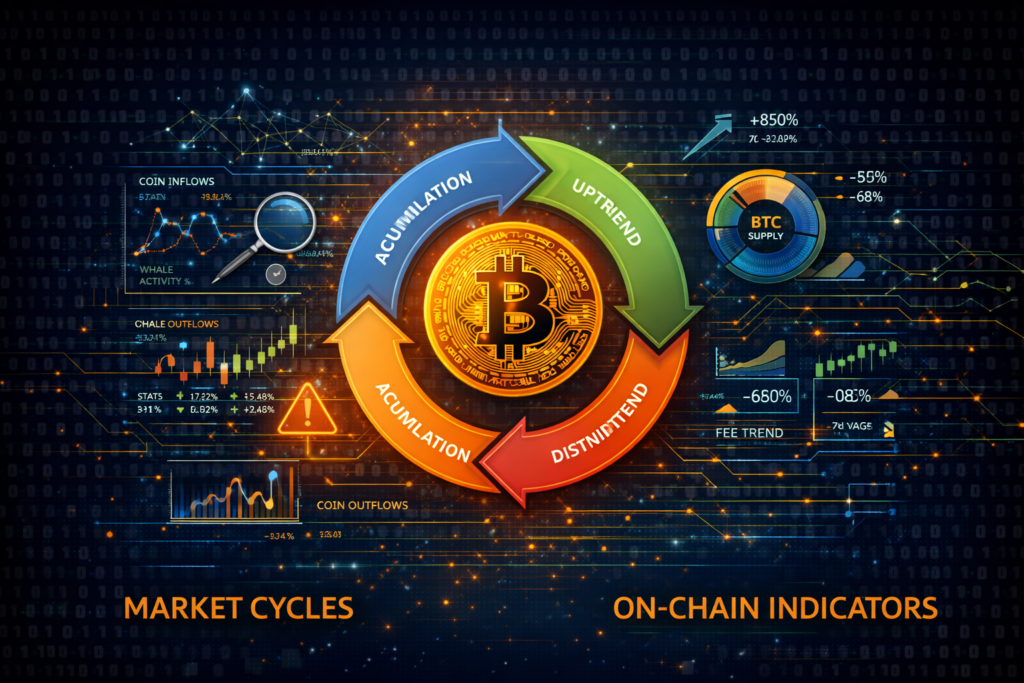
Over multiple Bitcoin market cycles, certain on-chain patterns have repeated.
Extended accumulation phases often precede major upward moves, while periods of heavy distribution tend to occur near market tops. On-chain indicators help identify where Bitcoin may be within its broader cycle.
While no indicator is perfect, combining multiple on-chain signals can provide a clearer picture than relying on a single metric.
This holistic approach is increasingly favored by long-term analysts.
On-Chain Data Versus Price-Based Analysis
Traditional technical analysis focuses on price patterns and indicators derived from price action. On-chain analysis complements this by revealing the behavior behind the price.
For example, a price breakout accompanied by strong accumulation is more convincing than one driven purely by short-term speculation. Similarly, price weakness during accumulation may indicate underlying strength rather than structural decline.
Understanding both perspectives allows for more informed market interpretation.
Limitations of On-Chain Data
While on-chain analysis is powerful, it has limitations.
Not all Bitcoin activity is easily interpreted. Some movements are internal transfers, custody changes, or technical operations that do not reflect market intent. Additionally, on-chain data often requires context and experience to avoid misinterpretation.
On-chain signals should be viewed as part of a broader analytical toolkit rather than standalone predictions.
How On-Chain Signals Could Shape Bitcoin’s Next Move
As Bitcoin navigates uncertain macroeconomic conditions and evolving investor sentiment, on-chain data may provide early clues about its next major move.
Signs of sustained accumulation, declining exchange balances, and limited selling pressure could support bullish scenarios over the medium to long term. Conversely, increasing distribution, rising exchange inflows, and elevated profit-taking may suggest consolidation or downside risk.
Importantly, on-chain data often changes gradually, offering insight into trends rather than sudden price moves.
What Investors Should Watch Going Forward
For investors and observers, key on-chain themes to monitor include holder behavior, supply dynamics, and network engagement.
Rather than reacting to every price fluctuation, tracking on-chain trends encourages a more patient and data-driven approach. This perspective aligns well with long-term investing strategies.
Understanding what is happening beneath the surface can help investors navigate volatility with greater confidence.
The Growing Role of On-Chain Analysis
As Bitcoin adoption grows and institutional participation increases, on-chain analysis is becoming more mainstream.
Institutions, analysts, and sophisticated investors are increasingly incorporating blockchain data into their decision-making processes. This trend reflects Bitcoin’s transparency and the unique analytical opportunities it provides.
On-chain data transforms the blockchain from a passive ledger into an active source of market intelligence.
Final Thoughts
On-chain data offers a powerful lens through which to understand Bitcoin’s market dynamics. By examining how coins move, who is holding them, and how supply evolves, investors gain insight into forces that are often invisible in traditional markets.
While on-chain signals do not guarantee predictions, they help shape expectations and identify potential shifts before they appear in price action. As Bitcoin continues to mature, on-chain analysis will likely play an even greater role in interpreting its behavior.
Bitcoin’s next move will be influenced by many factors, including macroeconomics, regulation, and sentiment. But beneath all of this, the blockchain continues to tell its own story—one transaction at a time. Listening to that story may offer valuable clues about where Bitcoin is headed next.