
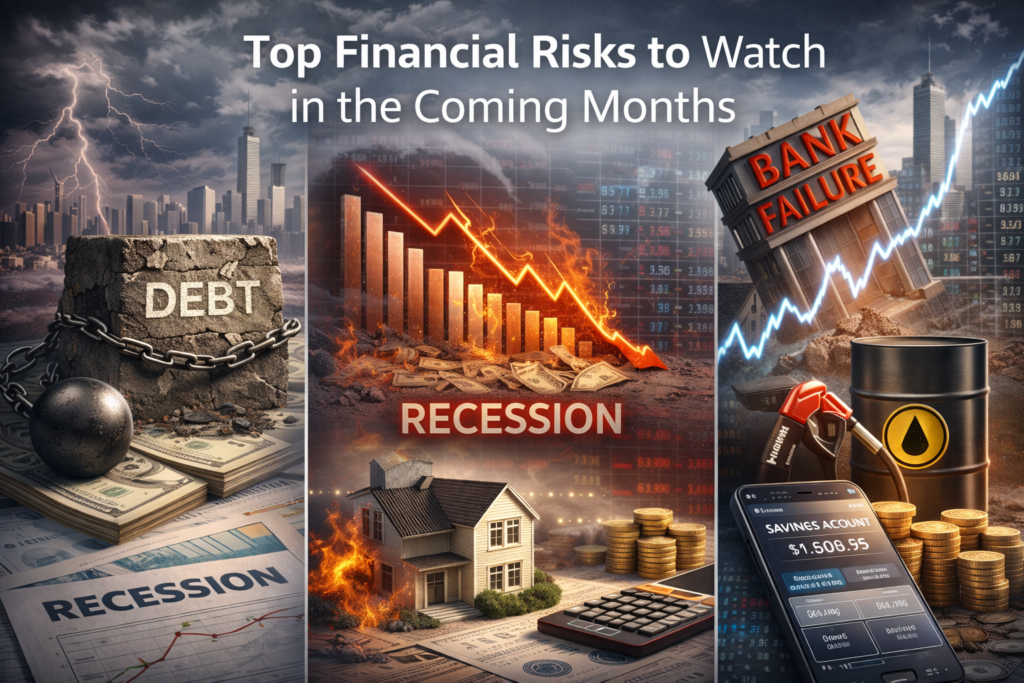
As the global economy continues to adjust to a rapidly changing financial landscape, uncertainty remains one of the defining themes of the months ahead. From inflation and interest rate decisions to geopolitical tensions and market volatility, financial risks are evolving in ways that demand close attention from investors, businesses, and policymakers alike.
Understanding these risks is not about predicting the future with certainty—it is about being prepared. By identifying the key financial threats on the horizon, individuals and organizations can make more informed decisions, manage exposure, and build resilience in an unpredictable environment.
This article explores the top financial risks to watch in the coming months and explains why each one matters.
1. Persistent Inflation Pressures
Although inflation has eased from its recent highs in some regions, it remains a major concern across the global economy. Price pressures continue to affect essential goods such as food, housing, and energy, putting strain on household budgets and business costs.
One of the key risks is that inflation may prove more persistent than expected. If prices remain elevated, central banks may be forced to keep interest rates higher for longer, increasing borrowing costs and slowing economic activity.
For consumers, persistent inflation reduces purchasing power. For businesses, it complicates pricing strategies and profit margins. Investors, meanwhile, must navigate markets where traditional safe assets may not fully protect against rising prices.
2. Interest Rate Uncertainty
Interest rates sit at the center of many financial decisions, and uncertainty around future rate movements is one of the most significant risks in the months ahead.
Central banks are carefully balancing the need to control inflation against the risk of damaging economic growth. While some policymakers have signaled pauses or slower tightening, the path forward remains highly data-dependent.
Unexpected rate hikes or delayed cuts could have widespread consequences, affecting mortgage payments, corporate borrowing, and asset valuations. Markets may react sharply to even small changes in central bank guidance, increasing volatility across equities, bonds, and currencies.
3. Economic Slowdown and Recession Risks
Another major financial risk is the possibility of an economic slowdown or outright recession. Leading indicators in several economies suggest weakening momentum, with reduced consumer spending, slower industrial output, and declining business confidence.
A slowdown can affect employment, earnings, and government finances. For investors, recession fears often lead to risk aversion and shifts toward defensive assets. For businesses, slowing demand can force cost-cutting measures and delayed investments.
While not all regions will experience the same level of economic stress, the interconnected nature of the global economy means that weakness in one area can quickly spread to others.
4. Financial Market Volatility
Volatility has become a regular feature of financial markets, and it is likely to remain elevated in the coming months. Rapid changes in interest rate expectations, earnings forecasts, and geopolitical developments can trigger sudden market swings.
Equity markets may face sharp corrections, while bond markets remain sensitive to inflation data and central bank signals. Currency markets can also experience abrupt movements as investors react to shifting economic outlooks.
High volatility increases both risk and opportunity. However, for those unprepared, sudden price movements can lead to significant losses.
5. Geopolitical Tensions and Global Instability
Geopolitical risks continue to cast a long shadow over the global financial system. Ongoing conflicts, trade disputes, and diplomatic tensions can disrupt supply chains, impact energy prices, and undermine investor confidence.
These risks are difficult to predict and often escalate quickly. Markets tend to react strongly to geopolitical events, particularly when they threaten global trade or financial stability.
For businesses operating internationally, geopolitical uncertainty can complicate planning and increase costs. For investors, it adds another layer of complexity to portfolio management.
6. Debt Levels and Credit Risks
High levels of debt across governments, corporations, and households represent another critical financial risk. Rising interest rates have increased the cost of servicing debt, putting pressure on borrowers with variable-rate obligations or large refinancing needs.
Increased credit risk can lead to higher default rates, especially among highly leveraged companies or vulnerable households. Financial institutions may tighten lending standards, reducing access to credit and slowing economic activity.
Government debt is also under scrutiny, as higher borrowing costs strain public finances and limit fiscal flexibility.
7. Banking Sector and Financial Stability Concerns
The health of the banking sector remains an important area to watch. While banks are generally better capitalized than in past crises, stress can emerge quickly in an environment of rising rates and economic uncertainty.
Liquidity issues, declining asset values, or unexpected losses can undermine confidence in financial institutions. Even isolated problems can have broader consequences if they trigger market fear or regulatory intervention.
Central banks and regulators are closely monitoring financial stability, but risks cannot be entirely eliminated.
8. Currency Fluctuations and Exchange Rate Risks
Currency markets are highly sensitive to interest rate differentials, capital flows, and political developments. Significant exchange rate movements can affect trade competitiveness, inflation, and investment returns.
For companies with international exposure, currency volatility can impact revenues and costs. Investors holding foreign assets may see returns affected by exchange rate changes, regardless of underlying asset performance.
Managing currency risk will remain a key challenge in the months ahead.
9. Asset Valuation Risks
In some markets, asset valuations remain elevated despite economic uncertainty. This creates the risk of sharp corrections if expectations shift or earnings disappoint.
Overvalued stocks, inflated real estate prices, or speculative investments can be particularly vulnerable during periods of tightening financial conditions.
Investors should carefully assess whether current prices accurately reflect underlying fundamentals.
10. Behavioral and Sentiment-Driven Risks
Market psychology plays a powerful role in financial outcomes. Fear, overconfidence, and herd behavior can amplify market movements and lead to poor decision-making.
Social media, rapid news cycles, and algorithmic trading can accelerate sentiment shifts, increasing the likelihood of sudden market reactions.
Understanding and managing behavioral risks is just as important as analyzing economic data.
How Individuals and Businesses Can Prepare

While financial risks cannot be eliminated, they can be managed. Some practical steps include:
- Diversifying investments across asset classes and regions
- Maintaining adequate liquidity and emergency reserves
- Monitoring economic and market developments regularly
- Avoiding excessive leverage
- Focusing on long-term goals rather than short-term noise
Preparation and flexibility are key to navigating uncertain conditions.
Looking Ahead
The coming months are likely to remain challenging, with multiple financial risks unfolding simultaneously. However, periods of uncertainty also create opportunities for those who stay informed and disciplined.
By understanding the key risks and their potential impact, investors and businesses can position themselves more effectively and respond with confidence.
Final Thoughts
Financial risk is an inevitable part of economic life, especially during times of transition and uncertainty. The months ahead will test markets, policymakers, and participants across the financial system.
Staying aware of the top financial risks—ranging from inflation and interest rates to geopolitical tensions and market volatility—can help individuals and organizations make better decisions.
In an unpredictable world, knowledge, preparation, and adaptability remain the strongest tools for navigating financial uncertainty.
Excellent article—very clear and insightful. It does a great job breaking down the key financial risks ahead in a way that’s easy to understand and genuinely useful.